Shikha Mukerjee | India-Russia Legacy Ties: Strategic Autonomy 3.0?

It is also not to argue that the visits planned for the arrival of teams from the European Union are not equally significant. The difference is that India’s relationship with Russia is a legacy with its own dynamics, which makes it easy to revise and renew, that is tailor-made, to fit in with the uncertainties of the present global environment
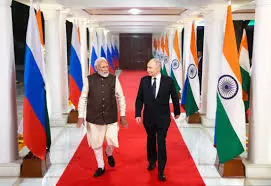
The visit of Russia’s President Vladimir Putin to India was a neatly choreographed performance to deliver a message to the multiple poles of this period in “the current complex, tense, and uncertain geopolitical situation”, as the joint statement called it, and the resilience of Russian-Indian ties under “external pressure”. India, impacted by punishing tariffs, the highest in the world, imposed by the administration of US President Donald Trump for being friends with Russia and buying its oil, and Russia, because of punishing sanctions and disagreements on how to end the war with Ukraine, have problems in common and the same sort of axes to grind.
That is not to say that the American delegation expected in India later this month to informally discuss the terms of a trade agreement will not be just as welcome and the parleys will not be just as important. The expectations in New Delhi are that the first part of the terms of the Bilateral Trade Agreement dealing with tariffs with the US will be sorted out soon. What happens after the officials have ironed out the terms of the trade agreement is between the leaders, and as one commentator put it: “Now it really is up to the leaders, and that too, one more than the other”.
It is also not to argue that the visits planned for the arrival of teams from the European Union are not equally significant. The difference is that India’s relationship with Russia is a legacy with its own dynamics, which makes it easy to revise and renew, that is tailor-made, to fit in with the uncertainties of the present global environment.
By describing the partnership as a “guiding star, Prime Minister Narendra Modi was indulging in cringe-making hyperbole, but there was truth in his statement that the relationship was “based on mutual respect and deep trust, these relations have always stood the test of time”. The India-Russia Strategic Partnership in 2000, upgraded to the “Special and Privileged Strategic Partnership” in 2010, was an evolution that progressed from the 1971 India-Soviet Treaty of Peace, Friendship and Cooperation, a 20-year agreement that covered the tumultuous period of change and upheaval, including the end of the Soviet Union and the emergence of Russia.
The visit by President Putin was a message that India used effectively to reiterate its “strategic autonomy”, which includes holding firm on imports of Russian oil, even though it invited punishing sanctions from the United States in terms of massive tariff increases. It was a moment which Mr Putin chose to underscore, that the relationship with India was “deeply rooted in history, but it is not the words that matter; it is the substance, which is very profound”.
The substance in sum is wide-ranging; it covers fuel and energy, including nuclear energy, defence and defence technology, trade, culture, politics and geopolitics, terrorism and peace. The expectation is that trade between the two countries will grow to $100 billion by 2030, though how India deals with the imbalance and millions of rupees stashed in Russia because of it, remains to be seen. Hit by US President Trump’s the tightening of immigration rules and the sheer unpredictability of how and when the rules will change, affecting lakhs of Indian students, Indians working in the US and now even those who are seeking the coveted green cards, Russia’s move to open up the labour market to enable up to 70,000 Indians to work in that country is a lifeline. There is more that Russia has offered that temporarily bails out the pressure on the Indian government vis-a-vis students who look for places to study overseas.
There is more Russia can do for India to tide over its current crisis in exports triggered by the Trump administration's tariff war; it can import fish and seafood and rescue the nearly three crore people whose livelihoods depend on the fisheries sector in politically sensitive states for the ruling Bharatiya Janata Party. And it can endorse India’s position that the additional 25 per cent tariffs was unjust and unreasonable by stating, as Mr Putin did, that: “The US continues to buy nuclear fuel from us for their nuclear power plants. That is also fuel. Energy. This is uranium for nuclear power plants that are functioning in the United States.”
In domestic politics, the Putin visit is marketable, even though it has less popular traction that a visit by a US President, a British Prime Minister, or even a US vice-president. It allows the Narendra Modi government to build up the image of India as the “Vishwa Guru”, or sage to the world, in troubled times. The careful confirmation by Mr Modi that India’s policy was for peace (particularly in Ukraine) by gifting a copy of the Gita, translated into Russian, was part of the choreography to use the visit to message the world and Indian audiences who could relate to the visual of a Gita being handed over as a token.
Neither Russia, nor President Putin, are the same as the Soviet Union and the leaders of the Communist Party, who profoundly influenced the popular imagination and were welcomed by spontaneous crowds. In a report in The New York Times in 1955, A.M. Rosenthal wrote: “The Calcutta police had to rescue the touring Soviet leaders today from the welcoming crush of one of the largest crowds in Indian history. More than 2,000,000 Bengalis turned out to greet Soviet Premier Nikolai A. Bulganin and Communist Party chief Nikita S. Khrushchev and turned a day of welcome into a security officer’s nightmare.”
The irony is that a partnership that began as an ideological connection and admiration for socialism and planning, predated the Cold War and endured even after it ended, was crafted and built by the Congress, esp-ecially Jawaharlal Nehru, and to some extent by the Communist parties in India. In Narendra Modi’s world, the root of all that is evil in today's India is the Congress and Nehru and the Gandhis. Despite that serious aversion to acknowledging the assets and achievements of his predecessors, Mr Modi was compelled to pay tribute to, albeit obliquely, the leaders who built the “deep trust” that has “always stood the test of time”. There is no way in which the Modi government can claim that it has taken the India-Russia relationship to never-before heights. It is a legacy relationship and Prime Minister Modi is its beneficiary.
Shikha Mukerjee is a senior journalist