Shikha Mukerjee | Centre vs State: G-Ram-G Fresh Thorn in Torn Flesh

New G-RAM-G law shifts welfare burden to states and weakens rights-based employment
The deed done, the Narendra Modi government has guaranteed its imminent arrival at the point of declaring India a developed country, or “Viksit Bharat”. The repeal of the Mahatma Gandhi National Rural Employment Guarantee Act and its replacement with a fundamentally altered Guarantee of Rozgar and Ajeevika Mission (Gramin) Act is a sleight of hand. It denies the reality of how India is experienced by crores of people who live in poverty or near poverty.
India is a brutally unequal economy that is compounded by the reality of the equally vicious hierarchy of caste. In the most populated country of the world, where one per cent of the wealthy own 40 per cent of the wealth, the rest of the total 1.4 billion are axiomatically seriously worse off.
Some are relatively better off than others; the rest are in need of guaranteed employment in seasons when work in the rural sector is scarce, affecting their ability to buy and consume the barest necessities of life.
The new law, “VB – G-RAM-G” -- overthrows the State’s commitment, as laid down in Part Four of the Constitution, that enjoins the government to bring in laws that are in consonance with the letter and spirit of the Directive Principles of State Policy. In Articles 38 and 39, it is supposed to fulfil the promise to “apply these principles in making laws” which are “to minimise the inequalities in income”, “the operation of the economic system does not result in the concentration of wealth and means of production to the common detriment”, and “that the citizens, men and women equally, have the right to an adequate means of livelihood”. There is also a direction that the task of the State in independent India is “that there is equal pay for equal work for both men and women”.
Quite apart from the khichdi change by using a pidgin form, Hinglish, by combining Hindi and English words to produce an acronym that serves the ideological imperative of the BJP and its parent Rashtriya Swayamsevak Sangh’s to appropriate Ram, as its most successful project and consequently icon, the “G-RAM-G” Act is a lousy substitute for what it replaced. For starters, it was not unanimously approved, unlike the original NREGA. It is “supply” based, as one parliamentarian described it, entirely correctly, instead of “demand” driven.
If India is on the doorstep of Viksit Bharat, as the title of the law slyly implies, then the coffers of the Union government ought to be overflowing with cash. The VB G-RAM-G Act, on the contrary, points to the poverty of the Union government, which has passed on its responsibility of ensuring “adequate means of livelihood” in distressing times, and dumped it on the states. Entirely aware as he must be of the endless brawling over money that defines Centre-state relations in India, the Narendra Modi government has added to the states’ woes by making “G-RAM-G” a 60-40 shared cost scheme. It is difficult to believe that the BJP is in denial that most states, including the oversize BJP-ruled Uttar Pradesh, are already reeling under huge burdens of debt and the structural limitation of having “hard budget constraints”, as economist Jean Dreze explained.
The stealth and speed with which “G-RAM-G” was introduced and passed in Parliament (and received the presidential assent earlier this week) is significant. It suggests that the minority BJP-led National Democratic Alliance government under Mr Modi’s stewardship has successfully bought out its regional partners -- the Telugu Desam Party of Andhra Pradesh, the Janata Dal (United) and Lok Janshakti Party of Bihar, and the nearly-engulfed Shiv Sena of Eknath Shinde in Maharashtra. It indicates the BJP is on a roll and perceives no drawbacks on its race to change the vocabulary and content of the ideas in the Constitution that were shaped by a national movement for freedom in which it played no part, since it did not exist before 1980.
Through “G-RAM-G”, it has created for itself an opportunity to play favourites with states; excluding some from the dubious benefits of the 60-40 scheme and including others. West Bengal, headed for Assembly elections, is one such example. The Mamata Banerjee government and the Modi government have been to court over the release of funds for Central schemes like the erstwhile MGNREGA and the Pradhan Mantri Awas Yojana for poor housing.
The Supreme Court, in October 2025, after three years of legal wrangling, refused to intervene in oversetting the Calcutta high court on resumption of MGNREGA. The high court had said: “The scheme of the act does not envisage a situation where the scheme will be put into cold storage for eternity.” The court did say there are enough tools with the Centre to identify irregularities and take care of them.
The “G-RAM-G” enables the Modi government to exclude states like West Bengal for being recalcitrant by invoking “state-wise normative allocations”. The norms are not as yet specified. This is the “switch-off clause” that Dreze warns about. In combination with the hard budget constraints that the states are under, it makes life difficult for Opposition-ruled states.
The change of name is the sort of symbolism that archaeologists read into variations in, for instance, temple iconography. Displacing Mahatma Gandhi with Rozgar and Ajeevika Mission, RAM for short, is just that. It is both disfigurement and denigration; a brutal step away from Jawaharlal Nehru’s perception that “the ambition of the greatest man of our generation has been to wipe ‘every tear from every eye’,” as India’s goal in its Tryst with Destiny.
West Bengal chief minister Mamata Banerjee reacted to the renaming, calling it an “insult” to Mahatma Gandhi. Her response was to remind voters that the MGNREGA substitute programme “Karmashree” would be renamed after the Father of the Nation. The first was rhetoric, the second move was a politically targeted move.
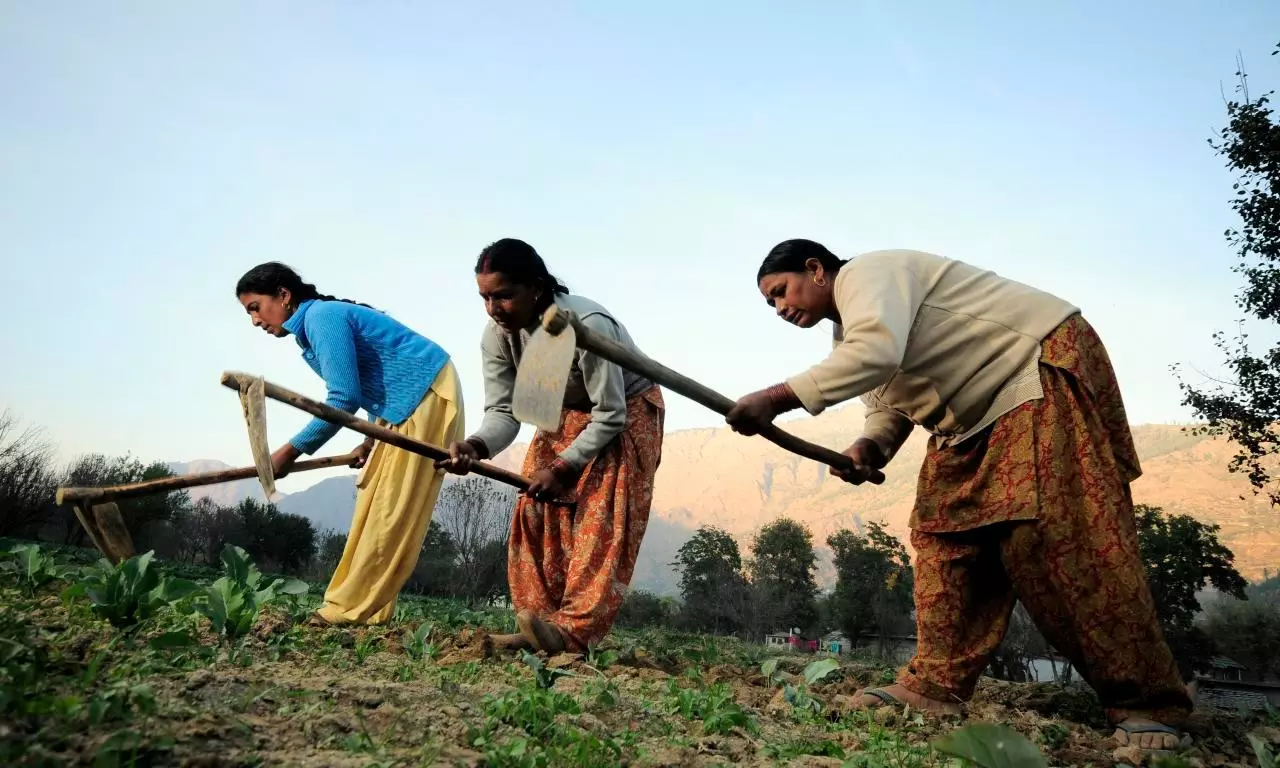
In recent state elections, the BJP has bent over backwards, dispensing cash transfer schemes on the eve of elections to wheedle women voters, the sort of programmes that it once scornfully described as “revri”. By bringing in “G-RAM-G”, the BJP should be wary; numerous research studies confirm that women were significantly benefited by the scheme, despite the flaws, including corruption, in its implementation. If “G-RAM- G” is not sensitive to women’s participation, it could trigger a negative effect among women voters, crucial for BJP’s dreams of becoming the Congress of yore, when the grand old party ruled in every state. Any change in their economic capability will harm India and its future if “G-RAM-G” fails to be inclusive.