Trade, Taiwan, technology and strategic minerals top the agenda amid growing rivalry
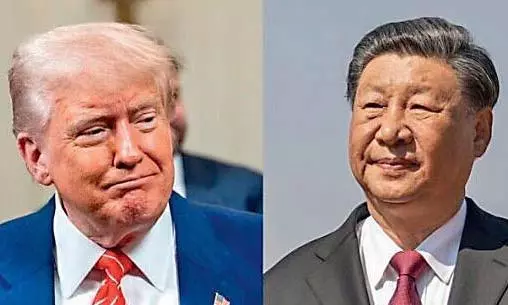
Chinese President Xi Jinping’s three-day state visit to the United States this week, barely four months after President Donald Trump travelled to Beijing, is one of the rare gestures by the Communist nation and indicates China's desire to keep the relation between two powerful countries stable.
Beijing has described the reciprocal presidential visits within six months as a milestone, while the White House is according Xi a full state welcome. Trump had visited China on May 13. Trump’s visit to Beijing in May followed Xi’s journey to Washington in September 2025.
The regular engagement between the two Presidents is part of Trump’s new policy to engage with China, rather than contain it through a web of alliances. This marks a shift towards a US-China bilateral duopoly, sidelining traditional multilateral alliances, and gives it the respect that China demands for its global heft.
The timing of the visit is also important as it comes merely days after the US Congress empowered US President Donald Trump to impose up to 100 per cent tariff on any country which trades with Russia and Iran. China is the biggest trade partner of both Russia and Iran. The Chinese President’s visit also comes weeks before the year-long bilateral trade truce, which was struck at Busan in South Korea, is going to end.
The bilateral talks between Mr Xi and Mr Trump are expected to focus on trade, technology, Taiwan, strategic minerals and several questions related to global security. The Chinese President is travelling with business leaders, just as Mr Trump took American chief executives with him to Beijing in May. Commercial engagement between both countries could provide ballast to a relationship increasingly dominated by strategic mistrust.
Artificial intelligence has emerged as another arena, where the United States and China are competing fiercely. Washington wants to preserve its technological advantage, while Beijing tries to expand its influence in technology. As part of this strategy, Mr Xi proposed to create an Open-Source AI Community for the global south during the recent BRICS summit.
Though Taiwan remains the most difficult issue between the US and China, Mr Trump appears keen to introduce realism to avoid confrontation with Beijing. However, Washington continues to maintain its longstanding policy framework and its legal commitments under the Taiwan Relations Act.
There is also a wider global dimension to these talks. The United States and China together contribute roughly 42 per cent of the global economy. If they deal with each other at the cost of others, it will create a global duopoly which will be harmful to the global order and strike at the root of the global order, which was created after World War 2.
The Trump policy has already forced the members of the Western alliance to close ranks to confront the US, whose demands violate the dharma of the multilateral alliance and violate their national sovereignty. Given the emergence of the G2, the middle powers, including India, Japan, Canada, Australia and the European Union, should coordinate with each other more closely to protect themselves from global bullies.