Sunanda K Datta Ray | Oil U-turn, Greenland Deal: Trump’s Credibility At Risk

The Mongol sacking of Kyiv in 1240 shattered Kievan Rus, sending the northern principalities (which eventually grew into Muscovy and Russia) and western/southern Ukrainian lands down very different political paths
Donald Trump’s astonishing purchase of Russian fuel may be old hat by the time this appears in print, but the world must still consider the implications of the lesson that what is sauce for the goose is definitely not sauce for the gander so far as the United States President is concerned.
Despite some recent signs of constitutional and political curbs on his authority, Mr Trump is unarguably the most powerful man on earth. He heads the biggest economy in the world. He also commands the world’s mightiest fighting force. His is the only country that has ever dared to deploy a nuclear weapon — two nuclear weapons in fact — against another belligerent. The most recent political developments concerning Greenland demonstrated that America’s least wish might be regarded as commands in the manner that the four sycophantic English knights at the court of the medieval English monarch, King Henry II, are believed to have literally interpreted the king’s “Will no one rid me of this turbulent priest!”, and murdered the less-than-subservient Archbishop of Canterbury, Thomas Becket.
Not content with what must be condemned as a blatant display of duplicity, Mr Trump then added insult to injury by suggesting that “it’s time for Ukraine to get a new President” and ripping into the present plucky incumbent, Volodymyr Zelenskyy, whose seeming inability to strike a deal to end the war with Russia he mocked. “I suggest they get a new leader who can make a deal. For some reason (Zelenskyy) never does,” Mr Trump told reporters. “President Putin would like to see a settlement, strongly,” he said of what the Russian leader had allegedly told him when the pair spoke on the telephone.
This is where history may be subject to perception, and assessments and expectations shaped by history. The shared saga of Ukraine and Russia spans over a millennium, rooted in the medieval state of Kievan Rus and marked by centuries of imperial domination, Soviet rule and modern conflict. Ukraine became Christian long before Moscow emerged as a state. Christianity became the dominant religion since its official acceptance in 989 by Vladimir the Great, who brought the faith from Byzantine Crimea and installed it as the state religion of medieval Kievan Rus, with the metropolitan bishopric in Kyiv.
The Mongol sacking of Kyiv in 1240 shattered Kievan Rus, sending the northern principalities (which eventually grew into Muscovy and Russia) and western/southern Ukrainian lands down very different political paths. By the 18th century, much of central and eastern Ukraine was absorbed into the Russian Empire whose militant Russification heavily suppressed the Ukrainian language and culture. The process extended into the Soviet era (1922-1991) when, apart for a brief period of independence, Ukraine was forcefully integrated into the Soviet Union as the Ukrainian Soviet Socialist Republic.
Those years of horror still haunt Ukraine’s memory because of Joseph Stalin’s manmade famine, the Holodomor, 1932-33, when millions of Ukrainians starved to death. During World War-2, Nazi Germany brutally occupied Ukraine from 1941 to 1944, causing massive destruction before Soviet forces reclaimed the region. In 1954, Nikita Khrushchev transferred the Crimean peninsula from the Russian Soviet to the Ukrainian Soviet. No wonder more than 90 per cent of Ukrainian voters chose independence from the collapsing Soviet Union in December 1991. Not that independence came without a price. Under the 1994 Budapest Memorandum, Ukraine agreed to give up the world’s third-largest nuclear arsenal in exchange for guarantees of its sovereignty and territorial integrity from Russia, the US and the UK.
What next? Successive Ukrainian governments alternating between pro-European and pro-Russian foreign policies, culminated in late 2013 in President Viktor Yanukovych abandoning an EU association agreement under Russian pressure. While mass protests ousted Yanukovych, Russia occupied and annexed Crimea and backed armed separatists in the eastern Donbas region, sparking a localised war which led to a full-scale military invasion on February 24, 2022, aimed at overthrowing the Ukrainian government and dismantling Ukrainian independence. Meanwhile, Europeans are wondering about the future of the strategically vital Thule Air Base which is a key hub for scientific missions like Nasa’s Operation IceBridge, and for operating radar systems for missile warning, missile defence and satellite tracking.
The site has been one of the major hubs of Operation IceBridge since it began in 2009, the largest ever airborne survey of Earth’s polar ice. Denmark supported a US military presence and Nato security guarantees because of its own limited ability to defend Greenland. The Americans could not have established a radar base at Thule during the Cold War without Danish support.
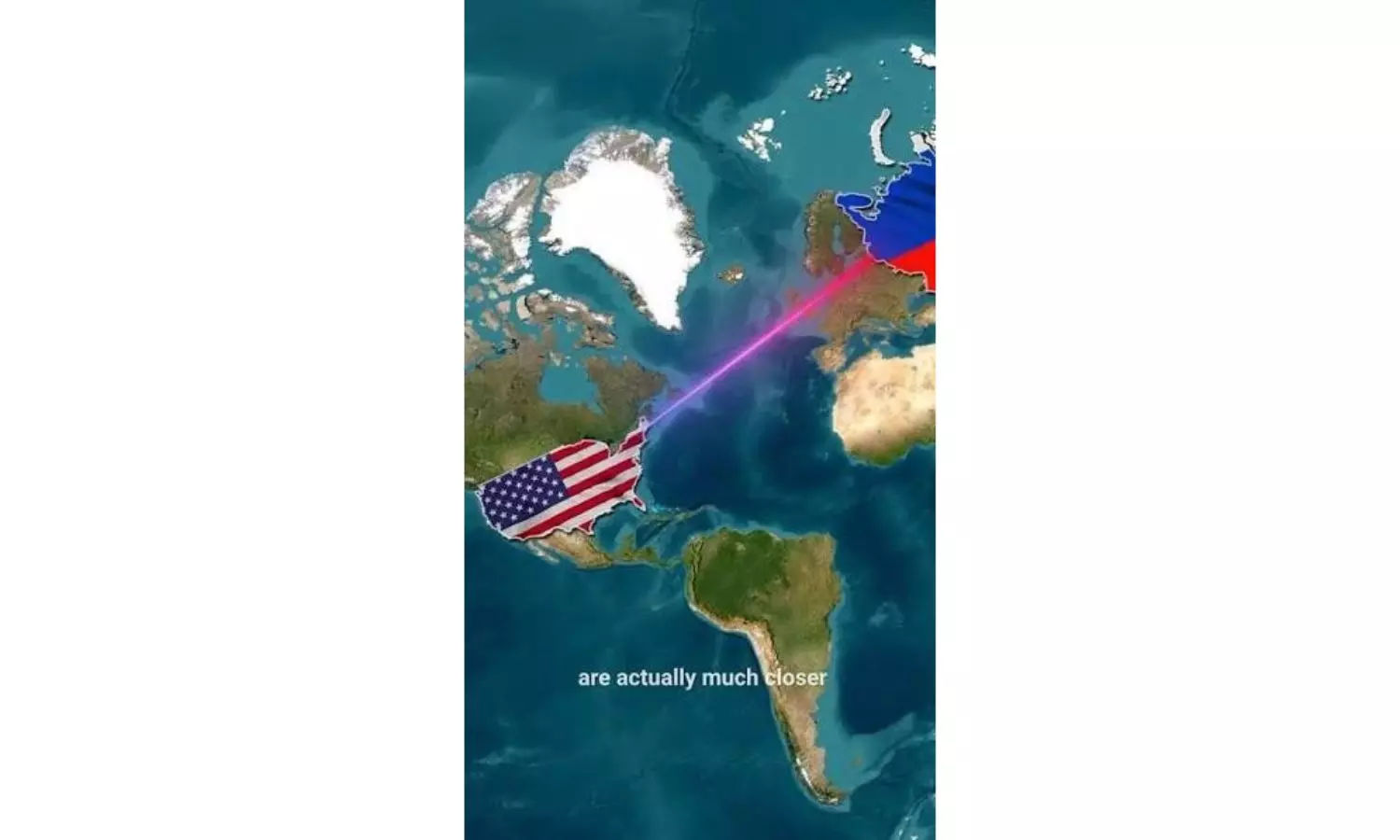
This is not the only sensitive border territory. There’s also the US’s 49th state, Alaska: Mr Trump and Mr Putin met for a highly-anticipated summit on August 15, 2025, at Joint Base Elmendorf-Richardson in Anchorage, Alaska, to discuss the Russo-Ukrainian war. Experts emphasise the historical significance of this location, specifically how the US purchased it from Russia in 1867.
According to the US department of state, “Russia has always had a keen interest in this region, which was rich in natural resources and lightly inhabited.” But Russia was also hard up, and although the treaty was signed in March 1867, the formal transfer was seven months later. The US paid $7.2 million, or about two cents per acre. The deal was initially mocked but later seen as a bargain, with inflation pushing the price up to more than $150 million.
The narrowest distance between Russia and Alaska is 55 miles. This body of water, the Bering Strait, contains two small islands, Big Diomede and Little Diomede. Russia still owns Big Diomede while Little Diomede belongs to the US. The stretch of water between the two is only about 2.5 miles wide and freezes over during the winter so that it is technically possible to walk from the US to Russia on this seasonal sea ice.
The Russo-Ukrainian war has caused hundreds of thousands of casualties and a massive humanitarian crisis. But it has not yet totally destroyed the American leader’s credibility. That is now in danger of happening because of what other Western leaders are bound to see as evidence of Mr Trump’s duplicity in advising one course to countries like India and himself following another.