Sanjeev Ahluwalia | After Trump’s Tariff Rebuff, Key Reforms Vital For India

Deals will have to be negotiated, compensating the immediate losers with financial support (grant transfers from the Centre to state governments), reskilling and economic rehabilitation grants for the affected families and new “loser” centric compensatory infrastructure investment. Sadly, there is no techno-political forum where this consensus can be reached
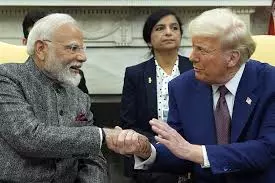
Fortress America, protected by high tariff walls, mimics the economic history of the United States from the 1930s. It is an unlikely answer to the low competitiveness of that economy today in low margin business. If flipping hamburgers costs eight times as much as in India, clearly, there are low-hanging fruit to be plucked there, but only by losing low value add jobs.
This explains why 2.5 million Indians employed in global capacity centres in India provide back-office support services, including accounting, finance and engineering design, for corporates in developed economies, thanks to global digitalisation. In the developed world, the policy conundrum between having both well-paid human workers and profitable corporates is being won by the latter. A flight of investment capital, creating new jobs in America, to evade high import tariffs, as expected by the Trump administration, is unlikely, because workforce costs are so much higher there. Own-shoring is always possible, but only at additional cost to US corporates and consumers.
Does this self-goal by America open up opportunities for reform in India? Conflating the two obscures the real reason why India is a slow reformer. Take, for example, the failed attempt to reform the agriculture laws in 2020. Entrenched economic interests in favour of maintaining the high-cost, convoluted subsidies shielding agriculture from market discipline, and the perceived self-interest of about one-half of the households in India -- concentrated in the populous, less developed states in the North, East and Central India -- make agricultural reform politically risky, in the absence of an all-party consensus.
Deals will have to be negotiated, compensating the immediate losers with financial support (grant transfers from the Centre to state governments), reskilling and economic rehabilitation grants for the affected families and new “loser” centric compensatory infrastructure investment. Sadly, there is no techno-political forum where this consensus can be reached.
Prime Minister Narendra Modi -- a savvy political player, better than the best -- promptly recast the Donald Trump tariff shadow as an outcome of his commitment to protect Indian farmers and fisherfolk. This strikes a populist chord ahead of the Assembly elections in Bihar in November this year. The unfortunate fact is that the poor and lower middle class – all deserving of “protection” -- extends well beyond agricultural families and includes weavers, artisans, textile factory workers, workers in leather goods manufacture, gems and jewellery, and the tertiary sectors in transport and supply chains for trade and industry. All of these will be adversely affected by a 50 per cent tariff wall for export to the largest market in the world.
Expert assessments of the impact on the Indian economy are still rolling in but could range up to a loss in economic growth of 0.5 percentage points if the tariff remains at 25 per cent to one percentage point of GDP if the tariff increases to 50 per cent or Rs 2 trillion to Rs 4 trillion by 2026. Can any domestic reform raise competitiveness to absorb this loss in the growth momentum in the near term?
A reform agenda to enhance competitiveness -- even if it were politically manageable -- requires a massive overhaul of government regulations, practices and fiscal allocations. The development metrics in India focus on high economic growth rates and the growing size of the economy relative to others. A growing tabletop is unstable unless supported by strong legs.
A more appropriate, albeit still imperfect measure (because it ignores income distribution inequalities) would be Per Capita Gross National Income (PCGNI). China started flexing its global muscle via the Belt and Road Initiative only in 2013, when its PCGNI (Atlas Method, World Bank) reached $6,860 versus the then global average of $10,820. By 2024, its PCGNI exceeded the global average at $13,660. India’s in comparison is just $2,650. Why shun the “small guy” advantage of evoking friendly sympathy from the big players and instead prefer polite but insincere endorsements of parity, playing to our vaulting expectations? Viksit Bharat is targeted for 2047. There is at least a two-decade wait till we can hope to play Russian roulette, as we did recently with the US trade negotiations.
Deep reform is a medium-term strategy. The economic war in which we are now engaged demands five near-term tactical initiatives.
First, it will be difficult to redirect our US exports to other markets, though these might evolve over time, including value addition shifts to those enjoying lower tariffs like the UK at 10 per cent. Our best near-term bet is to limit our losses by petitioning the US to retain the 25 per cent tariff till negotiations for the additional 25 per cent tariff are completed. At present, the 50 per cent tariff will become applicable from August 27.
Also petition to extend the negotiation till after the Bihar polls in November this year. Given the benefit of time, and some back-channel contacts to salve President Donald Trump’s outrage, some of the bonhomie with which negotiations began might return.
Second, India should support America’s bilateral peace initiative with Russia in Alaska. The talks are, coincidentally, expected on India’s Independence Day, and another possible follow-up trilateral with Ukraine.
Third, time our outreach to enlarge our global trade compacts via bilateral trade agreements with the European Union and others, till after the final US tariff is agreed. Pursuing them till the American snafu gets resolved is unlikely to be beneficial.
Fourth, rethink our approach to GM crops, which have much to recommend them, including climate resilience, lower chemical and water use and higher productivity. To work around farmer objections to potential disruption of traditional, domestic crops, the GM crops could be “only for export” initially, licensed to be grown in defined agriculture SEZs. Farmers’ co-operatives and corporates could pool in land to develop such export zones.
Finally, an out-of-the-box alternative. Explore co-production locations acceptable to the United States. Even a minimum 25 per cent markup creates a significant potential for favoured intermediary economies to benefit. Transferring Indian goods via an acceptable intermediary to the US, such as Israel (US import tariff 15 per cent), has a 10 per cent margin -- about $4.8 billion on taxable goods of $48 billion -- to be shared between Israel and India though logistics costs will be higher versus the direct export route. The UAE is yet another option. Both countries are partners in the proposed India-Middle East-Europe Economic Corridor. In dynamic deal-making, second-best options offer practical alternatives, once the best options become inconvenient to pursue. We should be open to them.
The writer is Distinguished Fellow, Chintan Research Foundation, and was earlier with the IAS and the World Bank