SANJAYOVACHA | A Mind In Fear In India of Gandhi and Tagore | Sanjaya Baru

It was the free flow of modern science into colonial India that enabled a C.V. Raman to earn a Nobel Prize and a Srinivasa Ramanujan to contribute to modern mathematics
A senior retired official of the Andhra Pradesh government recently posted a complaint addressed to Union finance minister Nirmala Sitharaman on the social media. His son had sent him a book as a birthday gift but the Indian Customs department officials were holding it back, demanding all manner of paperwork and proof of identity and residence. The fact of his being a retired official and a member of the Indian Administrative Service was not adequate. The documents he submitted to the Customs authorities were returned six times as being inadequate proof of his bona fides.
All this, said the retired official to the finance minister, “for the Customs to clear a book sent by a loving son to surprise his father on his birthday”. My wife had a similar experience receiving a book from overseas in which she had published a research paper. Governmental control on the import of books is an old sarkari disease.
The import and domestic publication of Salman Rushdie’s The Satanic Verses was banned by a Congress government in the late 1980s. There are no angels in this game of mind management.
This official monitoring of the import of books and journals is one aspect of attempts at governmental thought control. There is more that has been happening, ranging from official sanction to school textbooks to the grant or denial of visas to scholars resident overseas. The debate on these issues has become so partisan that there are enough number of so-called intellectuals on both sides of the debate ready to defend or oppose government censorship and bureaucratic control.
Several foreign scholars have been denied entry into India without in fact a reason being specified, but ostensibly due to official Indian disapproval of their views.
Rather than invite them to Indian platforms where their views can be contested and debated, establishment intellectuals seem to prefer banning their entry. In a world connected through the airwaves and with online conferences, the prevention of physical entry through visa denial is a typically wooden-headed bureaucratic response.
It was none other than Mahatma Gandhi who had once famously said: “I do not want my house to be walled in on all sides and my windows to be stuffed. I want the culture of all lands to be blown about my house as freely as possible. But I refuse to be blown off my feet by any.”
Every educated Indian is familiar with Gurudev Rabindranath Tagore’s famous prayer -- “Where the mind is without fear and the head is held high/Where knowledge is free/Where the world has not been broken up into fragments/By narrow domestic walls…”. What governmental diktats on monitoring import of books and visa for scholars is doing is to in fact impose such “narrow domestic walls”.
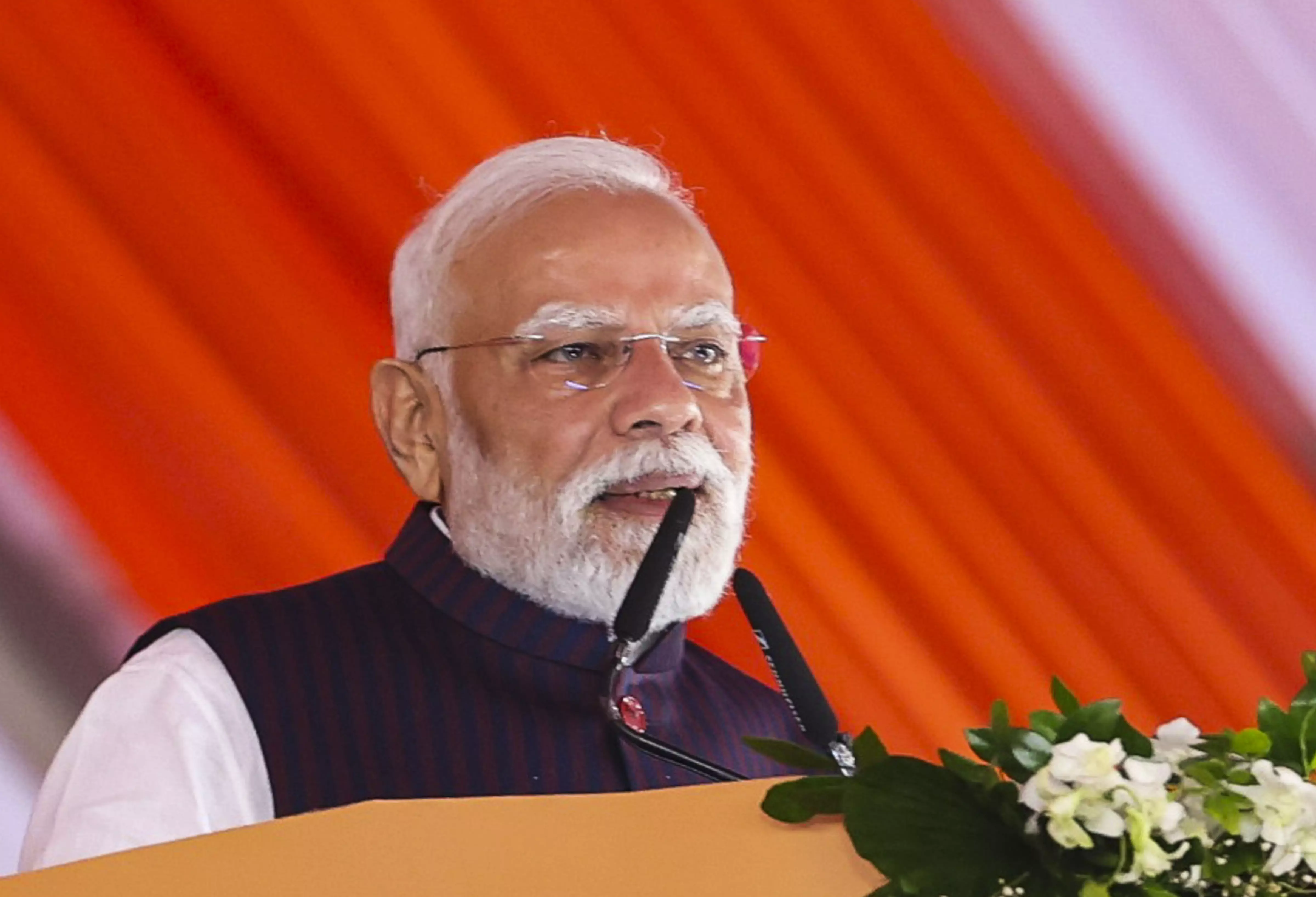
At a recent media event, Prime Minister Narendra Modi added his voice to that of legions of Indian critics of the now infamous Lord Thomas Babington Macaulay, stating that Macaulay’s “Minute on Education” had “shattered our self-confidence” and that Macaulay had “infused a sense of inferiority within us. With one stroke, Macaulay threw thousands of years of our knowledge and science, our art and culture and our entire way of life into the dustbin”.
It is true that Macaulay’s primary objective was to create “a class of Indians who may be interpreters between us and the millions whom we govern: a class of persons, Indian in blood and colour, but English in taste, in opinions, in morals and in intellect”. Much of the popular and populist criticism of Western scholarship and English education in contemporary India is derived from this view of Macaulay.
However, as Macaulay’s biographer Zareer Masani, son of the distinguished Minoo Masani, an intellectual leader of the Swatantra Party and a member of Parliament from Rajkot in Gujarat, has written, Macaulay was also the “pioneer of India’s modernisation”. According to Masani, “Macaulay’s educational minutes made it abundantly clear that he saw the teaching of English, far from replacing vernaculars, as a channel for the transmission of European knowledge into the vernaculars and through them down to the wide masses of the Indian population.”
Masani quotes Macaulay as writing: “Twenty years hence, there will be hundreds, nay thousands, of natives familiar with the best models of composition, and well acquainted with Western science.” It was the free flow of modern science into colonial India that enabled a C.V. Raman to earn a Nobel Prize and a Srinivasa Ramanujan to contribute to modern mathematics.
In 2025, a good three quarters of a century after Independence, it is a shame that India’s political leadership, across the political spectrum, still blames the past for the country’s present inadequacies. It is the inadequate attempt by successive governments to translate global knowledge into “the vernaculars”, that continues to privilege the English language in India.
It is also a fact that much of ancient Indian history and knowledge was unravelled by European scholars. From the discovery of the contribution of Buddhism, and of Buddhist sites from Nalanda to Ajanta, and of the roots of Indian languages, European scholarship made immense contribution to knowledge about our past. Rather than accept this fact and then proceed to invest in the creation of Indian scholarship, we continue to bemoan the past and the interest of “outsiders” in our history and society.
Prime Minister Modi referred to how China, Japan and South Korea have progressed as modern industrial nations without the dominance of English and by empowering their own languages. This is true, but all three of them borrowed heavily from Western scholarship and knowledge and today march ahead of the West in the most advanced fields of science and technology. They did not waste their time and energy glorifying their past without investing in the present and the future. India’s challenge is to catch up with East Asian nations in the fields of science, technology and other areas of knowledge. It is the pursuit of this goal that has to take precedence over the language in which these goals will be pursued.
For India to catch up with East Asia as a knowledge-based economy, it must have its windows open, to use Gandhiji’s metaphor, and break down “narrow domestic walls”, as Tagore urged, with our “head held high” and a ‘tireless striving stretching its arms towards perfection.’
Sanjaya Baru is a writer and an economist. His most recent book is Secession of the Successful: The Flight Out of New India