US aggression is speeding the shift toward a China-led order
It has been called a “war of choice”. It may well be remembered as the tipping point.
The war that defined the limits to American power. Naked aggression and the use of overwhelming power, including nuclear weapons, may still enable the United States to assert its dominance, but the era in which large parts of the world regarded the US as the natural leader of the international community has ended.
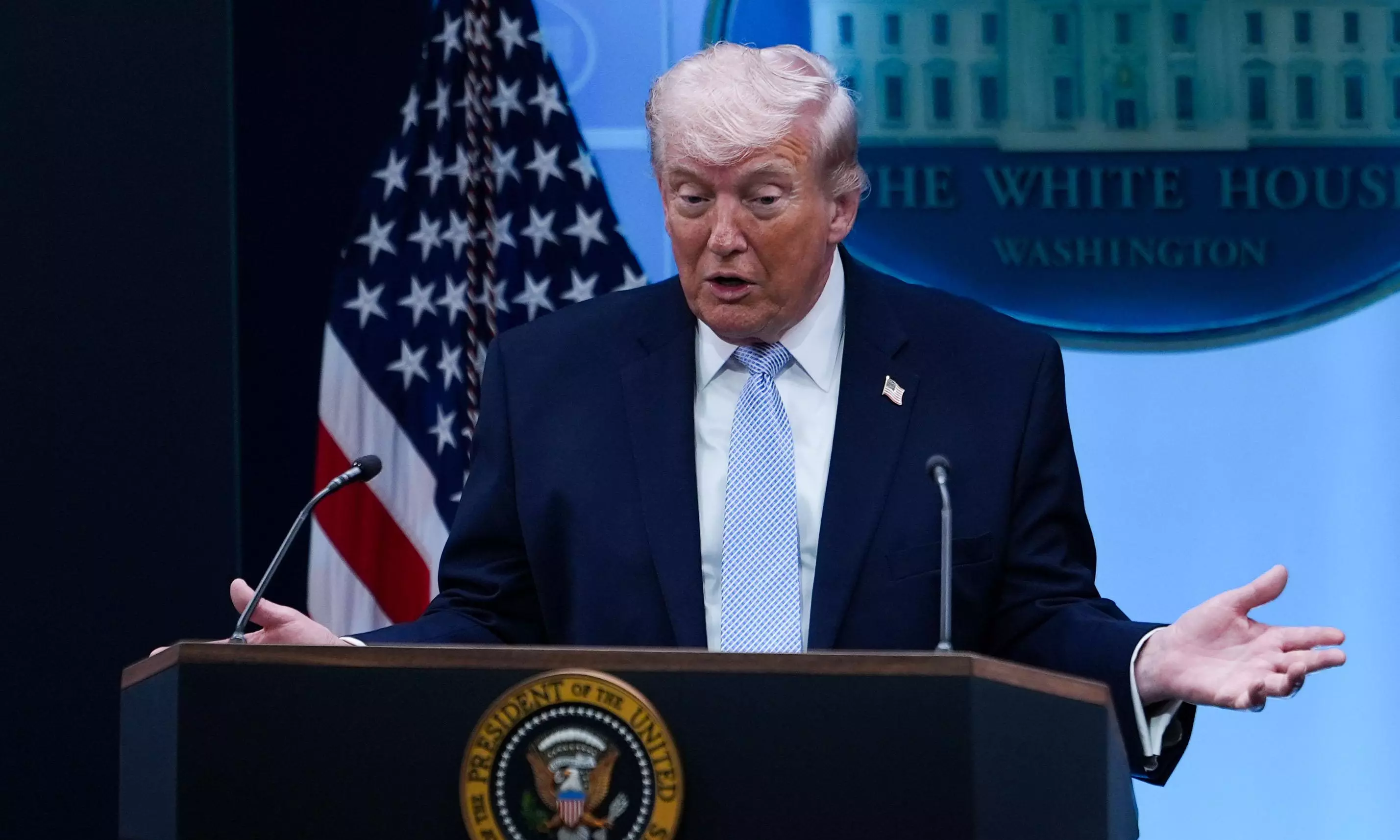
Nothing captured better the decline of a great nation than the language of its President. When the leader “on the hill”, resident of that hallowed home, the White House, asked leaders of other nations to “kiss his arse” and tweeted the F-word, it was clear that the barbarians were not at the gate but had entered the epicentre of Western power.
President Donald Trump threatened to wipe out an “entire civilisation” that has lived for thousands of years in a land that has come to be known as the “cradle of civilisations”. Instead, he merely signalled the end of civilisation in his own homeland.
President Trump has come to symbolise all that is ugly about a flailing giant, pinned down like Gulliver by the threads of lesser powers.
A quarter century ago the government in Beijing authorised the production of a 12-part television series titled “The Rise of Great Powers”. Released for airing in 2006, the series offered the Chinese people and the world a tour de force explaining the rise and fall of great powers. Beginning with Portugal, the TV series recorded the history of all great European powers as well as that of the United States, Japan and Russia.
Interestingly, the series recorded an interview with Paul Kennedy, the author of The Rise and Fall of Great Powers, and concluded with the thesis that the time had come for the next transition -- the decline of the US and the rise of China.
In 2007, preparing for his meeting with the Chinese leadership, Prime Minister Manmohan Singh sat down for a tutorial on China with Singapore’s founder Lee Kuan Yew. Mr Lee spoke at length about the “great powers” TV series. Everyone in China had watched the entire series, Mr Lee informed Dr Singh. It was perhaps the first time that a nation had not only been taught history on television but had been primed to understand what is expected of it.
Mr Lee suggested that the Chinese TV series should be shown on Indian television for an Indian audience to understand how China views the world and its place in it. However, that never came to pass. Perhaps two decades ago it was felt that the series was making tall claims for China. Few imagined then that the decline of American influence would be so rapid and the rise of China so steep.
The first turning point was what I have always referred to as the “trans-Atlantic financial crisis”, which the Western media pompously refers to as a “global financial crisis”, in 2008-09. China came out of that crisis relatively unscathed and underlined its relevance for the global economic system. Over the next decade and a half, China took off, increasing the distance between itself and the world.
Even so, till the return of President Trump for his second term in office, few around the world imagined that history would move at the pace it did in this past year. Mr Trump’s bombastic claims for American power and his naked use of force have only convinced the international community that we are living through the throes of a transition. While nothing is inevitable in human history, the logic of circumstances shapes its course. The more aggressive the US is in the deployment and the use of force, the less influential would it become.
The last time the world had witnessed anti-American protests across continents, from Paris to Tokyo, and anti-war demonstrations inside the US, was in the 1970s. The Vietnam war mobilised global public opinion as well as domestic opinion in the US against war. The combination of extremist Zionism and Christian bigotry masquerading as the “forces of good against evil” have once again mobilised world opinion against the hegemon.
In the past, US Presidents used to refer to the alliance of Iraq, Iran and North Korea as the “axis of evil”. The “axis of evil” more recently has been defined to include China, Russia, Iran and North Korea. Given the events of the past two years, the genocide in Gaza and the unprovoked bombing of Iran, it is now clear as crystal that the new “axis of evil” is the coalition of Israel and the US. It has a few willing recruits ready to join like Argentina.
What is ironic is that out of all this mess, China has emerged as a responsible power. Considering the fact that President Trump has close to three more years in office, one should expect that the decline of the US will proceed apace. There is no evidence to suggest that Mr Trump may change his ways and become a more responsible leader. If he decides to target Cuba and continues to deploy American hard power, he will further accelerate the decline of American soft power.
All that China has to do over the next few years is to continue to behave like a responsible power, not threatening its neighbours but keeping the US under check, and the transition from an American era to an Asian era, with China leading, will gain momentum.
It is now clear that even as India tries to maintain some balance in its relations with the United States, Indian leadership across much of the political spectrum will no longer trust the US in the manner it came around to between 1999 and 2024. A quarter century of trust building has been wasted and no sensible Indian leader should risk placing a bet on the US in dealing with the challenges India faces.
Rather, it is likely tthe Indian leadership will hedge its bets and seek to improve relations with other major powers, including China. If there is one country that can decisively signal the end of the American empire by the strategic choices it makes, it is India. Friendship with India kept the balance of power tilted towards the US even as China’s power was growing. By alienating Indian public opinion, President Trump has accelerated the decline of the US and the rise of China.
Sanjaya Baru is Distinguished Fellow, United Service Institution of India and Takshashila Institution
