A vibrant ship-building industry thrived both in Gujarat and in the Andhra region and these vessels could travel both to the Arab coast to the west and the Indonesian coasts to the east
I have been interested in Sanjeev Sanyal’s stitched ship project from day one, and not just because Kaundinya happened to be my mother’s gotra. Sanyal deserves fulsome praise for his intellectual curiosity, initiative and enterprise. Inspired by the depiction of a sailing ship in a painting in the Buddhist cave temples at Ajanta, Sanyal set out to prove that ancient Indians could build a ship with wood, rope and resin and make it sail across the waters around the sub-continent.
Half a century ago the Indian Navy commissioned Admiral K. Sridharan to record this history in his book A Maritime History of India (1982). Sridharan points to maritime links of Indian kingdoms both on the west coast, in Gujarat and Malabar, and the east coast, all the way down the Coromandel (Koramangala) Coast dating back to over two thousand years. A vibrant ship-building industry thrived both in Gujarat and in the Andhra region and these vessels could travel both to the Arab coast to the west and the Indonesian coasts to the east.
The maritime historian K.M. Pannikar noted in his 1945 monograph, India and the Indian Ocean: An Essay on the Influence of Sea Power on Indian History (1945): “Milleniums before Columbus sailed the Atlantic and Magellan crossed the Pacific, the Indian Ocean had become an active thoroughfare of commercial and cultural traffic.” Several historians, including Ashin Dasgupta, Sinnapah Arasaratnam, K.N. Chaudhuri, Kanakalata Mukund and Sanjay Subrahmanyam, have written about the Indian sub-continent’s maritime links with its wider Asian neighbourhood.
The European historian Fernand Braudel notes in his tome, Civilisation and Capitalism, 15th to 18th Century: The Perspective of the World, that the Indian Ocean region -- from the Arab coast to the South China Sea -- was the “greatest of all the world economies” of the pre-industrial, pre-capitalist era. “The relationship between these huge areas,” wrote Braudel, “was the result of a series of pendulum movements of greater or lesser strength, either side of the centrally positioned Indian subcontinent…. Through all these vicissitudes however, India maintained her central position: her merchants in Gujarat and on the Malabar and Coromandel coasts prevailed for centuries against their many competitors -- the Arab traders of the Red Sea, the Persian merchants of the Gulf, or the Chinese merchants.”
European colonialism altered the nature of India’s relationship with the waters around it. They ceased to be a bridge to prosperity and became a route to the de-industrialisation and destruction of the Indian economy. Since European conquest came via the sea, much of the discourse on the sea focused excessively on maritime security and defence, to the relative neglect of its economic potential. Given the nature of colonial commerce and the dominant thinking around the world on the role of trade in development, independent India turned inwards on the economic front and in so doing, forsook its maritime potential.
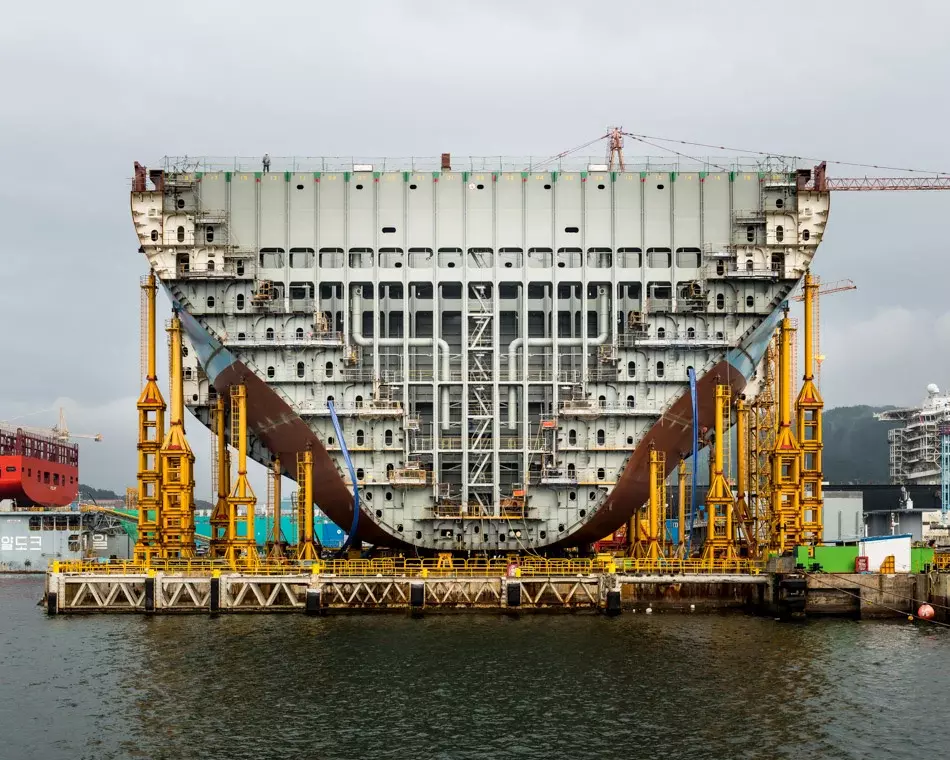
The nascent Indian ship-building industry died a slow death. In 1950 India had a bigger ship-building industry than South Korea. A decade later it was all but dead despite the fact that the Second Five-Year Plan, which laid the foundations of industrial development, envisaged further development of a nascent ship-building industry.
The Second Plan’s chapter on transport outlined the objectives for the ship-building industry as follows: (a) To cater fully for the needs of coastal trade with due regard to the possibility of diverting some traffic from the railways to coastal shipping; (b) To secure an increasing share of India’s overseas trade for Indian ships; and (c) To build up the nucleus of a tanker fleet.
However, the development of ship-building and development of ports and harbours was constrained by the limited requirements of an inward-oriented industrial and external trade policy. India’s inward-orientation on the economic front lasted for close to four decades during which maritime commerce and the maritime economy never entered the imagination of India’s economic planners and maritime strategists.
It is only after 1991, when Prime Minister P.V. Narasimha Rao opened up the economy to foreign trade, that both the maritime economy and India’s naval capability secured policy attention. Under successive Prime Ministers greater attention has been paid to the need to bolster India’s maritime capability. This has been sustained both by the fact that India’s share of world trade has increased over the past three decades and by the need to acquire better naval defence capability.
It is only recently that India is focused on the potential of the “Blue Economy”, on Underwater Domain Awareness (UDA) and has an Indian Ocean strategy named SAGAR -- security and growth for all in the region complimented by a port development programme called “Sagarmala”. Defence minister Rajnath Singh made an interesting remark in his address to the Naval Commanders Conference, referring to India as an “island state with land borders”. For a North Indian politician to articulate this view is a welcome departure from an obsession with land neighbours.
INSV Kaundinya’s successful sailing draws attention to not just the long history of Indian maritime capability but also the contemporary importance of maritime neighbours in defining the Indian neighbourhood. Two decades ago, I had questioned the external affairs ministry’s definition of India’s neighbourhood which remains largely defined by land connectivity.
The only change made by the Narendra Modi government to the limited perspective offered by the “Neighbourhood First” policy has been to exclude Pakistan and include Myanmar and Thailand by replacing Saarc with Bimstec. I have long urged a more expansive view of neighbourhood that includes Indonesia to the east, a mere 80 nautical miles away from Indian territory, and Oman to the west. It is useful to remember that the Indian cultural footprint remains firmly embedded in both these maritime neighbours.
A deeper awareness of this neighbourhood and its interaction with the Indian sub-continent is also important for crafting domestic politics and policy at home. The inclusive and plural definition of India as home to a multiplicity of religions, languages and ethnicities makes it easier for India to deal with a neighbourhood that includes Hindu, Buddhist and Islamic neighbours.
Both Indonesia and Oman have retained Indian cultural footprints and have not shied away from the history of their Hindu inheritance. It is only a multi-religious, pluralistic India that can proudly and rightly lay claim to the history of ancient civilisational interactions.
Sanjaya Baru is a writer and economist. His most recent book is Secession of the Successful: The Flight Out of New India.
