Parsa Venkateshwar Rao Jr | Budget 2026-27 Brings Back Old Populist Rhetoric, But It’s Still Muted

For quite some time now, Prime Minister Narendra Modi and his Cabinet colleagues like commerce minister Piyush Goyal and railway minister Ashwini Vaishnaw have avoided mentioning challenges and problems. Theirs was unqualified optimism that the Indian economy is doing well, and it can only do better
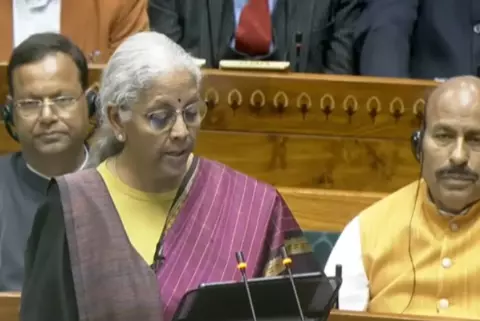
Union Budget 2026-27 appears to bring back the old populist Congress-era rhetoric of focus on the poor, underprivileged and the disadvantaged as one of the government’s “kartavyas”, or duties. Going by the government’s virile optimism of the Indian economy growing faster than many others, including China, the government seems to have realised that there is a need to sort out issues at home. Behind this sober recognition seems to be an acute awareness that the global situation is not too friendly.
For quite some time now, Prime Minister Narendra Modi and his Cabinet colleagues like commerce minister Piyush Goyal and railway minister Ashwini Vaishnaw have avoided mentioning challenges and problems. Theirs was unqualified optimism that the Indian economy is doing well, and it can only do better. And the poor, the underprivileged and the disadvantaged come into a government statement. Of course, no details are given how many poor there are in the country, who are the disadvantaged and who the underprivileged, and what are the specific measures to be taken to help them. There is a passing mention that 25 crore people, or 250 million, have moved out of poverty on the multidimensional poverty index. And how many more poor are left in the country. There is also not much indication if there are new criteria of counting someone as poor, underprivileged and disadvantaged. Not that these sections of the population had ever disappeared. In the last 10 years or more, Prime Minister Modi and his band of optimists have refused to refer to them.
The mood in the corridors of power is not only sober, but quite chastened. Critics and experts have been talking about the increasing levels of inequality as even the market economies across the world have shown signs of floundering. The arrival of US President Donald Trump on the American political stage with his punitive tariffs has cast a long shadow on the Indian economy as well.
The workmanlike Budget 2026-27 of finance minister Nirmala Sitharaman is a reflection of the sombre mood prevailing at the top. The sense of apprehension was fully articulated in the Economic Survey 2025-26, which was placed in Parliament on Friday. It distinguishes between economic policy and economic statecraft. It says: “How does economic policy differ from economic statecraft? Economic policy employs traditional instruments, including fiscal, monetary and trade tools to achieve economic objectives such as reducing deficits, controlling inflation and promoting economic growth. Economic statecraft goes a step further by employing economic tools to achieve foreign policy or national security objectives, such as compelling a country to stop hostilities with a third party or to liberalise its markets.” This indirect reference to Trumpism is writ large in the formulation about economic statecraft.
It is elaborated further in the Economic Analysis: “Across regions, the resurgence of ultra-nationalism, rooted in claims of cultural superiority and an anti-immigrant stance, is increasingly shaping political and policy issues. This shift is narrowing the space for multilateral cooperation and rule-based trading, while hardening domestic borders and constraining labour mobility.” This is both a description of the global situation as well as a national element. Of course, the irony cannot be overlooked: the Narendra Modi government has its own version of cultural superiority and anti-immigrant stance. But that is another debate.
The fact is the Budget looks at all the things the government wants to strengthen in the economy. This starts from providing Rs 10,000 crores in support to the micro, small and medium enterprises (MSMEs) to building hostels for girls in every district to enable them to pursue higher studies and training guides to boost the tourism sector. It makes for an interesting shopping list.
The “atmanirbhar” rhetoric gives way to the need to be integrated with global markets because of trade and capital needs. It is evident that domestic consumption and public investment is not sufficient to sustain economic growth. The sense of triumphalism of this government in 2016-17, when the Indian economy was slotted in the “sweet spot”, has given way to tariffs hurdles.
Apart from budgetary allocations to different sectors, from manufacturing to infrastructure to setting up institutes of creative technologies to support and encourage Animation, Visual Effects, Gaming and Comics (AVGC), and an increase in public expenditure from Rs 11.1 lakh crores to Rs. 12.2 lakh crores, there is little indication of how the goals of growth are to be achieved. The pious hope is that public expenditure will pay off in the long run, and it is a question of playing patience until that happens.
At the end of a decade in power, Prime Minister Modi’s desire to reach the utopia of “Viksit Bharat” by 2047 seems to be losing steam despite tiresome reiterations. All that the government is able to do, as reflected in the lackadaisical Budget menu, is to put in the money in the different sectors, though the funds allocated are not fully utilised. There is no desire to step up the growth rate beyond the optimal seven per cent and there is not much indication that there is a need to go beyond seven per cent. The policymakers in the government seem to recognise the harsh fact that given the global economic and political uncertainties, it is not possible to do so. There is also the reluctant admission that external factors matter in the growth of a country’s economy, and there is no brushing it aside. The BJP-led National Democratic Alliance of Prime Minister Modi is feeling the constraints faced by the Congress-led United Progressive Alliance in its last years in office in 2012-13. The country’s economy is certainly at a higher level than a decade ago, but the problems that dogged them remain present now.
That is why Mr Modi’s rhetoric of growth remains muted in Budget 2026-27.