The other one was the long-awaited meeting of the Chinese and US Presidents, which took place at an airbase near South Korea’s Busan on Thursday amidst their trade standoff
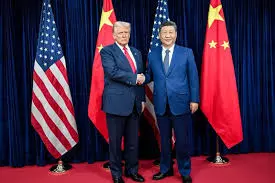
The six-day Asia tour of US President Donald Trump to Malaysia, Japan and South Korea went beyond just attending the Asean and Apec summits. The focus was really on two parallel events. One, his visit to Japan to engage the newly-appointed Prime Minister, Sanae Takaichi, who successfully used her proximity to late Prime Minister Shinzo Abe, assassinated in 2022, to gain Mr Trump’s goodwill. The other one was the long-awaited meeting of the Chinese and US Presidents, which took place at an airbase near South Korea’s Busan on Thursday amidst their trade standoff.
Speaking before his meeting with President Xi Jinping, Mr Trump referred to the “fantastic relations for a long period of time” between the two countries, and called President Xi a “distinguished and respected” leader of a great nation. But just minutes earlier, President Trump also announced resumption of nuclear testing “on an equal basis” with other nuclear weapon powers. He was perhaps provoked by Russia, which had announced the successful testing of new missiles and torpedoes, meant to carry nuclear weapons. The Chinese nuclear arsenal has also been expanding, perhaps to rival the US-Russia 1,550-deployed strategic weapons’ limit. However, even that treaty expires in under 100 days.
Despite President Trump’s lavish compliments, the Chinese side maintained a more businesslike stance. President Xi had just addressed the Communist Party of China’s fourth plenum, with some details emerging on October 29. He outlined the upcoming 15th Five-Year Plan (2026-30), arguing that “the balance of global power is undergoing profound adjustment… in a new phase of technological revolution and industrial transformation”. Also, that “unilateralism and protectionism” are rising globally. Therefore, China must adopt “extraordinary measures” for achieving breakthroughs in key technologies, such as semiconductors, high-end equipment and advanced materials.
President Trump’s intention, on the other hand, was to de-escalate the trade dispute, caused by his unilateral imposition of punitive tariffs. Analysts mostly believe that he has failed to intimidate China, which retaliated by withholding rare earths and critical minerals, vital for the US automobile, defence and electronics industries.
President Trump also desperately wanted China to resume buying American soybeans and other agricultural products. By procuring soybeans instead from Brazil, China left the US farmers without an export market. China absorbs almost 60 per cent of the world’s soybean exports, including about 51 per cent of US exports. China reportedly has already restarted imports from the US after the Trump-Xi summit on Thursday. The US also sought Chinese curtailment of the export of precursor chemicals used to produce the widely misused drug fentanyl.
China arrived at the summit seeking tariff relief and the lifting of US restrictions on the export of high-technology items like Blackwell chips. The US has allowed Nvidia to resume discussions with China, retaining the referee’s role. China also wanted enhanced port fees on Chinese ships suspended. All told, the only tariff relief was a one-year postponement of the threatened new tariffs and a 50 per cent reduction of the 20 per cent tariffs imposed due to China’s fentanyl-related role. Thus, the tariffs on Chinese products have dropped from 57 per cent to 47 per cent. The summit outcome is hence a temporary scale-back and not a finalised and comprehensive trade deal.
However, President Trump’s subsequent social media post has strategic implications for India. He wrote, preceding the summit, that “The G-2 WILL BE CONVENING SHORTLY”. Xu Feihong, China’s ambassador to India, adopted a similar stance. He wrote that friction between the “two leading economies” was normal. He added China’s “development and revitalisation” can proceed alongside Mr Trump’s “Make America Great Again”. And finally, that China and the US can “jointly shoulder our responsibilities” to solve global problems.
India has always feared the emergence of such a new bipolarity, relegating India and other middle powers to a subordinate role. Prime Minister Narendra Modi’s absence from the Kuala Lumpur meetings reflects the Indian conundrum. President Trump’s unpredictability elevates the risk of diplomatic embarrassment if he keeps repeating, in Mr Modi’s presence, claims of mediation between India and Pakistan and the loss of Indian aircraft. He may worsen it by praising Pakistan and urging India to make peace with it. On the other hand, the Indian absence vacated space for India’s strategic rivals to gain US goodwill and advantages in trade and technology.
There is a method emerging to deal with Trumpian disruption and resulting uncertainties. It firstly involves appealing to his ego, such as loudly and repeatedly nominating him for the Nobel Peace Prize and acclaiming his diplomatic wisdom and activism, however flawed his approach. Secondly, it requires feeding his family’s financial greed and handing him wins that make great news headlines.
Take, for instance, the announcements by Japan and South Korea of $500 billion and $350 billion worth of investments in the US respectively. President Trump expected that much cash handed to him for investing at his discretion. After the latest talks, South Korea rationalised it as $20 billion per year of cash transfer, totalling $200 billion.
The rest they will pump into shipbuilding in the US. In addition, South Korean President Lee Jae Myung presented a replica of a historic gold crown, effectively fanning Mr Trump’s regal pretensions.
The Indian political leadership faces a major dilemma. Courting President Trump by public kowtowing would have negative public implications for Prime Minister Narendra Modi’s public image as a strong and influential global leader. Avoiding the phlegmatic US leader and letting Indian diplomatic and ministerial negotiators to finalise a trade deal defies the tested method of Trump management.
India is left with at least three options. One, continue with arms-length diplomacy, maintain public poise and await Mr Trump’s inevitable domestic political engrossment. Two, offer Mr Trump ostensible wins in trade talks, while protecting India’s core interests. This may require extra-diplomatic outreach and allurements still not ostensibly employed by India. Three, do a major rethink of the Indian strategic master plan. India must assume that the US no longer sees India as critical to its containment of China or stability in the Indo-Pacific. Based on that, India needs to approach neighbouring countries afresh, finalise trade deals with the European Union and economically and commercially closely engage Australia, Canada and Japan. Perhaps the Prime Minister needs a Cabinet reshuffle, bureaucratic shakedown in his own office and some ministries.
The lesson to imbibe is that hugs provide no certainty of diplomatic proximity, nor do warm greetings on X constitute permanent friendship.
