Describing his Indian interlocutor as “my greatest friend and a powerful and respected leader” in his own country, Mr Trump attributed the trade deal to the “friendship and respect” the two leaders shared
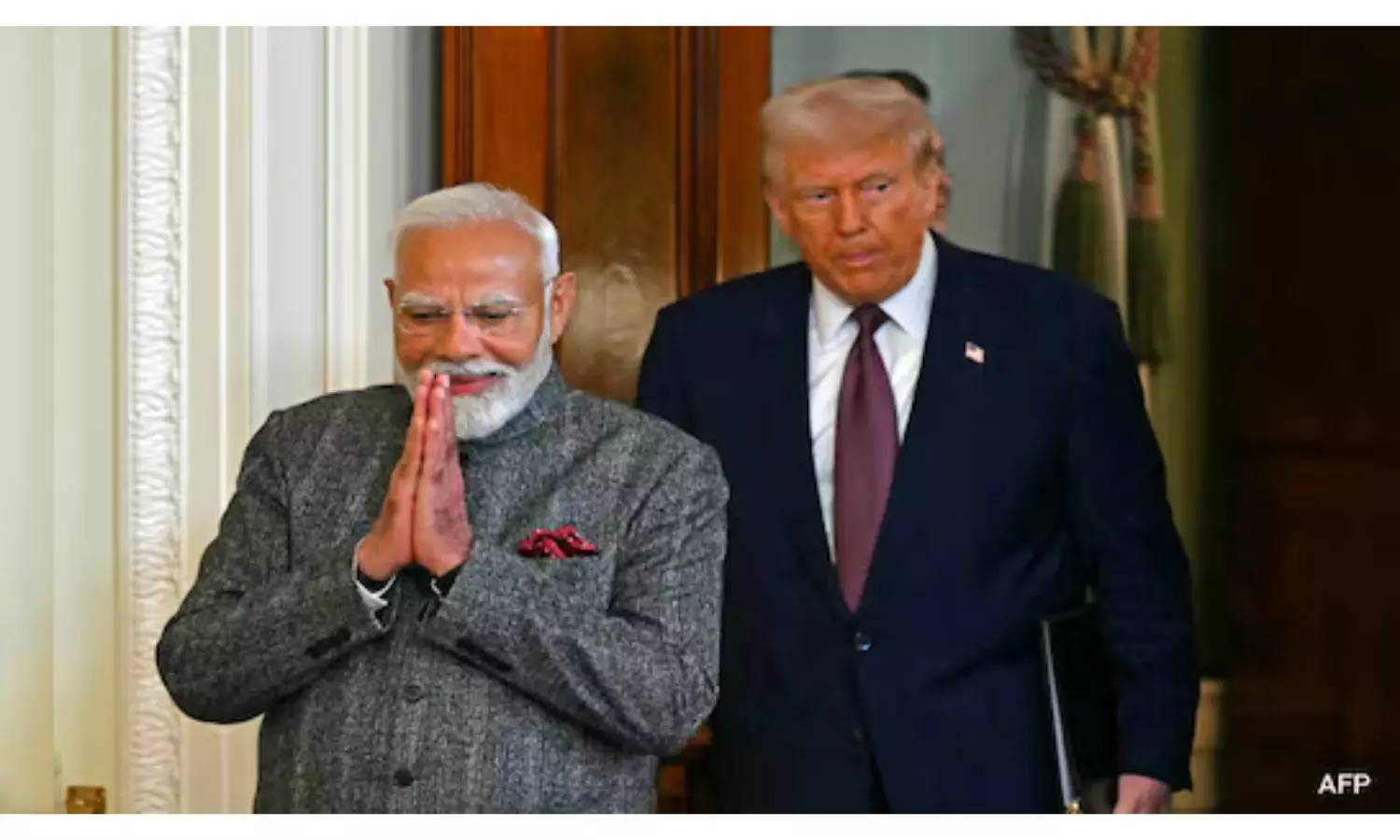
At 10.30 pm Indian time on Monday, US President Donald Trump announced on social media that he had just concluded a telephonic conversation with Prime Minister Narendra Modi and the two countries had reached agreement on their long-awaited trade deal. Describing his Indian interlocutor as “my greatest friend and a powerful and respected leader” in his own country, Mr Trump attributed the trade deal to the “friendship and respect” the two leaders shared.
The same post displayed some details. The reciprocal tariffs on India are to drop from 25 per cent to 18 per cent. The additional punitive 25 per cent tariffs, for India’s ongoing Russian oil imports, would also go as the Indian Prime Minister had agreed “to stop buying Russian oil”. This was justified as crucial to Russia ending the Ukraine war.
Noticeably, Prime Minister Modi, in his own social media post where he “thanked” President Trump, did not acknowledge any such commitment. Russia too publicly claimed that India had not conveyed that it was curtailing Russian oil imports.
Additionally, President Trump claimed India will reduce “tariffs and non-tariff barriers against the United States, to zero”. India, he added, also committed to a greater degree of “BUY AMERICAN”. That includes India procuring “$500 billion of US energy, technology, agricultural, coal and many other products”.
Mr Modi thanked President Trump and, compensating for ignoring his self-proclaimed peace-making in the past, lauded his leadership as “vital for global peace, stability, and prosperity”. India, he added, despite New Delhi avoiding membership of the Trump-created Board of Peace, “fully supports his efforts for peace”.
Mutual back-slapping aside, while the announcements are welcome, unrestrained cheering often requires a reality check. Firstly, as some analysts pointed out, only a preliminary agreement has been announced. A formal trade deal is still being negotiated. Hence the trade concessions, if any, made by India are still unclear. India’s commerce minister Piyush Goyal briefed the media, without taking questions. Thus, his claim that agriculture and dairy are “fully protected” must await the emergence of details. India’s farmer union leaders have already begun criticising the deal. US agriculture secretary Brooke Rollins has claimed that America’s agricultural products will attain a “higher level”.
The US export of agricultural products to India climbed from $1.85 billion in 2020 to $2.34 billion in 2021. After a slight drop in 2022, these touched $2.37 billion in 2024. During January-November 2025 these reached $2.85 billion, one- thirds higher than the same period in 2024. The Indian export of agricultural products to the US climbed from $5.30 billion in 2020 to well past $6 billion in 2021, 2022 and 2024. The trade imbalance has actually been dropping over the same period. The US has been eyeing India’s huge market for years. The need is now greater as China has used its purchase of US agricultural products as a bargaining chip to counter US tariffs. It has done so by turning to Brazil and other suppliers.
It is unlikely that India would compromise on not importing products of genetically modified crops or dairy products derived from cows on non-vegetarian diets. However, the lower tariffs will relieve Indian seafood and rice exporters. Besides spices, these two products are amongst the top three agricultural exports. Also relieved will be jewellers, textile and garment exporters.
During Prime Minister Modi’s February 2025 Washington visit, bilateral trade was targeted to touch $500 billion by 2030. During 2024 it reached $212.3 billion. Of this, the goods trade constituted about 60 per cent, with the trade balance in India’s favour.
President Trump now declaring that India will absorb $500 billion of US goods requires some context. Both Japan and South Korea have promised to invest in America $550 billion (by 2029) and $350 billion respectively. The South Korean Parliament is examining a bill about this investment, with only gradual transfer of capital, mostly into shipbuilding.
India has thus learnt a lesson. President Trump requires huge numbers to claim domestically that manufacturing was returning to the United States. This was part of the “Make America Great Again” (MAGA) agenda. The details are left to the negotiators. Therefore, the Trumpian claims should not be given a reality check. With popular ratings of the Republican Party plunging, it is widely accepted that the Democrats may capture the House of Representatives in the November 2026 mid-term elections. Some Republican members of Congress are now reportedly urging President Trump to roll back tariffs. Therefore, India needed to buy time by ending the trade confrontation with the US.
The experience of both Canada and South Korea demonstrates that with President Trump, no trade deal is final. He is in fact using tariffs not just to balance trade but as weapons to coerce friend and foe alike to accept his worldview. The 2025 US National Security Strategy paper has already spelt out his neo-colonial, xenophobic and rule-less approach to international relations. Across the Americas, referred to as the Western Hemisphere, the 19th century’s Monroe Doctrine has been resurrected, while misreading its original intent. The abduction of Venezuelan President Nicolas Maduro demonstrates the new doctrine of total US dominance in the Americas.
Prime Minister Narendra Modi has observed that the “world is tilting towards India”. It might appear so, because within a week, a draft India-European Union free trade agreement and an initial India-US trade deal have been announced. However, caution is advisable for multiple reasons.
Firstly, as Evan Feigenbaum writes, “trust is much easier to lose than to build”. It would be naive to assume that the United States has restored India’s strategic position in Asia, as a balancer of China. The revival of Pakistan’s diplomatic stature, pampering by President Trump of its Army chief Field Marshal Asim Munir and the American interference in politics of Nepal, Bangladesh and the region raises doubts about US reliability.
Secondly, India-Russia relations can’t be shut down overnight. The oil trade may have diminished but it can hardly be blocked suddenly. Will the US still drop the 25 per cent punitive tariffs, pending India’s compliance, or await its outcome? If these tariffs linger, normalcy can hardly return to India-US trade.
Finally, President Trump is headed to China in April for a summit with President Xi Jinping. He has in the past referred to such meetings as “G-2” encounters. That betrays a clear acceptance of China as America’s main global rival. This approach relegates India to a subsidiary role.
Public jubilation may be useful in domestic politics. However, geo-strategically, India should play along with America, while strengthening all possible alternative alliances.
