Observers noted the contrasting body language of the two leaders. President Trump appeared extra conciliatory. When introducing to President Xi the dozen-plus American chief executives accompanying him, he obsequiously observed they had come “to pay respect to you, China”
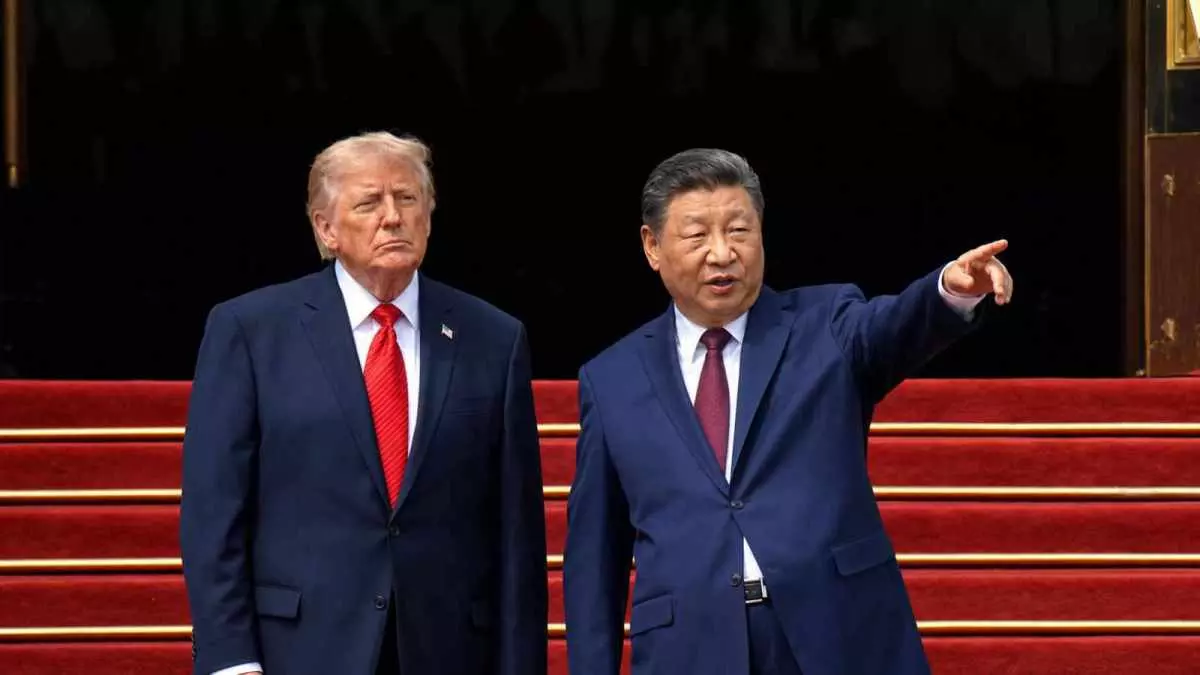
The much-awaited summit meeting between China’s President Xi Jinping and US President Donald Trump took place in Beijing on May 14-15, as the war in the Middle East was on “pause”, but not over. Coincidentally, the 11-member Brics’ foreign ministers’ meeting was being held in New Delhi simultaneously. Prime Minister Narendra Modi also embarked on his five-nation visit to the UAE and Europe on May 15. The global focus, however, was on the US-China Beijing interaction.
Observers noted the contrasting body language of the two leaders. President Trump appeared extra conciliatory. When introducing to President Xi the dozen-plus American chief executives accompanying him, he obsequiously observed they had come “to pay respect to you, China”. President Trump continued the appeasement, saying “you are a great leader”. He later claimed that President Xi had become “really a friend”, with whom he had “settled a lot of different problems”. President Xi, on the other hand, maintained a restrained but firm stance, especially on Taiwan.
The summit followed almost a year and a half of confrontation between the two economic giants. President Trump had with him the leaders of top US companies like Tesla, Nvidia, etc. China, on the other hand, kept its companies like the major automotive player BYD and emerging Artificial Intelligence giant DeepSeek in the background. Each side, however, articulated suitably their own priorities.
The US agenda included normalising the supply of Chinese rare earths, restoring the sale of US agricultural products, especially soya beans, getting China to endorse the Strait of Hormuz re-opening and have Iran accept the US ceasefire proposals. China had restricted the supply of rare earths in response to the US tariffs on Chinese exports as well as restrictions on Chinese investments in the US and the transfer of US technology to China.
The Chinese approach is best articulated in the statement of its foreign ministry. It opens by saying the contemporary global transformation has not been seen in the last century. It terms it as “fluid and turbulent”. Hence, China is seeking “constructive strategic stability” in its relations with the United States. Taiwan, as President Xi emphasised, is the most important issue for China. The US and China, it adds, are “the most powerful countries of the world”. They can, therefore, “do big and good things both for themselves and the world”. This is clearly a redefining of the world as a new G-2 construct, in which all other countries have subordinate roles.
India has always feared such a convergence, between the US and China. It negates the old argument that India was vital for America as a counterweight to China. Before analysing the overall impact of the summit, first an assessment of each side’s priorities is necessary.
Between President Trump’s interviews and US media briefings, the following claims emerged. First, that China will be buying 200 Boeing planes and 450 General Electric engines. Also, China will import $10 billion worth of US agricultural products. China, it was claimed, also agreed to help the US end the war with Iran, resolve the nuclear issue and open the Hormuz Strait. However, when the Chinese side was asked to comment on these claims, the replies were evasive. China also has not given any public commitment to free the export of rare earth minerals.
On Taiwan, however, China was openly assertive. It warned that any escalation, if handled poorly, could create “an extremely dangerous situation”. China also introduced the “Thucydides Trap” theory, based on the ancient rivalry between a rising Athens and already dominant Sparta, resulting in the Peloponnesian war.
Misunderstanding the implied decline of American power, President Trump simply blamed his predecessor, President Joe Biden. Regarding the proposed sale of weapons and other military gear to Taiwan, pending with his office, President Trump refused to clearly indicate whether he would approve the sale or ignore it.
China, at present, faces serious obstacles in investing in the US. For instance, from $45 billion in 2016, Chinese investments in the US have dropped to $3 billion in 2025. Similarly, Chinese clean energy technology and electric vehicles face sundry obstacles. A $2.4 billion electric battery factory in Michigan has been cancelled. A board is proposed to oversee the reduction of US tariffs on $30 billion worth of Chinese goods.
Similarly, on the Iran issue, the two sides have differing public stances. President Trump’s claim about President Xi offering help to end the Iran war was ignored by China. The Chinese suggest that the nuclear and other issues can only be resolved by accommodating “the concerns of all parties”. China had earlier presented a four-point plan, proposing lasting security and shared development in the Persian Gulf region. The Chinese foreign ministry reiterated its old position that the Iran war “should not have happened in the first place”.
The New York Times observes that the images of a “deferential American President and a confident Chinese leader” indicate Chinese success. President Trump has invited President Xi to the White House in September. The two leaders would also be meeting on the sidelines of the G-20 summit.
The issue being widely debated is whether the camaraderie in Beijing can last. Some observers note that after similar warmth during the 2017 Beijing summit, the relationship soon relapsed into bitterness.
Nvidia boss Jensen Huang had accompanied President Trump, with the sale of their H200 chips to China having been earlier approved. Yet China showed little interest in him, arguing that they were focused on indigenous production.
A comparison to India-US relations is unavoidable. The Indian reluctance to defy the United States, even when requiring Russian or Iranian oil, shows India lacking retaliatory options. China, by denying rare earths, could threaten US defence and aerospace systems, semiconductors and electronics, and green energy and the automotive industry. With the G-2 construct now looming, Indian foreign policy must anticipate and adapt to a mutating global order. Prime Minister Modi’s stopover in the UAE and open strategic alignment amidst the temporary ceasefire is one such move. But diplomacy must go beyond that. Almost simultaneously, the Iranian foreign minister in New Delhi, ignoring Mr Modi’s Abu Dhabi halt, urged India to not abandon Chabahar.
Thus, widened engagement, including with Pakistan, as the RSS quite correctly advises, is mandatory. That is the only way to counter the perils of the emerging G-2, born out of the US-China handshake.
The writer is a former secretary in the external affairs ministry. He tweets at @ambkcsingh
