India wasn’t an American priority and a meeting might have disappointed Indians fed on propaganda about this country being the “Vishwa Guru”, or Global Teacher.
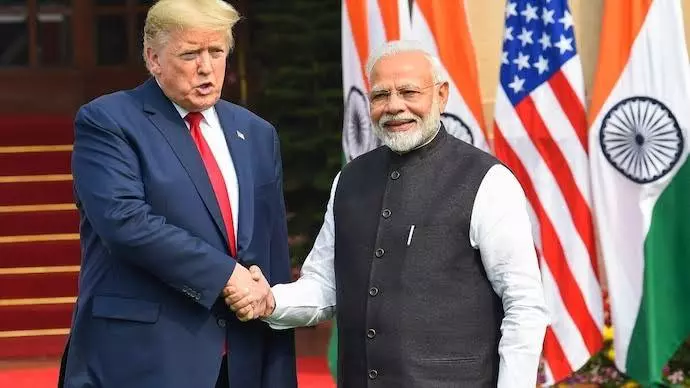
It’s just as well that, resisting the temptation to hobnob with the great and the good, Prime Minister Narendra Modi skipped the chance of an encounter with US President Donald Trump at the Association of Southeast Asian Nations summit in Kuala Lumpur recently. India wasn’t an American priority and a meeting might have disappointed Indians fed on propaganda about this country being the “Vishwa Guru”, or Global Teacher.
Indeed, disagreement seemed inevitable after the Congress general secretary in charge of communications, Jairam Ramesh, announced that Mr Trump had aired his claim of brokering peace between India and Pakistan no fewer than 56 times since the May 10 ceasefire agreement. Given that repetition of a boast that New Delhi -- if not Mr Modi personally -- denies, the Prime Minister is unlikely to have been amused if Mr Trump had unilaterally raised his score to 57. Instead, Mr Trump identified his global partner by defining the world as “G-2” -- the People’s Republic of China replacing the Soviet Union in a new binary equation -- while China and the United States swapped tariffs on fentanyl for more rare earths, the give and take extending to soybean purchases and a shipbuilding investigation.
New Delhi may have yearned to participate in transactional diplomacy but it was China that was courted even though President Xi Jinping warned the leaders of the 21 Asia-Pacific Economic Cooperation countries at the Gyeongju summit in South Korea against American attempts to discourage them from buying from China. All the more reason for Indian chagrin at Mr Trump calling his summit meeting with Mr Xi at an airbase in South Korea a “great success” and giving it “12 out of 10” marks.
Indian grumbling is usually less substantive and more emotive, reflecting the conflict between private aspiration and an austere rectitude that has been the supposed national ideal ever since Mahatma Gandh demonstrated that poverty, too, can be expensive. Although the US Green Card is often called the most prized dowry that an Indian boy or girl can bring to a marriage, it’s fashionable to decry it in public. “When I call on Cabinet ministers, the President, or governors, they all love to talk about their sons, sons-in-law and daughters in the United States and how well they’re doing and how well they like things,” mused William B. Saxbe, US ambassador to India in the 1970s. “The next day I read in the papers the very same people are denouncing the United States as a totally different kind of country.”
It was the same with Israel, which was for years a non-country for Indians. India’s hard-pressed armed forces and intelligence services sought Israeli help in 1962 and Israel’s David Ben-Gurion overcame his initial disinclination and responded to Jawaharlal Nehru’s appeal by despatching enough 120-mm Tampella mortars plus ammunition and spares for two regiments. Many such instances can be cited. When a Communist mayor of Calcutta wanted to twin his city with San Francisco, the surprised American consul-general reminded him that the city was already twinned with Odessa. “Yes, but my son is studying in California”, was the bland explanation of a mayor who needed a politically correct reason for family holidays in the US at public cost. How could Americans take seriously the moralising of a minister whose son was angling for a Green Card? Or the strictures of a diplomat who pulled every string to extend his Washington posting? Nehru’s worldly sister, Vijayalakshmi Pandit, who lived a privileged life as the president of the United Nations General Assembly, found the US “a difficult country”, but enjoyed every minute of living there.
Disinformation like exciting “revelations” in a Communist Party of India publication, I Was A CIA Agent In India, may have helped to shape opinion. But the authorities needed little persuading to brand the United States Information Service, which ran the only worthwhile libraries in India, a nest of spies, treat American scholars and missionaries as subversives, investment as economic penetration, and small magazines like New Delhi’s Thought and Pratap or People in Bombay as instruments of ideological warfare. Even Nehru’s other sister, Krishna Hutheesingh, became suspect when the USIS distributed free copies of the Ladies Home Journal, in which she had written an autobiographical article that had displeased her brother. In 1955, John T. Bailey of the New York Times spent three months in India trying to obtain permission to print an overseas edition of his paper. He failed.
The $600,000 budget Asia Foundation, as popular with Indians as the USIS, brought conflict to a head although even the vitriolically anti-American V.K. Krishna Menon sought its help for the Indian Institute of International Law. Its beneficiaries included a Gandhian institute in Ahmedabad, a Calcutta history project, a municipal affairs programme in Hyderabad, and the Indian Institute of Mass Communication in New Delhi. Distinguished lawyers and scholars with unimpeachable credentials profited from the foundation’s scholarships and travel grants. But the revelations in early 1967 that the foundation had received CIA funds demonstrated that even paranoids have enemies.
Ordered to pack his bags, Richard G. Heggie, the foundation’s representative, went out with flags flying. Amidst a series of farewell parties that the high and mighty attended, there was even a three-minute farewell call on the Prime Minister who was at her gracious best. “I know Asia Foundation did some good things,” were Indira Gandhi’s last words to Heggie.
The nature of the relationship has changed. India is no longer an international supplicant. Indians no longer comprise the world’s most determined migrants. But India still ranks only 130 out of 193 countries in the UNDP’s Human Development Index, and the “Vishwa Guru” label seems an empty boast while 15,75,780 young men fight and squabble for a mere 4,543 jobs as junior police officers in Uttar Pradesh, supposedly India’s most prosperous and best-run state, and the key to its future.
No wonder Mr Trump celebrated his meeting with President Xi by claiming the G-2 appellation for the world’s two biggest economies. No third country is in the picture, and India wasn’t qualified even to attend the Gyeongju summit as the Big Two pow-wowed. Asked why Apec had rejected India, a Japanese diplomat once explained that regional members were all former Japanese colonies. He demurred at accepting Japan’s November 6, 1943 transfer of the Andaman and Nicobar Islands to the Indian National Army whose leader, Netaji Subhash Chandra Bose, has renamed them “Shaheed” and “Swaraj” as constituting independence.
