Seventeen years after the 2008 Malegaon bomb blast claimed six lives and injured nearly a hundred, we still don’t know who did it.
Seventeen years after the 2008 Malegaon bomb blast claimed six lives and injured nearly a hundred, we still don’t know who did it. Justice has not just been delayed and denied — it has been sacrificed at the altar of political expediency — as major political parties continue to use the trial court verdict to settle scores over the “saffron terror” narrative.
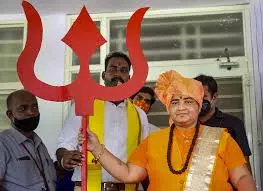
From the very beginning, the investigation became a political flashpoint. The Maharashtra Anti-Terrorism Squad (ATS), led by the late Hemant Karkare, arrested individuals linked to the right-wing Hindu group Abhinav Bharat, including Sadhvi Pragya Singh Thakur and Lt Col Prasad Purohit. It was the first time a Hindutva-aligned organisation was implicated in a terrorist act.
The Congress and its allies seized the moment to coin the term “saffron terror”, using it as a political weapon. The BJP, in turn, condemned the label as an insult to Hindu sentiment and accused the ATS of acting at the behest of its political masters. Both sides exploited the investigation hoping for electoral gain.
Muslim organisations had welcomed the ATS arrests, viewing them as long-awaited justice. When Karkare was later killed in the 26/11 Mumbai attacks, an attempt was made to link Hindutva forces to it. The unsubstantiated claim further politicised the tragedy. Later, a road in Malegaon was named after Karkare, which was also a politically motivated move.
After the national regime change in 2014, the investigation took a different approach. It was transferred to the National Investigation Agency (NIA), which soon dropped charges against several key accused and declared there was no conclusive evidence. Witnesses turned hostile. Forensic findings were revised. The explosives, initially reported to contain RDX, were later said to have shown no trace.
Former Special Public Prosecutor Rohini Salian, who was eventually replaced by advocate Avinash Rasal, alleged publicly that she was told by the NIA to “go soft” on the accused after the BJP came to power. Opposition parties accused the agency of becoming a political tool, rather than a neutral institution dispensing justice.
Amid this political tug-of-war and shifting narratives, the truth was lost, and the families of the victims forgotten. For them, the court’s verdict is not closure; it only deepens their trauma. The prolonged investigation, procedural failures, and political interference have left glaring questions unanswered.
If the arrested individuals were falsely implicated, who planted the bomb? Was the prosecution’s failure a result of incompetence, or intentional sabotage? Do our institutions have the resilience to resist political pressure and uphold truth even when it’s inconvenient? The Malegaon case has become a sad tale of how terror investigations can be manipulated, how narratives are rewritten, and how justice can be sidelined by electoral calculus.
It is not an isolated failure. It mirrors the trajectory of the 2006 Mumbai train blasts case, where all 12 accused were acquitted after 19 years. These cases reflect a broader pattern of dysfunction in India’s judicial process in terror-related cases, where trials drag on for decades, evidence is compromised, and public faith is eroded. Justice, in its truest form, requires more than just arrests and convictions — it demands facts, integrity, and above all, accountability