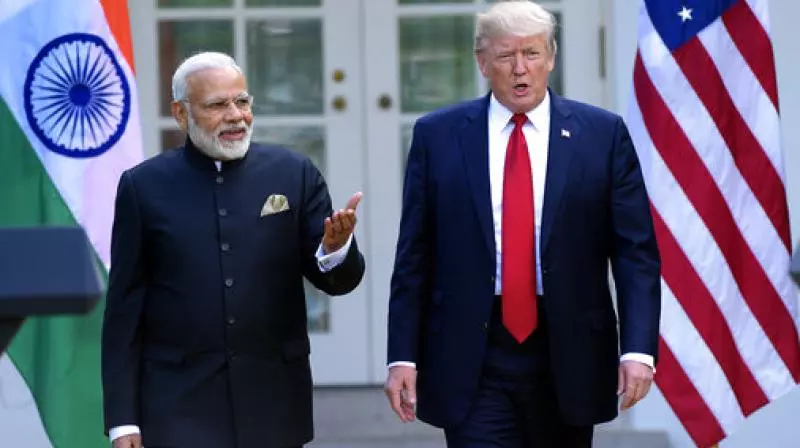
The Narendra Modi-Donald Trump friendship saga continues. The restarting of trade talks on the eve of the Prime Minister’s birthday may have been a coincidence, but there was no doubting the genuineness of the feeling of mutual admiration that spilled over into their exchange of greetings over a phone call about Mr Modi’s milestone day. Whether that will lead on to a trade deal, and soon, too, is a different matter.
Trump’s accent was on Mr Modi’s supporting role in trying to end the Ukraine war whereas Mr Modi emphasised on taking the Indo-US comprehensive and global partnership to new heights. Is there a distinction to be discerned there in the objectives of the two leaders? It does appear that the prospect of resetting ties with an eye on the overall strategic relationship is brighter than arriving at a comprehensive trade deal quickly.
The political lead given to the resumption of trade negotiations by the friendly messages exchanged by the leaders on a phone call, the first one since the imposition of tariffs plus secondary sanctions amounting to 50 per cent on Indian goods, may impel more intense efforts to get past the obstacles. And yet there is no denying the fact there are red lines neither India nor the US can cross to make a full trade deal possible.
The basic premise that India will not or cannot buy US corn nor will not or cannot stop buying Russian oil will probably be the biggest stumbling block. Even if political signals are plenty to try and ease off rigid positions, there is no way India can justify opening the agriculture sector that would endanger the lives and livelihood of 700 million people dependent on dairy and food grain farming.
Unless global oil prices drop to levels nullifying the financial advantage of Russian oil prices, India will have to continue buying the oil that is also refined down to diesel, which even Ukraine has been buying. But pointing out the double standards as Europe buys Russian gas and refined oil products to a whimsical US President would be to risk his going off on a tangent again from his current position of stressing that India and its Prime Minister are his very good friends.
There are other issues that are also to be viewed as impediments even as a promise of accelerated trade negotiations are in the air. The US has expressed concerns over India’s quality control that it sees as a non-tariff barrier even as it seeks tariff parity across sectors. India has, of course, offered to cut tariffs on all American industrial goods, but only if India’s red lines on its protected sectors are not crossed.
It is hard to see much progress on the Russian oil front if the US does not drop the secondary sanction of 25 per cent, but that would be a political decision rather than an economic one. Unless the Ukraine war comes to an end, with India helping Vladimir Putin to realise that this is not the era of war, it is hard to see a happy conclusion in quick time. Of course, a limited trade deal in specified sectors is possible soon if only to satisfy the positive signals from the White House and the Prime Minister’s Office.