The timing is significant -- just weeks before the West Bengal state Assembly elections, which the BJP is desperate to win. No wonder then that Ms Banerjee has led a protest rally, filed complaints with the police, challenged the raids in the Calcutta high court and announced plans to gherao the Election Commission office for alleged voter list manipulation.
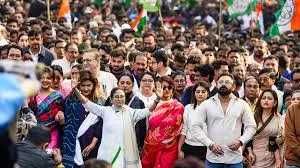
West Bengal chief minister Mamata Banerjee has claimed that her political detractors have “awakened” her. “I feel rejuvenated”, she declared, leading protests against the Enforcement Directorate (ED) raids on her party’s political consultancy firm I-PAC.
The incident has allowed her to return to her favourite “street fighter” role. She claims that the ED raid was an attempt to steal her party’s electoral plans on the eve of Assembly elections in the state. The raid on a political consultancy firm is fairly unusual, although there is no independent evidence of the ED having stolen election management data belonging to the Trinamul Congress (TMC).
The timing is significant -- just weeks before the West Bengal state Assembly elections, which the BJP is desperate to win. No wonder then that Ms Banerjee has led a protest rally, filed complaints with the police, challenged the raids in the Calcutta high court and announced plans to gherao the Election Commission office for alleged voter list manipulation. Combining institutional push back with mass mobilisation, she has framed the events as an attack on democracy and federalism. Ms Banerjee is trying to create a narrative of vendetta. Even if no election strategy related data was stolen, the optics of raiding a political consultancy firm on the eve of elections is likely to fuel the suspicion that confidential data could have been compromised. Ms Banerjee’s allegation is, therefore, politically understandable.
It is also a credible narrative as the Narendra Modi government’s record of using the Central investigative agencies on the eve of state and Lok Sabha elections is well-known.
Between 2014 and 2019, several Congress leaders were raided by the Central agencies on the eve of state and Lok Sabha polls. The demonetisation of 2016 was perceived by many Opposition leaders as an attempt to cut off the Opposition’s funding channels, months before the Uttar Pradesh elections. The BJP knew that elections in India have traditionally relied heavily on cash for mobilisation, logistics and patronage and that the sudden invalidation of Rs 500 and Rs 1,000 notes would disrupt these flows. The party allegedly had already adjusted its own finances, presumably because of prior knowledge, and it swept the Uttar Pradesh elections.
In 2019, on the eve of the Lok Sabha polls, the Kolkata police commissioner, considered close to Mamata Banerjee, was raided by the CBI. In Karnataka on the eve of bypolls in 2020, Congress leader D.K. Shivakumar was raided.
The pattern of raids by Central agencies on the eve of polls was repeated in state elections as well. In 2020 in Bihar, several Rashtriya Janata Dal leaders were raided; in 2021 in West Bengal Ms Banerjee’s nephew Abhishek Banerjee was raided by the CBI in the coal smuggling case; and in Maharashtra in 2022 Shiv Sena and Nationalist Congress Party leaders were targeted. The Central agencies were particularly active before the state Assembly elections of 2023 conducting raids in Rajasthan on Congress leaders, targeting K. Kavitha of the Bharat Rashtra Samithi in Telangana and several DMK leaders in Tamil Nadu, and arresting Hemant Soren in Jharkhand. In addition, in 2023, Aam Aadmi Party leader Manish Sisodia was jailed in an excise case before the Municipal Corporation of Delhi polls.
A cluster of raids just before polls disrupted Opposition campaigns. A National Herald tracker shows that since 2014, the ED investigated 121 political leaders, of whom 115 were from the Opposition parties.
Ms Banerjee’s suspicion about the I-PAC raid, therefore, is consistent with a template of weakening the Opposition before elections. This decade-long pattern, its timing, selectivity and optics deepen the perception that Central investigative agencies have been weaponised by the Modi government. In 2024, 14 political parties had petitioned the Supreme Court alleging the misuse of investigative agencies only to be told that political parties cannot be immune from investigation. However, Ms Banerjee is probably quite right in thinking that voters tend to believe the political narrative rather than the legal one.
She has, therefore, used the raid on I-PAC to create a “victimhood vs power” narrative. Ms Banerjee has consistently used such confrontations with the Centre to frame herself and her party as victims of the Central government’s vendetta. The tactics of rallying supporters through protests, marches and public campaigns is a hallmark of her political style in election season.
She did it in the case of the 2019 raid on the Kolkata police commissioner, in 2021 when ED and CBI actions linked her party leaders to coal smuggling cases and in 2023-24 took up the case of Jharkhand and Delhi, to weave a broad narrative of Central agencies victimising the Opposition.
This strategy works for Ms Banerjee because it positions her party as the underdog fighting government overreach. Most importantly, it allows her to negate anti-incumbency of 15-years -- if the party leaders adopt an anti-establishment narrative they can direct public anger against the Centre. She is also able to project targeting by the Centre as an attack on Bengali identity -- thus the iconic song sung by her supporters during the protest, Ami Bangalay Gaan Gai, written by Pratul Mukhopadhyay, expressing deep concern for the Bengali language, culture and identity. She has also situated herself and her party in the long culture of protest politics in West Bengal. The raids so close to the election are likely to ginger up her party cadres who will see them as an existential threat.
Surely, the Narendra Modi government must have factored in such a possible fallout. That it still went ahead with the raids suggests either nervousness or recklessness. Nervousness, because the BJP faces strong resistance in West Bengal, is apprehensive of the TMC’s organised campaign and wants to pre-empt its electoral strategy. And reckless, because raiding a political consultancy firm like I-PAC is akin to raiding a party office. If that perception spreads it could make the raid counter-productive.
Whatever drove the decision, it turned out to be a reckless one with Ms Banerjee being able to turn the tables and converting the ED’s action into political advantage.
As of now, this round seems to have gone to Ms Banerjee. Her party seems to be moving from initial outrage to organising ground mobilisation, while her political messaging has become stronger, combative and media savvy. She has been careful to simultaneously opt for a legal process, expressing faith in the judiciary, to avoid being branded lawless. This is however, only the first major exchange of salvos as the election season warms up in West Bengal. There will be more to come.
The writer is a senior journalist based in New Delhi