India’s partnership with Axiom Mission 4 is crucial, as it prepared Shukla to lead the country’s human space mission, Gaganyaan, in 2027. The experience gained through Shukla’s training with Nasa and SpaceX, including real-time crew–ground coordination and the endurance of the physiological effects of spaceflight, has equipped Indian agencies with insights that would have otherwise taken years to accumulate
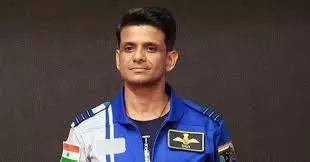
As Group Captain Shubhanshu Shukla emerged from the spacecraft Grace after his successful 18-day mission to the International Space Station (ISS), he became far more than just India’s first space traveller in four decades. He emerged as the new face of India’s space ambition and became an inspiration for children and students.
Shukla’s space voyage marks a significant turning point in India’s space journey, which began in 1984 with Rakesh Sharma’s flight into space aboard the Soviet Union’s Soyuz spacecraft. However, the current space journey is qualitatively different from the 1984 mission, as Shulka represents a new India that has emerged as one of the major global powers.
India’s partnership with Axiom Mission 4 is crucial, as it prepared Shukla to lead the country’s human space mission, Gaganyaan, in 2027. The experience gained through Shukla’s training with Nasa and SpaceX, including real-time crew–ground coordination and the endurance of the physiological effects of spaceflight, has equipped Indian agencies with insights that would have otherwise taken years to accumulate.
Apart from helping India gain real-time knowledge about space voyages, Shukla’s mission may well serve as a psychological booster for new generations to take up careers in science and technology. His images and videos from the ISS could serve as an inspiration for lakhs of young minds in India.
At several schools across the country, space clubs were formed, and science teachers reportedly discussed microgravity, which was one of the subjects Shukla experimented on at the ISS. The ripple effect is undeniable: India’s next generation is now dreaming not just of becoming engineers or doctors, but astronauts, astrophysicists and space entrepreneurs as well.
With Beijing having bigger plans for space, India cannot remain uninterested, both for the sake of its youth as well as for accessing the best technologies in the world. Even if a fraction of the students who have been inspired by this mission choose space sciences or space entrepreneurship, India’s future as a leading space power will be much more secure.
A successful space mission, while enhancing India’s global standing, could also help the country perfect several military technologies, which are widely used in space missions.
The dual-use technologies involved in the mission could be applied in secure military communication, navigation, remote sensing, border surveillance, defence gear, HVAC systems, protective clothing and electronics cooling, submarines, heat-resistant lightweight materials for protective shields, high-altitude aviation, robotic arms, military drones, bomb disposal robots, military surveillance equipment, and defence command systems, among others.
The space mission could also equip India, which houses a sixth of the world’s population, with several technologies that could improve its healthcare, agriculture as well as industry. An example of an exclusive military product that runs the whole world now is ARPANET, which is known as the Internet today.
Shukla’s space mission will also contribute to India building its own space station by the 2030s and achieving a moon landing by 2040. His mission may have lasted just 18 days in orbit, but its impact on Indian youth, science and policy will echo for years to come. While Shukla has just returned to Earth, India’s space ambitions have achieved the true liftoff.
