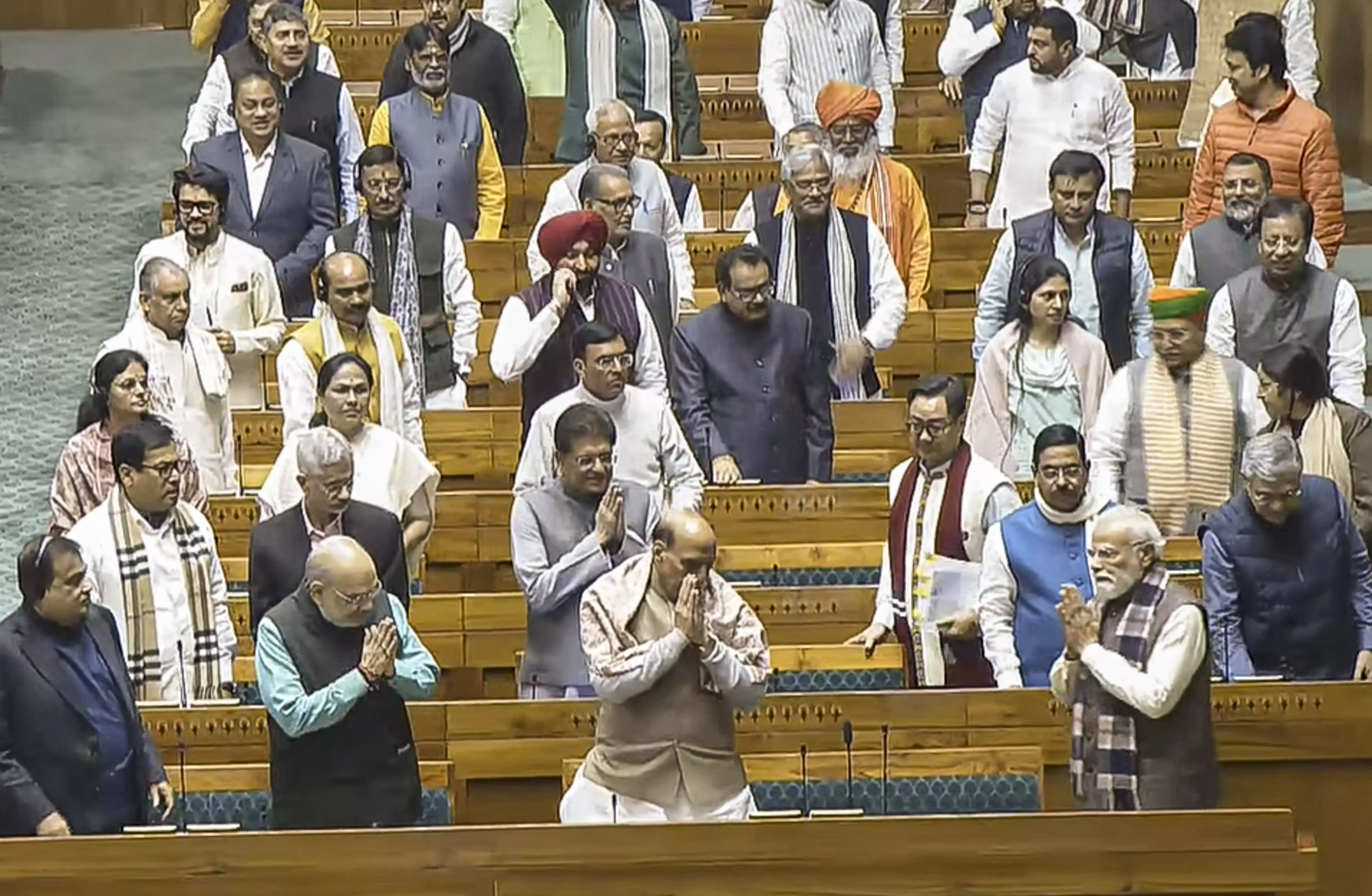
Discussions on the national symbol should ideally leave the country more united than before, but the BJP’s attempt to discover a new controversy on the 150th anniversary of the national song months ahead of the West Bengal Assembly elections has instead seen the saffron party leaders, led by Prime Minister Narendra Modi, trying their hardest to widen the rent already present in the social fabric of India.
The national song as it stands today is the song of all Indians and is sung wherever it is ought to be sung. It portrays, like the Constitution, the vision of a nation that is beautiful and prosperous, with abundant water, air and food, looking after the needs of all. It is an idea shared by every Indian. No one has a quibble with the text, and every Indian holds the song in her heart when she dreams of a better India for her children.
But the Prime Minister and Sangh Parivar have still raised a red flag over the topic of the national song, complaining that it was chopped up by the Indian National Congress, led by Pandit Jawaharlal Nehru, to appease the separatists and conservatives belonging to the Muslim League. And it is true that only two of the six stanzas of the famous poem of Bankim Chandra Chatterjee in Anandamath have been recognised as the national song. But that is the case with the national anthem, too: ‘Jana Gana Mana’, the poem written by Rabindranath Tagore, has five stanzas but only the first has been recognised as the national anthem till date.
There are, certainly, references to Hindu goddesses in the full text of the poem Bankim Chandra Chatterjee published in 1882 and they are not part of the national song. The Sangh Parivar’s consternation at the absence of those references is thus, in some sense, understandable. But then again the Parivar had little role to play in the national movement. Nor did it have any part to play in the institution of the national song. What right does it have then to pointlessly rake up a dead dispute today? It is in fact a redux of the “divide and rule” tactic of the British and should be rejected.
Indeed, the leading lights of the RSS and the Hindu Mahasabha never bore the onerous responsibility of devising a strategy to win India freedom from a foreign ruler. The leaders of the national movement, Gandhi and Nehru, on the other hand, had realised that it will take the effort of every Indian, irrespective of her religion, caste or belief, for India to attain independence. So they might have plumbed for the common denominator that could accommodate most of the population. This pattern can indeed be observed not only in the selection of the national song but also in other movements of the time. It is this spirit of accommodation that prompted a large majority of Indians, who could have found points of difference on every second topic, to ignore those and join hands for a common cause. The BJP will only do well to understand this dynamic of the freedom struggle if retrospectively.
There is no gainsaying that the BJP and the RSS, the party’s ideological fountainhead, are opposed to the idea of compromise and have instead opted for an atavistic idea of India even if it is divisive and weaponises communal hatred ever since they came into the national scene 100 years ago. However, once behind the wheel, they must now be open to the idea of accommodation and discover ways to take this nation ahead as a single entity. The Sangh Parivar must create its own history, instead of attempting to rewrite or hijack it.