Opposition alliance faces internal conflicts even as it targets key national issues
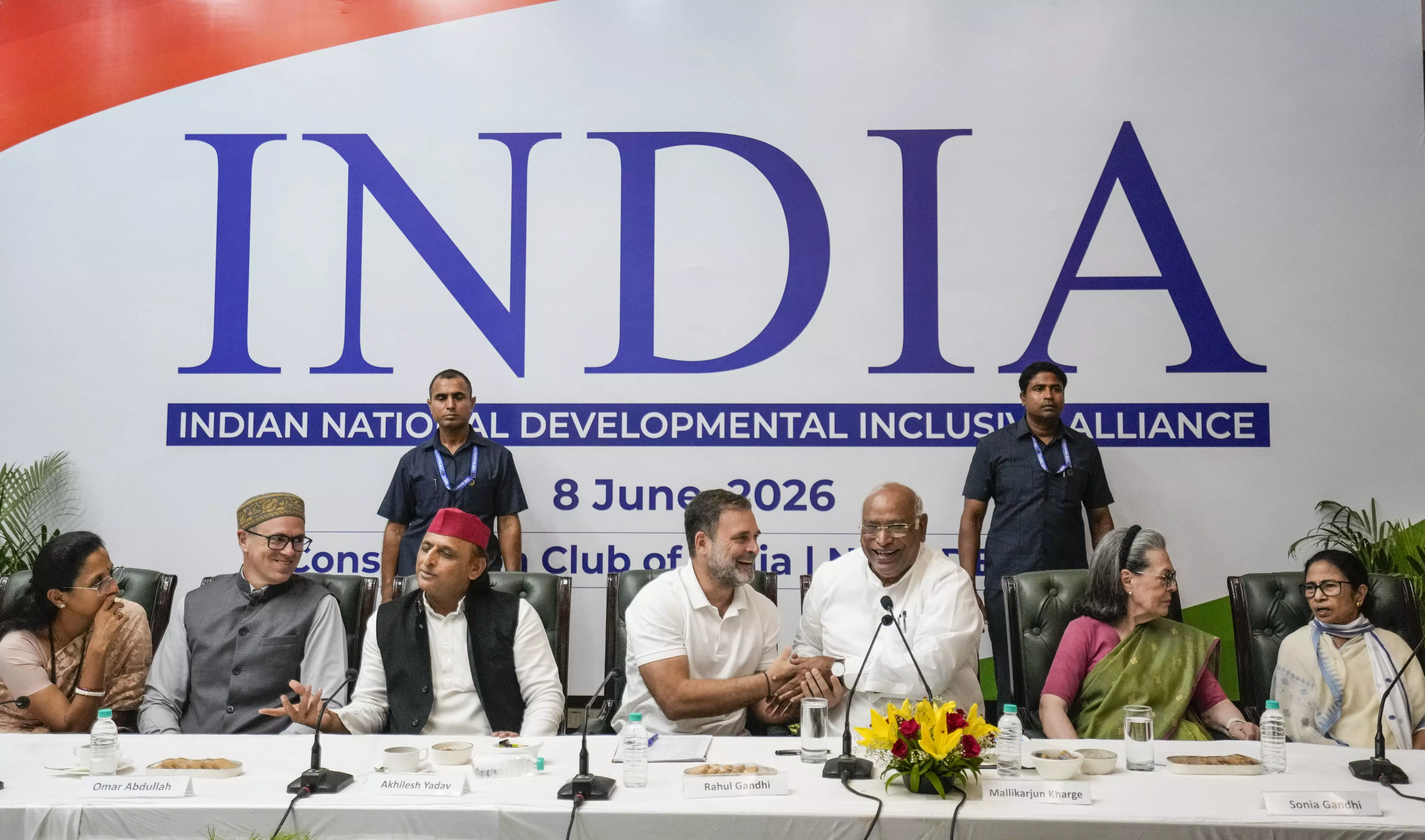
Indian politics today is a paradox of the weird variety: There is a ruling alliance headed by a party obsessed with election victories and always plotting for the next, a disparate group of Opposition parties who run a recreation club called INDIA where they meet occasionally or when partners meet with electoral rout and a people seething with anger against a government teetering even when facing something as routine as an entrance examination, leave alone substantive issues such as economy or the foreign policy.
In normal cases, it is the job of the Opposition to command the attention of the people in a restive polity but the cross purposes at which each of the alliance partners works neutralise their efforts. The meeting of 25 parties in Delhi on Tuesday under the INDIA banner was nothing but a reflection of the fact that it has still not been able to reconcile the contradictions among themselves before taking on the formidable alliance led by the BJP. The Opposition platform indeed sought to address some of the profound issues that the country faces now but its emaciated look sans two major founding allies, the DMK and the AAP, cannot be brushed aside.
A look at the political reality on the ground would convince anyone that the single important factor that makes them form a common platform is their opposition to the BJP’s Hindutva politics. This could naturally lead to a situation in which the partners fight with one other for the same space in the states where they are strong. This would also bring the Congress, the only de facto national party in the alliance, in conflict with their INDIA allies in states. Three years into the formation, the bloc has not been able to make a framework for practically addressing this contradiction.
This explains why the DMK and the AAP are no more with the formation. The recalcitrant and often irrational approach of the Congress in Tamil Nadu, Delhi and Punjab to reclaim its lost space resulted in the key partners walking out of it; it has left the ally in Jharkhand also miffed that the Congress refused the basic courtesy of consulting it before taking as important a decision as fielding a candidate for the Rajya Sabha. The Left, the natural partner in an anti-BJP alliance, is upset because senior Congress leaders went to Kerala and alleged that the LDF there and the BJP are in an electoral deal.
Every one of the five issues that the bloc has identified is critical for the people, and the Opposition must hit the streets and make the government see reason. The series of lapses in the education sector has the youth seething with anger; the SIR has undermined the constitutional principle of adult suffrage and the economy is saddled with serious issues that may need urgent fixing. Better parliamentary coordination is required to make the most of the opportunity during sessions. A functional Opposition is a critical requirement of a functional democracy and it is welcome if the INDIA bloc can provide one. But to take on the BJP electorally is a different task; the Congress-led group will have to work overtime and with unity of purpose if it were to achieve that goal.