The tales of young survivors who were away at school while the rest of their families were swept away would bring tears to the eyes. The plight of around 4,500 people who have been rendered homeless after the ice-rock avalanche crashed to the Himalayan valley with a bang and exhibited the raw power of nature in a 40-foot tsunami of mud, rock and debris, which swamped the Chinese immigration centre in the Gyriong Port, renders this a heartbreaking episode of contemporary history
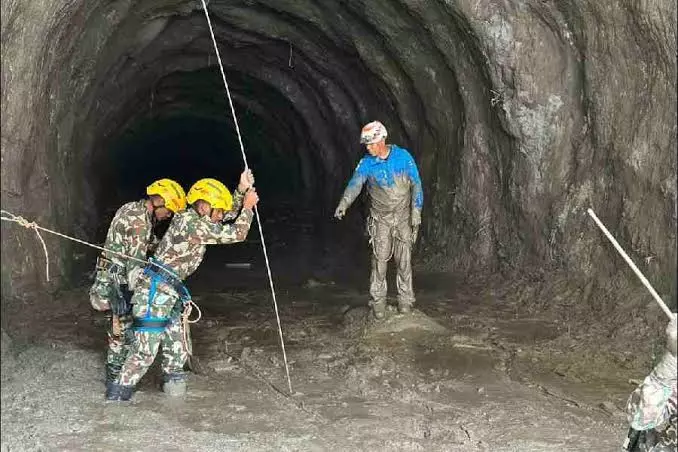
Humanity can be said to alive and kicking considering how hard rescuers are trying to get to the last possible man or woman standing in the tunnels or lying buried in the mud after the Bhote Koshi river carried floodwaters downstream on Aug. 26, washing away dreams of young people while taking lives indiscriminately and sweeping away homes, roads and bridges.
Keeping aside thoughts of their comforts and their lives for the moment, rescuers have been doing a herculean job trying to give anyone still alive after 12 days of the biggest ever tragedy to have struck Nepal-Tibet, the toll of which is still being counted, with the toll past 1,300 in terms of body counts but 5,500 people still missing. The toll on the Tibet side in China, appears lesser, at 21, but there are at least 500 missing.
The tales of young survivors who were away at school while the rest of their families were swept away would bring tears to the eyes. The plight of around 4,500 people who have been rendered homeless after the ice-rock avalanche crashed to the Himalayan valley with a bang and exhibited the raw power of nature in a 40-foot tsunami of mud, rock and debris, which swamped the Chinese immigration centre in the Gyriong Port, renders this a heartbreaking episode of contemporary history.
Amid the story of death and destruction, what stands out is that more than 13,000 people have been rescued and no one has given up yet on finding more survivors, however bleak the scenario looks. According to experts and Nepal officials, there is reason to believe that at least 100 people may still be alive in 12 hydropower tunnels.
What kind of cataclysm is this that carries away people on a pilgrimage, or a trekking holiday, or simply at home in the relative cool of the Himalayas and just hoping to see how their life goes to the end of another quotidian day. Many of the kin of those dead or missing may not find closure for weeks, or months, or even years as the haunting story of a possibly human existence-induced calamity lingers.
The cost of reconstruction on the Nepal side, estimated at around $2.5 billion plus 50 million in rescue efforts pales in comparison to the human suffering. Will the tragedy help humans understand how their interventions are leading to climate change and consequent global warming is the question. And we don’t know yet what suffering the ‘Super El Nino’ will bring in its wake soon.