The recent violence along the Assam-Arunachal Pradesh border is a useful reminder. The two states have been trying for years to settle competing claims over villages and territory; the dispute has periodically produced local confrontations despite political negotiations and a 2023 agreement that resolved a substantial portion of the contested areas
Calling Arunachal Pradesh, Assam, Manipur, Meghalaya, Mizoram, Nagaland, Sikkim and Tripura the “Northeast” is geographically convenient, administratively useful and strategically unavoidable. But politically and socially, the term can be deeply misleading. It suggests a degree of commonality that does not exist. The eight states occupy a contiguous space on the map, share several historical experiences and face common challenges of connectivity, remoteness, border security and economic underdevelopment. Yet they are divided by ethnicity, language, competing territorial claims, distinct constitutional arrangements and sharply divergent political interests. The Northeast is, therefore, real as a geographical and policy category, but much less real as a single political community.
The recent violence along the Assam-Arunachal Pradesh border is a useful reminder. The two states have been trying for years to settle competing claims over villages and territory; the dispute has periodically produced local confrontations despite political negotiations and a 2023 agreement that resolved a substantial portion of the contested areas. Assam has similarly longstanding boundary disputes with Nagaland and Mizoram. Assam’s official records themselves describe disputes with several neighbouring states, underlining how the supposedly unified Northeast contains multiple unresolved territorial fault lines.
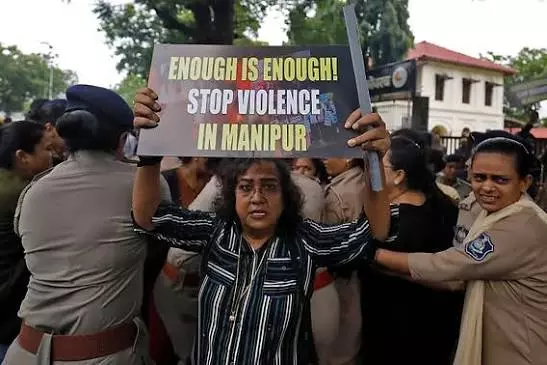
Manipur demonstrates the problem even more starkly. Its conflict, which began principally as a Meitei-Kuki confrontation in 2023, has entered its fourth year and acquired another dangerous dimension: conflict between Kuki-Zo groups and Nagas. Recent clashes, hostage-taking and blockades have shown that the ethnic geography of Manipur cannot be reduced to a binary Meitei-Kuki divide.
What must also be noted is that each state has its own political vocabulary.
Assam is the demographic, economic and logistical hub of the region, but its interests often collide with those of its neighbours. It is simultaneously concerned about immigration, land and forest protection, resource extraction, floods, river management and its disputed boundaries with Arunachal Pradesh, Nagaland, Mizoram and Meghalaya. For Assam, the Northeast often means a region in which it must defend its own territorial and demographic interests.
Arunachal Pradesh, by contrast, is overwhelmingly shaped by its long frontier with China, its sparse population, tribal land systems, connectivity deficit and hydropower potential. Its relationship with Assam is not always one of regional solidarity: Questions of historical territory and control over villages can become matters of acute local sentiment. The state also has a strategic identity quite different from that of the densely populated Brahmaputra Valley. Recent reports of Chinese activity in the Taksing area, rejected by authorities in India as untrue, underline that Arunachal’s security concerns are also directly linked to the India-China frontier.
Nagaland has perhaps the strongest reason to resist being treated simply as one component of a generic Northeast. Its central political question remains the Naga national and political settlement, whose geographical implications extend beyond Nagaland into Manipur, Arunachal Pradesh and Assam. Nagaland’s relationship with Myanmar is equally distinctive because Naga communities live on both sides of the international boundary.
Mizoram has an equally distinctive security and demographic outlook. Its long border with Myanmar, its Mizo ethnic links across international boundaries, particularly in Myanmar, and its experience of receiving refugees have produced concerns quite different from those of Assam or Sikkim. At the same time, Mizoram has its own unresolved boundary dispute with Assam, while its 109-km border dispute with Tripura is also being revived for negotiations. Thus, even two states often portrayed as culturally close do not automatically share territorial interests.
Meghalaya illustrates another contradiction. Its politics are strongly shaped by tribal land ownership, the Sixth Schedule, ecological concerns and resource rights. The controversy over coal mining and the state's opposition to uranium mining demonstrate a tension between local control of natural resources and national development priorities.
Tripura has a different historical trajectory, dominated by the transformation of its demographic balance after Partition and subsequent migration, and by continuing demands for greater recognition of indigenous tribal interests. Its current political concerns are therefore substantially different from those of the Himalayan frontier states. Even Tripura has a live interstate dispute with Mizoram, showing again that regional identity does not erase competing territorial interests.
Sikkim is arguably the greatest challenge to a one-size-fits-all Northeast framework. Its political history, demographic composition and constitutional relationship with India are distinct. Article 371F gives it special protections, while its Lepcha, Bhutia and Nepali communities have developed a particular conception of Sikkimese identity. Its immediate strategic concerns revolve around China, Tibet, Bhutan, Nepal, ecological fragility, tourism and the management of its small Himalayan environment.
That leaves a crucial question: if the states are so different, why retain the nomenclature “Northeast” at all?
The Government of India itself recognises the paradox. The Ministry of Home Affairs describes the eight states as culturally and ethnically diverse, with more than 200 ethnic groups, while identifying common problems arising from difficult terrain, ethnicity, migration, tribal rivalry, resource competition and international borders. These commonalities justify institutions such as the North Eastern Council and the Ministry of Development of North Eastern Region. Infrastructure corridors, digital connectivity, disaster management, tourism, trade with Southeast Asia and border management can also benefit from a regional approach.
The mistake, therefore, is not the word “Northeast”; it is treating the word as a policy prescription.
New Delhi needs to try out a three-layer policy architecture. First, there should be a common Northeast framework for genuinely regional issues: connectivity, logistics, climate resilience, disaster management, cross-border trade, aviation, higher education, tourism and integration with Southeast Asia. Second, there must be state-specific strategies reflecting different constitutional protections, demographic structures, resource regimes and security concerns. Third—and most importantly—the Centre needs mechanisms for managing disputes between Northeastern states. Boundary commissions, shared-resource agreements, inter-state economic zones and permanent conflict-resolution mechanisms may be more valuable than another generic development package.
The Inner Line Permit question captures the larger dilemma. Nagaland, Mizoram and Arunachal Pradesh have historically used protective mechanisms to preserve indigenous interests, while Manipur has also entered the ILP framework. Such arrangements complicate the idea of an unrestricted internal economic region, but they are also rooted in legitimate historical and constitutional anxieties, something that a “Northeast policy” cannot ignore.
The Northeast, then, is neither a complete fiction nor a coherent political unit. It is a shared geographical theatre containing multiple political worlds. The eight states have enough in common to require a regional strategy, but enough differences to make a single uniform policy counterproductive. The Centre should, therefore, stop asking whether there should be a “Northeast policy” or eight separate state policies. It needs both.