Secularism is a political principle where the state treats all religions equally and protects every citizen’s freedom of belief, while pluralism refers to a society where different religious and cultural communities coexist, interact, and respect one another in everyday life
When people in places like Hyderabad call themselves ‘secular’ yet invoke Lewis Carroll’s Alice in Wonderland with cries of ‘Off with his head!’—a phrase born from that world of absurd command and inverted logic—or become associated with communal violence, it reveals not just contradiction but also suggests a perceptual distortion in which the ‘raised’ ideals of identity are repeatedly undone by the ‘razed’ realities of action.
Secularism is a political principle where the state treats all religions equally and protects every citizen’s freedom of belief, while pluralism refers to a society where different religious and cultural communities coexist, interact, and respect one another in everyday life. In that sense, interfaith marriages, celebrating each other’s festivals, and more syncretic ways of living—where people blend, observe, and perform elements of different cultural and religious traditions in everyday life—are personal and social expressions of pluralism, showing openness across religious boundaries, but they are not what defines secularism itself.
There is also a deeper layer to this engagement with culture, one that demands more than visibility or ritual acknowledgment. To observe a festival, to step into another’s sacred space, or to participate in shared traditions carries an unspoken responsibility—to understand its mythologies, its histories, and its emotional weight, rather than reducing it to aesthetic experience or social display. Without this depth, even gestures of inclusion risk becoming hollow, detached from the meanings they claim to honour. Riots and violent threats signal a collapse of pluralism and public order, where tensions escalate into harm, fear, and intimidation, undermining secular values and peaceful coexistence.
In lived experience, including my own in a place like Hyderabad, there can also be a sense of betrayal when some people who publicly speak in the language of secularism or tolerance are perceived to behave differently in practice—through actions like avoiding or restricting shared spaces, defending “their side” uncritically, or contributing to environments where others feel excluded or even verbally attacked.
This creates a deeper feeling of distrust, where ideals like secularism and pluralism feel distant from everyday reality, even though they remain the standards societies claim to uphold. At the same time, these experiences do not define all individuals, and responses within any community vary widely, with some people speaking out against wrongdoing while others stay silent due to fear, pressure, or polarization.
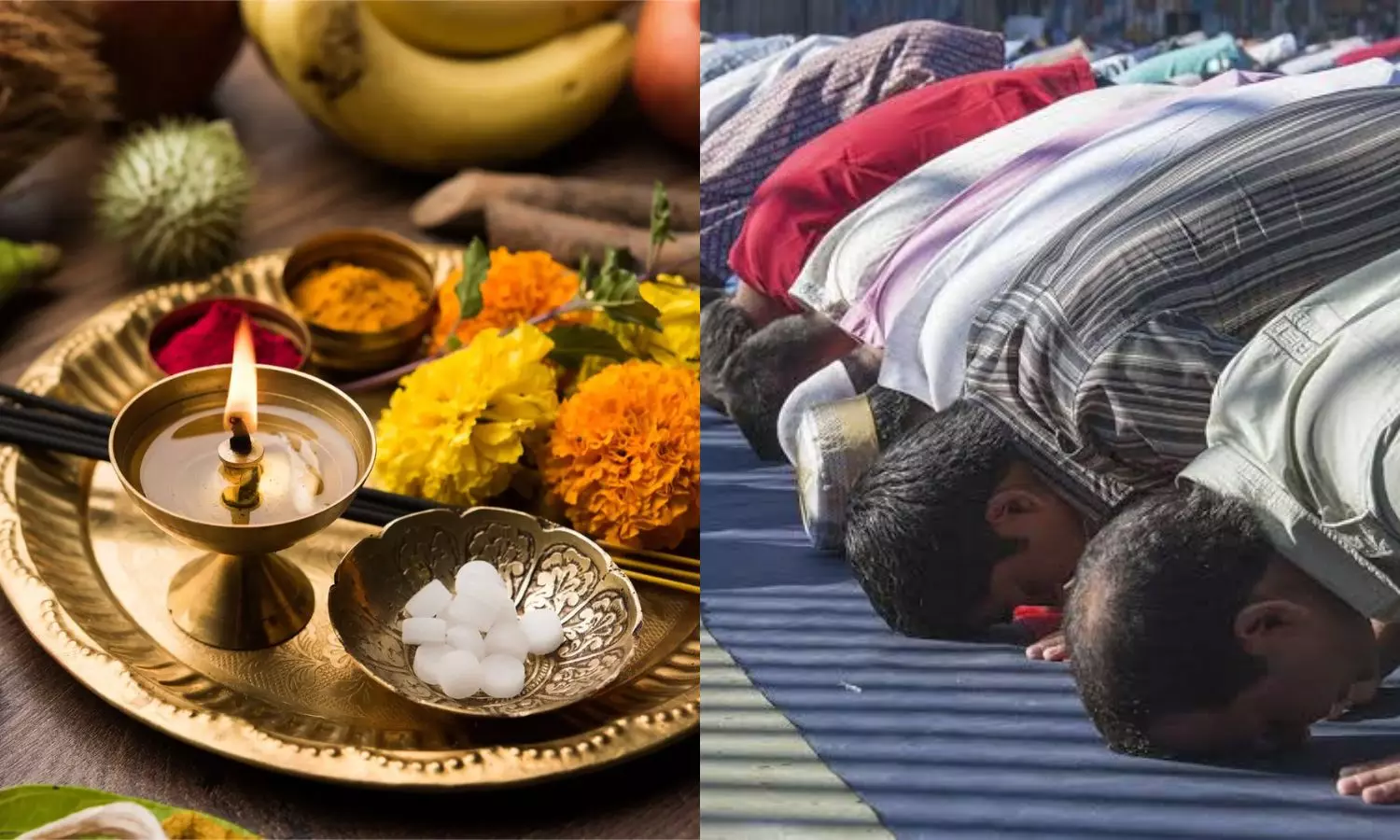
There is a quiet grandeur in the way sacred life is composed across different traditions—temple bells dissolving into air thick with incense; turmeric; ashes and vermillion, where deities are adorned in silk, gold, and gemstones, and offerings of milk trace gestures of devotion older than memory; and mosques where geometry unfolds into silence, where symmetry and floral arabesques hold space for stillness, and rows of prayer align the body into collective rhythm where quartz stones and talismans are worn. One speaks in the language of ornament and abundance, the other in restraint and abstraction, yet both are architectures of surrender, gestures toward something that exceeds the self.
Across these forms runs a more subtle syncretic undercurrent, where belief is not only inherited but lived—observed, blended, and performed in everyday life, often without announcement. There is a kind of cultural grammar here, where gestures, festivals, and shared spaces accumulate meaning beyond doctrine, forming a lived tapestry that is neither fully written nor fully spoken. In this space, difference does not always signify distance; it can also become overlap, a soft continuity where traditions are not merely juxtaposed but quietly interwoven through habit, memory, and proximity.
Even amid tension, small acts of recognition preserve connection—a shared greeting, a moment where reaction could have become rupture, or brief understanding that interrupts assumption. These quiet gestures resist complete separation.
In the period when Urdu was the dominant language of the bourgeois circles in Hyderabad, my grandfather, B. P. R. Vithal was not only fluent in speaking and writing it but also read illuminated manuscripts composed in the language. He later served in the IAS and as Finance Secretary of Andhra Pradesh, and wrote books, including his biography, in collaboration with his friend, Narendra Luther, during a time when rock formations and local flora were regarded as heritage precincts—all of which are now marked like territories of a cat in an urban jungle worn down by time, conflict, and loss.
At the same time, lived experience can carry its own dissonance. In places like Hyderabad, there can be moments where those who speak in the language of secularism or tolerance are perceived—rightly or wrongly in different situations—to act differently in practice: through guardedness around shared spaces, through defensiveness toward criticism, or through silence when clarity might have helped. Such experiences, whether isolated or repeated, can create a sense of betrayal, where trust feels unevenly distributed and where ideals appear more coherent in discourse than in daily life. Yet even this perception exists within a broader and more complex reality, where responses vary widely and cannot be reduced to a single pattern.
And still, beneath these layered contradictions, there remains a shared ground. Across languages of speech, there are also languages of living: the way people eat with their hands in quiet intimacy with food, or serve meals on banana leaves and from shared thalis that hold both austerity and abundance in the same form. In these gestures, eating becomes less an act of consumption and more a cultural rhythm, shaped by memory, geography, and belonging.
There are also other embodied grammars of expression—flowers woven into hair, carried like fleeting offerings; and dance traditions where intricate footwork and precise bodily alignment become instruments of storytelling, rhythm, and invocation, turning movement itself into narrative. In parallel, the material world carries its own aesthetic memory: ceramics shaped by patient hands, block printing that repeats history through pattern, etching that preserves line and shadow, and weaving and stitching that bind labour and imagination into form. These crafts travel through markets and small stores that increasingly frame them within the language of sustainable luxury, where tradition is not only preserved but also reimagined as something contemporary and enduring.
We are, in quiet and continuous ways, always creating such fusions—not as dilution, but as survival and preservation—threads of continuity that hold communities together and render them whole even as they evolve.