Syed Ata Hasnain | Climate & Geology Posing Fresh Himalayan Threats

In October 2023, the South Lhonark lake in Sikkim gave way, sending a wall of water downstream that obliterated the Chungthang dam. By August 2025, flash floods in Dharali near Harsil -- a key transit zone for both troops and civilians -- demonstrated just how quickly mountain waterways can turn violent
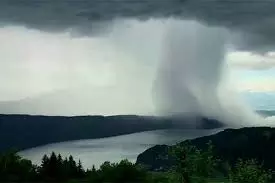
Stretching from Ladakh’s arid heights to Arunachal Pradesh’s green ridges -- and spilling across Nepal, Bhutan and Sikkim --the Indian Himalayan belt is entering an era of heightened climatic stress and geological instability. Once seen as a natural bastion against both external threats and internal upheaval, these mountains are now the stage for overlapping disasters: glacial lake bursts, flash floods, landslides, avalanches and sudden cloudbursts that can transform entire valleys within hours. These hazards ignore political boundaries, seasonal patterns, and sector divisions -- cutting across civilian life, economic activity and national security alike.
The pattern of recent events underlines the urgency. February 2021 saw Chamoli in Uttarakhand hit by a catastrophic flood after a fragment of a glacier collapsed, destroying the Tapovan hydro project. In October 2023, the South Lhonark lake in Sikkim gave way, sending a wall of water downstream that obliterated the Chungthang dam. By August 2025, flash floods in Dharali near Harsil -- a key transit zone for both troops and civilians -- demonstrated just how quickly mountain waterways can turn violent. Such events are no longer statistical outliers; they have become hallmarks of a destabilised Himalayan climate.
Part of the danger lies in the chain reactions they trigger. A single cloudburst can set off landslides, blocking roads, severing rivers and heightening flood threats downstream. A glacial lake failure can wipe out power stations, villages and bridges in a matter of minutes. Avalanches weaken ridgelines, making them prone to further collapses. The combined impact erodes more than just infrastructure -- it erodes confidence in the longevity of mountain development.
These risks span geographies and political borders. Ladakh’s cold deserts now experience glacier recession, thawing permafrost and seasonal flooding. In Jammu and Kashmir, recurring landslides close the Srinagar-Jammu national highway, disrupting both trade and strategic troop movements. Himachal Pradesh and Uttarakhand face the twin pressures of mass tourism and erratic weather, rendering road and tunnel projects more perilous and short-lived. Nepal and Sikkim sit in the crosshairs of glacial lake floods, their transboundary rivers carrying danger across frontiers. Bhutan and Arunachal Pradesh wrestle with rapid-onset riverine floods, made worse by sharp gradients and slow information exchange.
Development choices have often aggravated these vulnerabilities. In the race to improve connectivity and strategic infrastructure, slopes are cut, tunnels bored, and dams raised without adequate geological checks. The Himalayas are young, fragile, and seismically restless; projects not tailored to this reality can destabilise terrain. Even beneficial initiatives -- like year-round roads or rural linkages -- can become liabilities when climate sensitivity is ignored.
For the armed forces, these are more than environmental challenges -- they are operational hazards. Border posts, patrol routes, and supply chains often pass through disaster-prone terrain. A single landslide can isolate a garrison; a sudden flood can erase a critical bridge; an avalanche can block a vital approach road. As India builds to match infrastructure across contested borders, it must also reckon with the possibility that natural forces, not just human adversaries, could sever its lines.
Policy, however, is beginning to adapt. The 15th Finance Commission (2021-26) broke with tradition by embedding climate and disaster resilience directly into fiscal planning. A dedicated Mitigation Fund within the State Disaster Risk Management Funds (SDRMF) allows states to invest in prevention, not just relief -- backed by Rs 1.6 lakh crores over five years. This funding supports hazard mapping, early-warning systems and climate-proofing of assets before crises strike.
This represents a strategic pivot from reaction to anticipation. States have been encouraged to weave disaster risk reduction into urban planning, engineering standards and service delivery. For the Himalayan belt, this could mean reinforcing bridges in flood-prone valleys, stabilising vulnerable slopes along highways, or installing sensors to monitor glacial lakes. Sikkim and Uttarakhand have begun exploring such interventions, linking resilience with development.
Looking forward, the 16th Finance Commission (2026-31) is expected to push this further -- potentially tying fiscal transfers to climate vulnerability scores and resilience outcomes. This would reward states that invest in long-term safety. There is also talk of enabling local governments -- panchayats and municipal bodies -- to tap mitigation funds directly, an especially valuable change in the hills where local action often determines survival.
Emerging ideas include incentives for green infrastructure, disaster insurance schemes and climate-responsive budgeting. These aren’t abstract financial tools -- they’re mechanisms to enable frontline action in glacial corridors, seismic fault zones, and monsoon-flooded valleys. Linking funds to performance could create a virtuous cycle where fiscal policy actively drives risk reduction.
India’s shift toward embedding resilience in financial and policy architecture also got a global platform during its G-20 presidency in 2023. That year, “Disaster Risk Resilience” was formally recognised as the grouping’s 13th priority vertical -- an unprecedented elevation of the issue in a forum primarily focused on macroeconomics and development. Under India’s stewardship, the agenda expanded to include risk financing as a subcomponent, recognising that building climate-resilient economies requires not only technical measures but also robust financial instruments to absorb and transfer risk. This global acknowledgment dovetails with India’s Himalayan challenges, offering opportunities to leverage multilateral cooperation, insurance pools and cross-border data sharing -- tools that could directly enhance mountain resilience.
Such an approach dovetails with global compacts like the Sendai Framework for Disaster Risk Reduction and the Paris Agreement, but is shaped to India’s federal system and Himalayan realities. Shared watersheds and hazard zones mean states -- and even neighbouring countries -- have common stakes. Well-designed funding could spur joint flood drills between Uttarakhand and western Nepal or integrated early-warning systems between Sikkim and Bhutan.
None of this implies halting progress. Resilient development is the only viable path for the highlands. That could mean promoting low-impact tourism over high-volume pilgrim surges, prioritising decentralised solar over mega-dams, or training local youth in climate-smart construction rather than relying solely on outside contractors. Every infrastructure rupee spent here should pass through the filter of risk analysis and adaptation planning.
The Himalayas are a living, interlinked ecological and cultural zone. They feed the great rivers, house rare biodiversity, and sustain communities with centuries of adaptive knowledge. Yet climate disruption, layered over unsustainable growth, threatens to unravel this balance. Protecting these mountains is as much about securing borders as it is about safeguarding water, livelihoods, and culture.
Managing the Himalayas means balancing climate risks, border security, and cultural heritage -- anchored in safe infrastructure that, if mismanaged, can undermine national security.
The writer, a retired lieutenant-general, is a former GOC of the Srinagar-based 15 (“Chinar”) Corps. He is also a member of the National Disaster Management Authority.