Sunanda K. Datta-Ray | Justice or Vengeance? No End to Violence in B’desh

Muhammad Yunus’ call for parliamentary elections next February confirms that Bangladesh remains a “riddle wrapped in a mystery inside an enigma”
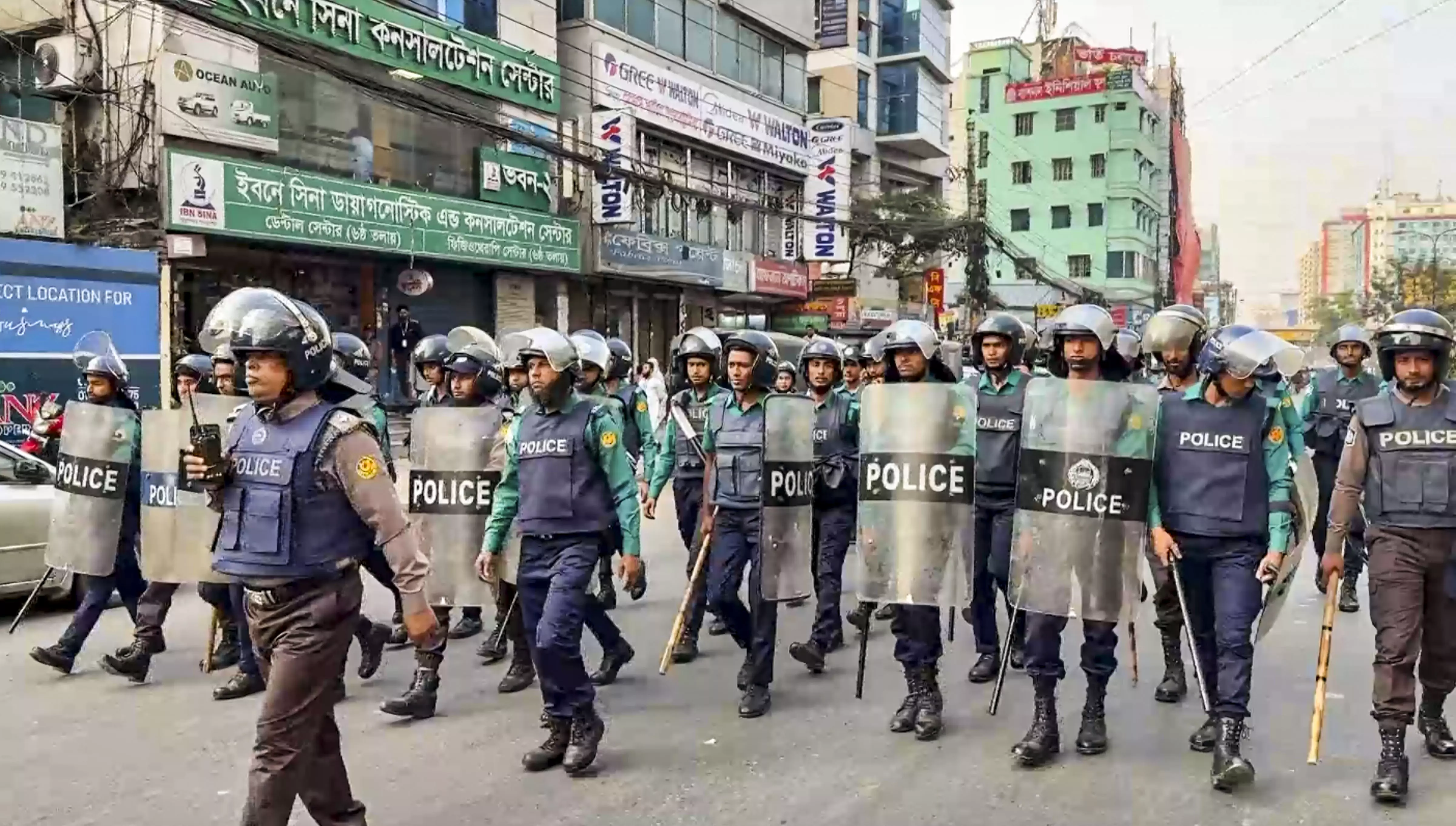
When the hall in Dhaka exploded in applause because Sheikh Hasina Wazed, the ousted Prime Minister now living in exile in India, was sentenced to death, I was reminded of Sir Edward Penderel Moon, a British member of the Indian Civil Service and a historian, arguing in his book Strangers In India that Anglo-Saxon jurisprudence was unsuited to the subcontinent. His argument was that most Brits had little understanding of India’s moral values, historical legacy and traditional ethic, although they had copied the Westminster system lock, stock and barrel.
Muhammad Yunus’ call for parliamentary elections next February confirms that Bangladesh remains a “riddle wrapped in a mystery inside an enigma”. The 85-year-old economist, entrepreneur and politician is Bangladesh’s “fifth chief adviser” since 2024. Have four simply disappeared as politician after politician is murdered or executed. Perhaps an even more lofty authority whom “advisers” advise and in whom vests ultimate power is lurking somewhere.
Realising that the system was not best suited to their needs, Gen. Hussain Muhammad Ershad, the dictator from 1983 to 1990, enacted the eighth constitutional amendment to elevate Islam’s status. In the same spirit, he changed “Dacca” to Dhaka which sounds closer to Bengali phonetics. He should also have revised the justice system, especially crime and punishment and rules of evidence.
It’s said in Pakistan, Bangladesh’s other half for 25 years, that no matter who wins the polls, the military remains in power. No wonder Gen. Ershad was considering how to involve the military in governance, as in Suharto’s Indonesia. Meanwhile, Bangladeshis may wonder if like Pakistan’s ISI, which is never out of office, Mr Yunus is a permanent chief adviser. Is he now the sole incumbent or does he share the crown with the former Chief Justice, Shahabuddin Ahmed, on whom the honour was bestowed (by whom?) in 1990?
Shahabuddin Ahmed served twice as President of Bangladesh and as Chief Justice from 1990 to 1995. As Chief Adviser, he oversaw Bangladesh’s 1991 general election with powers like those of a Prime Minister, except for the sacred defence portfolio with which a nation that has not forgotten its Pakistani past can’t entrust to mere civilians.
Gen. Ershad won a controversial presidential election in 1986 after ousting the civilian incumbent, but was ultimately worsted by the two Begums of Bangladeshi politics, Sheikh Mujibur Rahaman’s daughter, Sheikh Hasina Wazed, and Mrs Khaleda Zia, widow of the assassinated Gen. Ziaur Rahman, who buried the hatchet for once to unite against the military usurper.
The then Army chief, Gen. Nuruddin Khan, refused to support Gen. Ershad, who had to step down when Army officers loyal to him were removed.
Gen. Ershad tried one last ploy. He appointed Justice Shahabuddin Ahmed to form an acceptable neutral caretaker government and prepare for democratic elections. But instead of doing so, Mr Shahabuddin immediately arrested Gen. Ershad, an action that Bangladesh’s Supreme Court struck down but too late in the day.
Bangladesh is lucky to have a reserve of so many potential advisers and chief advisers who can be dragged out of the closet when there is a crisis. They function then as ministers but, not having been elected, are not answerable to Parliament. However it evolved, the system has always seemed to function with smooth effectiveness in contrast to the often-tantalising acrobatics of democratic ministry-making. Initially intended to support the transition from authoritarianism to democracy, the caretaker system was institutionalized in 1996 by the Sixth Parliament as mistrust increased between the Bangladesh Nationalist Party and the Awami League.
The present adviser for foreign affairs, Mohammed Touhid Hossain, for instance, was a career diplomat and Bangladeshi deputy high commissioner in Kolkata before becoming foreign secretary. If he offended Indians by denying allegations of illegal migrants in Northeast India and by blaming New Delhi for stagnant India-Bangladesh relations, he could also be caustic about Anwar Bakht Choudhury, the Bangladeshi-origin high commissioner that London sent to Dhaka in 2004. “He has passed the Tebbit test!” was Mr Hossain’s reported comment.
Along with Mrs Wazed, a former home minister, Asaduzzaman Khan Kamal, was sentenced to death in absentia. A third accused, ex-Inspector General of Police Chowdhury Abdullah Al-Mamun, was sentenced to five years’ imprisonment. Mr Yunus thought the verdict “historic”, while Mrs Wazed called it “biased and politically motivated”.
This is not the end. It’s not the beginning either for that lay in the Partition riots of 1947, compounded by the 1971 war that created Bangladesh.
Another grim round followed in 1975 when Sheikh Mujib and his extended family were murdered in their Dhanmondi residence. Not forgotten yet, that bloodbath inspired vicious calls during the recent upheavals in Dhaka to raze Mujib’s long demolished house to the ground. Mujib’s key colleagues -- home minister Tajuddin Ahmed, Syed Nazrul Islam, A.H.M. Qamaruzzaman and Muhammad Mansur Ali -- were bayoneted to death in Dhaka Central Jail three months after the Dhanmondi carnage, apparently on the orders of Mujib’s erstwhile colleague, Khondaker Mushtaq Ahmad, who immediately stepped into his murdered boss’ shoes to become President.
Brigadier Khaled Musharraf’s abortive counter-coup against Mushtaq was crushed and Col. Abu Taher’s loyal troops freed Ziaur Rahman from house arrest, whereupon he appointed himself the chief martial law administrator. But Gen. Zia was also gunned down, whereupon Gen. Ershad took over.
Formal democracy was restored. But the cycle of death continued. When Fazlur Quader Chowdhury, a former Pakistan National Assembly Speaker, was jailed in 1973, his son, Salahuddin Quader Chowdhury, a leading light in the BNP, warned Tajuddin and his colleagues to have air-conditioners and other comforts installed in the jail as their time would also come. It did. Fazlur Quader Chowdhury died behind bars before Tajuddin and the others were butchered. Then Salahuddin and Ali Ahsan Mohammad Mujahid were hanged after being convicted of genocide and rape – charges that they denied.
So, it goes on. Trials are conducted under antiquated British laws. Evidence is based on concepts that locals may not comprehend. Questions are more intelligible to lawyers than to respondents. Who knows what the latest killing of Sharif Osmann Hadi, chief of the right-wing Inquilab Mancha, will lead to? Few can tell where justice ends and vengeance begins. Partly because of the Judaic punishment system and the Anglo-Saxon code of right and wrong, Bangladesh is still wallowing in blood. It’s not the only aspect of Asian life that needs reviewing in light of indigenous requirements.