Sunanda K. Datta-Ray | Bangladesh With Tarique As PM, Can’t Ignore Hasina’s Legacy

20 Feb 2026 1:51 AM IST
Now that one problem in Bangladesh -- perhaps the most disruptive one -- seems likely to be solved with Tarique Rahman being sworn in as Prime Minister, there remains the contentious issue of his predecessor
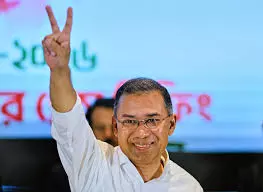
Tarique Rahman (Image: DC)
Now that one problem in Bangladesh -- perhaps the most disruptive one -- seems likely to be solved with Tarique Rahman being sworn in as Prime Minister, there remains the contentious issue of his predecessor. Let it not be forgotten that the aging Sheikh Hasina Wazed is far from being a woman of no importance. She stands with her peers in South Asia, the equal of Sri Lanka’s Sirimavo Bandaranaike, Pakistan’s Benazir Bhutto and -- let us remember --
India’s indomitable Indira Gandhi. The victorious Bangladesh National Party’s secretary-general, Mirza Fakhrul Islam Alamgir, must be complimented therefore on the political maturity that prompted him to declare that Sheikh Hasina’s fate will not be held hostage to India-Bangladesh relations.
Just as Bangladesh’s recent election does not become “illegal and unconstitutional” merely because Sheikh Hasina says so, 1,500 Bangladeshi youths may not have met a gory end even if she had willed it. There has been obvious and blatant tampering on both sides with procedures and protocols. The woman who may well be facing death today has long known that her enemies would give her no quarter should they ever gain the upper hand. It was and is a fight to the finish. It is the task of those who seek peace and stability in a South Asia that must be saved from drowning in its own blood to ensure a civilised end to this blood-curdling feud so that sanity can discipline the wildness of political strife. Sheikh Hasina, who served as Prime Minister of Bangladesh three times from 1996 to 2001, 2009 to 2014, and 2014 to 2024, is the longest serving Prime Minister in her country’s history. She was born on September 28, 1947, in
Tungipara village, and being Sheikh Mujibur Rahman’s daughter, was drawn into politics even as a Dhaka University student. Later, she served as the Opposition leader from 1986 to 1990 and from 1991 to 1995. Hasina has been recognised as one of the most powerful women in the world, ranking 26th on Forbes’ list of The World’s 100 Most Powerful Women in 2018. She was also included in Foreign Policy journal’s list of the decade’s 100 Global Thinkers. In 2014, she was conferred the Unesco Peace Tree award for her commitment to women’s empowerment and girls’ education. After years in exile, she returned to Bangladesh in 1981 and as president of the Awami League, led the party in opposition to military rule and played a key role in the 1990 uprising that restored parliamentary democracy. Khaleda Zia, her future longtime political rival in what was called the “Battle of the Begums”, was then her ally. After serving as Leader of the Opposition from 1991 to 1996, she won the June 1996 general election, and became Prime Minister.
She led the Opposition again from 2001 to 2006 before winning the 2008 general election and beginning her second premiership, which was marked by significant economic and infrastructural development, as well as increasing
international concern over democratic backsliding, enforced disappearances, human rights abuses and restrictions on the political opposition and press freedom. As often happens in Asia’s raucous democracies, critics accused her government of consolidating power, corruption and embezzling foreign reserves. They mentioned allegations of electoral irregularities in the 2014, 2018 and 2024 elections. But she was always popular with India’s first family, the Nehru-Gandhis. Pictures of a warm embrace between Sheikh Hasina and Sonia Gandhi of the Opposition Indian National Congress, a reminder of shared history, also set tongues wagging. Both belonged to prominent political families that enabled South Asian nations to gain independence from British rule while also being responsible for partitioning their countries and for widespread bloodshed. There was a deeper personal bond that was manifest when Sheikh Hasina appeared in New Delhi as a state guest for Narendra Modi’s swearing-in as Prime Minister for a third consecutive term.
Sonia Gandhi called on Sheikh Hasina in a New Delhi hotel, along with daughter Priyanka and son Rahul, both of whom had recently emerged as important political figures in India, setting off speculation about whether the Bangladeshi Prime Minister was snubbing Prime Minister Modi. But the general view was that political strands only reinforced the personal rapport between old family friends. Everyone agreed that India’s Congress leadership had trained and armed Bangladeshi guerrillas and set up their government-in-exile because it suited India’s diplomatic, political and security strategy; that motivation had not lost its power since Indira Gandhi and the exiled Bangladeshi Awami League leaders denounced Richard Nixon and Henry Kissinger for continuing to supply financial and military aid to Pakistan because it facilitated their policy of reaching out to China. Sheikh Mujib returned to a free Bangladesh in January 1972 but his short and tumultuous rule ended in tragedy when he and several members of his family were gunned down by Bangladesh Army officers on August 15, 1975. Sheikh
Hasina, who was in Europe with her nuclear physicist husband, escaped death.
They wouldn’t have been safe during the troubled period of coups and counter-coups that followed if Indira Gandhi hadn’t offered Sheikh Hasina political asylum. She and her family took up residence in New Delhi near the Gandhis, where Hasina was a regular guest while her husband had a job with India’s nuclear research centre and India covertly supported armed Bangladeshi groups fighting against the military dictatorship. In 1981, Sheikh
Hasina returned to Bangladesh as the Awami League chief, leading the opposition to the military dictatorship.
Both families -- the Gandhis and the Wazeds -- have known death and disaster. Both have suffered. Both have trimmed public policy to personal ends and adjusted personal predilections to public purpose. The friendship
blossomed anew when Sheikh Hasina became Prime Minister of Bangladesh for a second time in 2009. Narendra Modi’s saffron interregnum doesn’t appear to have weakened a bond based on the national interest, recalling Lord Palmerston’s famous dictum: “We have no eternal allies, and we have no perpetual enemies. Our interests are eternal and perpetual, and those interests it is our duty to follow.” Given this background, Sheikh Hasina cannot be relegated to the dustbin of history. She must be measured against her peers; her impact on the moving show taken into account and her future decided accordingly. She need not be allowed the licence to interfere in active politics but she cannot be denied the role of informed observer.
( Source : Asian Age )
Next Story