Suman Sahai|98% Shortfall in Green Mission & Deforestation Amid Climate Change

The Bank also estimates that over the past two decades more than 750 million people in South Asia have been affected by at least one climate-related disaster.
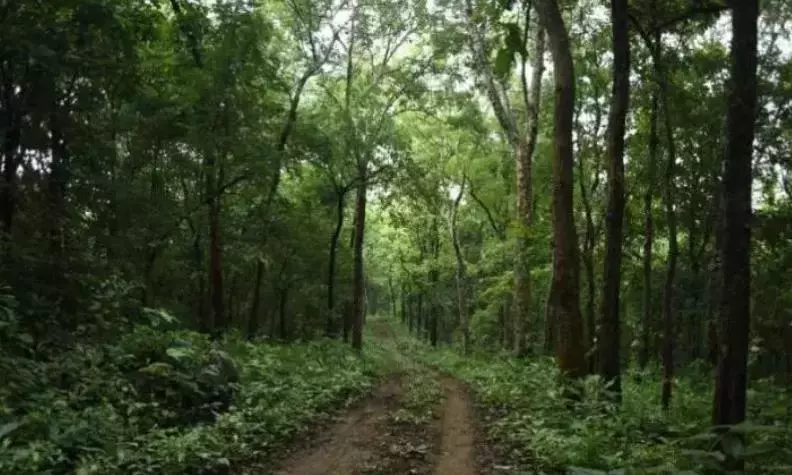
The Comptroller and Auditor General of India told Parliament in August 2026 that the government has failed to meet its targets to increase and improve forest cover in India, by nearly 98 per cent.
South Asia is one of the regions most vulnerable to the global climate crisis. The World Bank’s South Asia Climate Change Roadmap warns that annual economic losses could hit $160 billion by 2030 in the region, heavily impacting poor families and worsening food insecurity. The Bank also estimates that over the past two decades more than 750 million people in South Asia have been affected by at least one climate-related disaster.
For a region so vulnerable to climate change, forests, a crucial asset for any nation, should be at the centre of our adaptation strategies. They hold water, protect soil, moderate temperatures, store carbon and provide suitable habitats for an extraordinary range of plants animals, microbes. For millions of people, particularly forest-dependent communities, they are also a source of food, fuel, medicine and livelihoods. So, the obvious policy response should be to protect existing forests and increase green cover.
Recognising the climate catastrophe staring at us, The Government of India formulated the National Action Plan on Climate Change (NAPCC) 18 years ago in 2008. Of the eight missions flagged for urgent action to cope with climate change, an important one was the Green India Mission (GIM). The focus of the GIM is on restoring, enhancing and protecting, the country’s diminishing forest and tree cover. Three specific targets were laid down: Increase forest and tree cover on five million hectares; Improve the quality of the forest and its species diversity on another five million hectares and Support and Supplement the forest-based livelihoods of the roughly three million households of forest dwelling communities.
We are failing on all fronts of the Green India Mission. The Comptroller and Auditor General’s performance audit of the Green India Mission, tabled in Parliament in August 2026, shows just how large the gap is between stated goals and what has been achieved. The GIM had set a target of increasing forest cover by 1.4 million hectares between 2015-16 and 2024-25. The actual increase was only about 0.03 million hectares, a 97.57% shortfall. This embarrassing figure reveals the absolute and total failure on the part of those whose job it was to use the allotted funds to meet the targets of the National Mission to increase forest cover. The story is similar when it comes to improving the quality of existing forests. The CAG found a shortfall of nearly 92%. This is not just inefficiency; it is a catastrophic inability to recognise the gravity of the climate crisis and its consequences.
Why did this happen? The CAG audit is scathing, pointing to the i) Failure to use available funds with states utilising just half of the money available; ii) Lack of convergence between programs and deficient monitoring leading to structural gaps; iii) Failure to secure the massive fund proposed for the second phase and inappropriate selection of landscapes for afforestation.
In this backdrop, the scale of government sanctioned deforestation, the cutting down of large tracts of forest for so called ‘development’ is baffling. Government data shows that between April 2023, and March 2026, 71,023.30 hectares of forest land was approved for diversion to non-forestry purposes across India. Madhya Pradesh accounted for 19,432 hectares, Odisha 8,966 hectares, Arunachal Pradesh 7,335 hectares, Jharkhand 5,410 hectares and Chhattisgarh 4,219 hectares.
Mining and stone quarrying accounted for the largest share of 16,463 hectares. Hydroelectric and irrigation projects accounted for another 14,294 hectares, while roads accounted for 12,715 hectares. These are not just numbers on a spreadsheet. Every hectare represents a piece of an ecosystem, and often a landscape that has taken decades, sometimes centuries, to evolve.
Look at Hasdeo in Chhattisgarh. The Hasdeo-Arand forest in North Chhattisgarh is one of the most important forest patches of Central India, popularly referred to as the lungs of Central India. The Adani Parsa East and Kente Basan (PEKB) coal mine is located in this biodiversity-rich region. Approximately 4.48 lakh trees are slated to be cut down in phases. Around 1,013 hectares of closed canopy forest has already been cleared and the government has also given in-principle clearance for the felling of trees in 1,742.6 hectares for the Kente Extension coal block.
In the misguided project to link the Ken and Betwa rivers in Madhya Pradesh, 9,000 hectares including 5,761 hectares of forest land will be submerged. This will involve killing approximately 215,875 trees. Not just that, the project will also claim over 4,000 hectares of the densely forested Panna Tiger Reserve and 1,314 hectares of its buffer zone. The highway widening construction activity linking the Char Dhams of Uttarakhand (Badrinath, Kedarnath, Gangotri and Yamunotri) has already claimed nearly 60,000 trees.
These are just some examples. Looming in the future is the mega project to destroy the biosphere of the environmentally unique and fragile Great Nicobar island. A commercial hub including an airport, an international transshipment terminal, a township and associated infrastructure is to be built for which rainforests will be slashed and biodiversity rich indigenous lands will be appropriated. According to government records, approval has already been given for the diversion of 130.75 sq km of forest land.
The CAG’s findings on the Green India Mission should not be seen merely as another story of a failed government programme. The larger question is about the coherence of our environment policy. On one side, we recognise forests as critical to climate resilience. On the other, we continue to divert existing forests for mining, infrastructure and so-called development projects. Both development and environmental protection are necessary. But development cannot mean treating natural forests as expendable, interchangeable pieces of land. The real test of India's climate policy will not be the number of saplings planted for a photograph. It will be whether the mature forests that have survived for generations are still standing when the next heatwave, drought, flood or extreme rainfall arrives.