Suman Sahai | Ken-Betwa Link: Development or More Mindless Discrimination?

A mega-project promises water for Bundelkhand but threatens forests, livelihoods and displaced communities
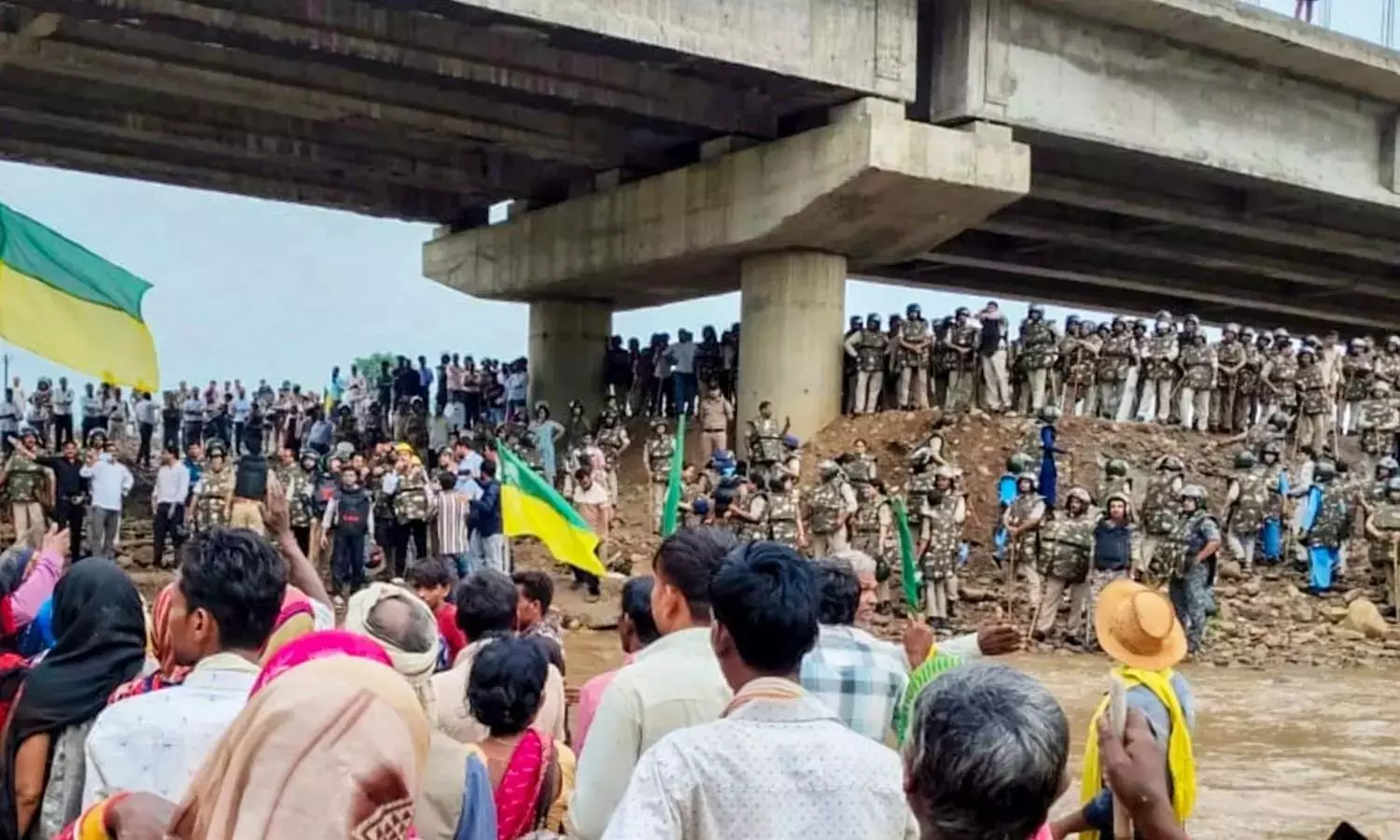
Linking the Ken and Betwa rivers has become an issue once again. Members of the communities living along these rivers are protesting this in novel ways, lying on simulated funeral pyres in the river waters, starting hunger strikes in a submerged state, or standing in the river with nooses around their necks. “We’ll turn into Durga and Kali,” say the women protesting in chest-deep water. The images are powerful, disturbing, they tell you how much this move has upset those who live along the river and venerate it.
I have travelled through this landscape a few times over the years. In Panna the Ken river flows with a rare serenity, almost stillness. The forests are alive with biodiversity, the terrain rugged yet beautiful, and the river sustains not only wildlife but entire communities of farmers, fishers, forest dwellers and pastoral families. To stand on the banks of the Ken is to understand that rivers are not merely channels of water to be engineered on drawing boards. They are living ecological systems. Which is why the Ken-Betwa river-linking project is deeply troubling.
The project is being promoted as a solution to Bundelkhand’s water crisis, with promises of irrigation and drinking water for drought-prone districts. But beneath the language of development lies a familiar and disturbing reality: forests will be destroyed, the ecology dented. Thousands of people will lose their homes and ancestral lands, and they will lose their livelihoods. India’s track record on rehabilitating persons displaced by dams and development projects is very poor, in fact rehabilitation in India has rarely been just or complete. Rather than equitable development, this project too, like earlier dam projects, will help some and discriminate against many others.
Independent estimates suggest that more than 22 villages would be displaced, affecting over 7,000 families in Panna and Chattarpur districts, and of these, 20 villages would be completely submerged by the Ken-Betwa project, many of them Adivasi communities dependent on forests and river ecosystems for survival. The Daudhan dam, the cornerstone of the ₹45,000 cr Ken-Betwa Link Project (KBLP), alone will submerge large areas, including parts of the Panna Tiger Reserve. The irony is painful: a project meant to solve distress in one region will create another geography of suffering elsewhere.
This is a familiar playbook and India has seen it before. When the Bhakra-Nangal dam was built after Independence, it was hailed as one of the “temples of modern India”. It is located on the Sutlej river along Bilaspur in Himachal Pradesh and Rupnagar in Punjab. Yet behind that grand national narrative lay the 371 submerged villages which took away everything from some 36,000 families — their homes, their assets and their livelihoods.
Families were promised cultivable land, rehabilitation and a better future. Decades later, many oustees were still fighting legal battles for proper compensation and land rights. Reports have documented how displaced families were pushed onto barren or disputed lands, while many landless workers and labourers were excluded entirely from compensation because they did not possess formal land titles.
This pattern repeated itself across India. The Hirakud dam in Odisha displaced more than one lakh people and submerged over 300 villages. Many never received proper rehabilitation.
The Pong dam displaced more than 30,000 families from Himachal Pradesh, many of whom were relocated to Rajasthan with promises of fertile agricultural land. Several families reportedly received arid land without irrigation or clear ownership rights. Some are still fighting for justice after half a century.
The Narmada Valley Development Project, which includes large structures like the Sardar Sarovar Dam and other dams on the Narmada river, led to massive displacement. Over two lakh rural and tribal people lost their homes and lands to reservoir submergence without fair compensation. The Narmada project also caused severe environmental damage, like submergence of dense forests, destruction of local wildlife habitats and obstructed the migration paths for fish.
Official statements usually assert that rehabilitation has been completed, but independent investigations document missing land allotments, fake registries, uncultivable plots on a large scale and thousands of excluded families. Even today, many displaced families continue to seek their just dues and compensation. This is the history of “development” and discrimination in India.
Such discrimination results in livelihood collapse. The forest gatherer loses access to forest produce. The fisher loses the river. Tenant farmers, artisans, cattle grazers, boatmen and agricultural labourers disappear from official compensation records because they do not exist in government records. This is why people in the Ken-Betwa region are anxious. They know of the government’s track record on rehabilitation. They know that promises made at the time of land acquisition often dissolve once construction begins.
Equally worrying is the ecological blindness underlying the river-linking approach itself. Experts have warned repeatedly that the hydro-dynamics of Indian river systems are still inadequately understood. Climate change has already altered rainfall behaviour across India. Rivers that appear “surplus” today may not remain so tomorrow. Yet massive irreversible interventions are being pursued with astonishing confidence.
Bundelkhand’s water crisis is real. But it cannot be solved through ecologically disruptive mega-projects. Destroying the environment and upsetting the natural balance can never provide sustainable solutions, which is what we should be seeking, not shortcuts that have failed time and again. Rivers are not pipelines. Their flow patterns, seasonal rhythms, sediment loads, groundwater recharge functions and biodiversity relationships are deeply interconnected.
Dry regions in India built sustainable systems to ensure water access using decentralised water systems — tanks, ponds, watershed structures, forest protection and groundwater recharge practices adapted to local ecology. Instead of strengthening such systems and improving them, we choose to chase gigantic engineering solutions because they appear politically dramatic.
The tragedy is that in such projects, the benefits and burdens are rarely borne by the same people. Water and electricity flow somewhere else, to urban centres and commercial agriculture. But the people who surrender their forests, villages and ancestral lands are often left with nothing more than broken promises.