Skand Tayal | BRICS at crossroads: At 2026 Summit in Delhi, Keep Focus on Its Core Agenda

New Delhi aims to redefine BRICS amid expansion, tensions and global uncertainty
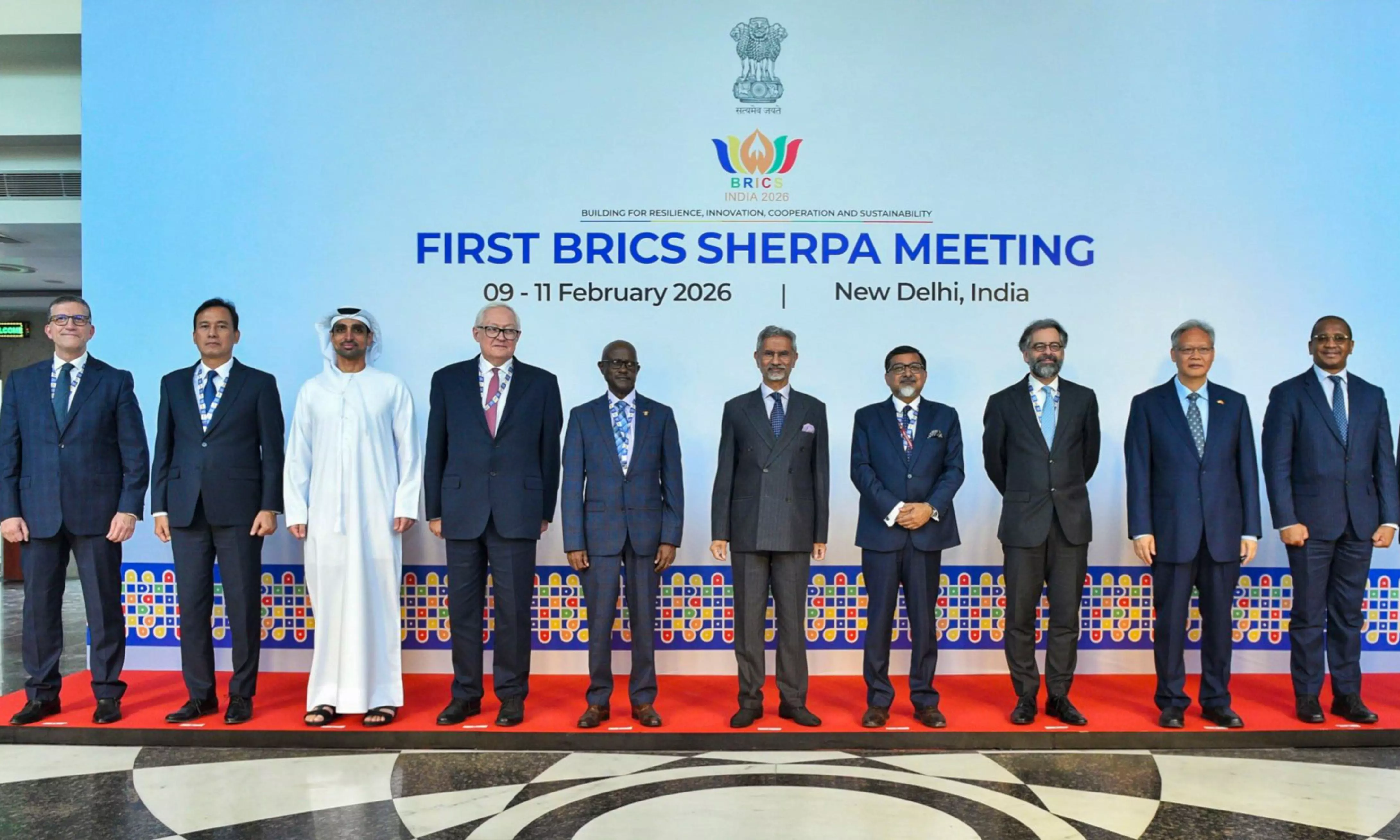
With the BRICS Sherpas meeting in New Delhi on February 10 and 11, India has kickstarted the preparations for the Brics annual summit later this year. India is the rotational president of Brics for 2026 in a deteriorating international environment which is more uncertain, more unpredictable and more fraught than in previous years. The rules-based international order is under strain, there is talk of a G-2 or a G-3-dominated world and the voice of the rising powers needs to be articulated and asserted.
What are the objectives of Brics as a group? The acronym “Bric” was coined by Goldman Sach’s chief economist Jim O’Neill in 2001, identifying the then fastest-growing major economies -Brazil, Russia, India and China. In the wake of the global financial crisis of 2008, the first summit of 20 major economies G-20 was convened by President Barack Obama in Washington in November 2008. There it was realised that the G-7 countries spoke with one voice, whereas the rest of the members had no common agenda or views. To harmonise positions, Russia hosted a summit meeting with the leaders of Brazil, India and China in Yekaterinburg in June 2009, before the second G-20 summit in Pittsburgh in September 2009. A brief one-page joint statement stated the objectives as: (i) coordinate positions on global financial and economic issues; (ii) reform of international financial institutions, and (iii) improvement in the international trade and investment environment. Thus, “Bric” as a group was born, and its agenda was purely economic.
For making the group more representative, South Africa was invited to join to represent African nations, and in 2011 the group was renamed as “Brics”.
Over time, gradually, the agenda of Brics grew bigger. China rose as the second largest economy. The Russia-Ukraine war since 2022, the Israel-Palestine conflict since 2023 and US President Donald Trump’s unconventional foreign policy further transformed both global geopolitics and geoeconomics.
Strangely, South Africa, during its 2023 presidency of Brics, unilaterally embarked on a mission to increase the group’s membership. South Africa approached over 40 countries to ascertain their interest in joining Brics, and more than 20 responded positively. India’s plea to first agree on some criteria for future Brics’ membership was unfortunately seen as obstructionist by the host. Seven countries -- Argentina, Egypt, Ethiopia, Indonesia, Iran, the UAE and Saudi Arabia -- were admitted as new members at the Johannesburg summit, of which all except Argentina have joined.
The theme of the 17th Brics summit in Brazil in 2025 was “Strengthening Global South Cooperation for a more Inclusive and Sustainable Development”. The question arises whether Brics is a bloc representing the “Global South” or the “Fast Rising Major Economies”?
It must be noted that China and Russia do not belong to the Global South. There is a need, under India’s presidency, for the members to ponder whose interests and concerns the group primarily represents.
The Western countries perceive Brics as an anti-West group. India has been at pains to state that Brics may be “non-West”, as it does not have any OECD country as member, but it is not “anti-West”. However, including Iran as a member does send a signal of the “anti-West” orientation of some of its members.
On any new members, India has rightly stated that it is the time for consolidation of the enhanced membership of Brics and no new members are being considered during India’s presidency.
Conscious of this drift and the lack of focus in Brics, Prime Minister Narendra Modi in his address at the Rio summit in July, while accepting the presidency for 2026, had said: “Our goal will be to redefine Brics as ‘Building Resilience and Innovation for Cooperation and Sustainability’.” In a press conference on January 13, 2026, external affairs minister S. Jaishankar had further outlined Mr Modi’s vision for Brics as “Humanity First and People Centric”. He said that Brics was for “dialogue and cooperation” and aims for cooperation among emerging economies and the developed world.
The message of cooperation with the West is important. It would be prudent for the members not to push for the Brics currency “UNIT”. In December 2025 a prototype gold-backed currency UNIT was launched, composed of 40 per cent physical gold and 60 per cent national currencies of Brics member states. During the Rio summit on July 6, 2025, US President Donald Trump had warned on Truth Social: “Any country aligning themselves with the anti-American policies of Brics will be charged an additional 10 per cent tariff. There will be no exceptions to this policy.” On July 8, he reportedly said that Brics was set up to “degenerate the US dollar… and any country that was part of it will face consequences”.
India is wisely steering clear of any controversy and there is no talk of “de-dollarisation”.
The sherpas’ meeting emphasised cooperation in health, agriculture, labour, employment, disaster risk reduction, environment, climate change, energy, innovation, ICT, security and counter-terrorism and economic and financial domains. People-centric activities would be related to sports, youth connect, cultural engagements, Academic Forum, Think Tank Council and Brics Civil Forum. The Brics Business Council and Brics Women’s Business Alliance would also be active.
As seven members of the current eleven members are also members of G-20, the Brics summit in New Delhi will be an opportunity for the seven to coordinate their positions on important issues prior to the 21st G-20 summit to be hosted by President Donald Trump in Miami in December this year.
It is important that Brics remains a compact group of fast-growing developing economies with a clear criteria for membership and a manageable economic agenda. Any uncontrolled increase in membership and pursuit of an all-encompassing agenda would lead to lack of coherence and open the door for its future irrelevance like the G-77 and the Nonaligned Movement.
The writer is a retired Indian diplomat