Sanjeev Ahluwalia | India, Russia and China: Collaborators or Rivals?

China feels that the relationship with India should not be determined solely by the disagreements on border issues
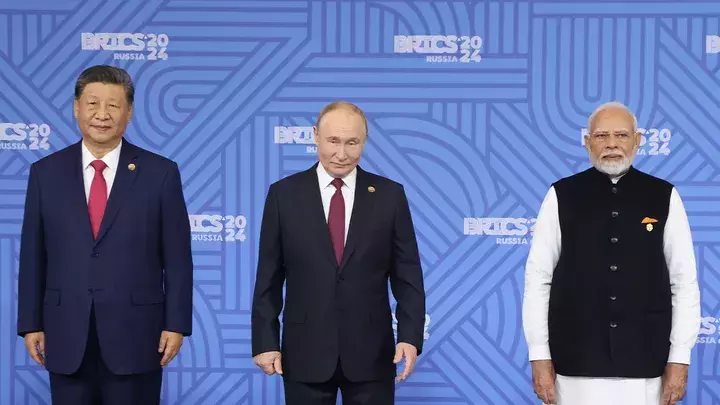
Today, India and Russia are collaborators, as are China and Russia, whilst China and India are perceived as adversaries jostling for global space with long-standing border disputes left unresolved -- bleeding sores demanding economically draining deterrent assets on both sides of the 3,500-km-long border. It is an odd threesome.
Russia is not by culture, convention or geographical location of its human population, an Asian country. More than three-fourths of its land area is in Asia but its power centres and three-fourths of its population are in Europe, with a long tradition of relationships with the European great powers. It is a Eurasian power straddling two continents.
China and India are Asian powers, but that commonality hides more than it reveals.
China has always been a top-down authoritarian regime first under local imperial rule and then under the Communist Party of China. It was never colonised. India, like much of Asia and Africa, emerged from colonial rule only recently and the national ethos is still being shaped across the divides of language, religion, regional culture, caste and gender.
Russia and India are historical collaborators. India continues to support Russia in the United Nations by abstaining, most recently in 2023 on multiple UN General Assembly resolutions condemning Russia, requiring it to end the war in Ukraine and the impositions of sanctions on Russia. Russia reciprocates this friendliness by consistently backing India’s resolutions against terrorism, blocks attempts at internationalising the Kashmir issue, which India regards as a bilateral matter with Pakistan and supports India’s inclusion as a permanent member of the UN Security Council. It risked a nuclear confrontation in 1971 by despatching a nuclear armed fleet to neutralise America’s Seventh Fleet, tasked by President Richard Nixon and his aide Henry Kissinger to overawe India into abandoning support for Bangladesh’s freedom struggle.
India’s relationship with China is handicapped by the forcible occupation of the Aksai Chin area by China in 1962, the illegal 1963 cession by Pakistan to Chin of more than 5,000 sq km of land in the Shaksgam Valley, north of the Siachen Glacier, in Pakistan-occupied Kashmir, the Doklam standoff in 2017 and the Galwan skirmishes in 2020. This was also the period when the US-India relationship was soaring, and deeper strategic alliances were being forged via the Quad. President Trump’s capricious disregard of allies in general and India in particular, whilst imposing arbitrary, unilateral import tariffs and threatening India with penal tariffs for importing Russian crude oil, has left India adrift in 2025.
Could this be an inflection point, which China wants to exploit? China’s ambassador to India, Xu Feihong, raises hopes when he points to possible good news from the Tianjin SCO summit later this month. The post-Galwan tactical disengagement, along the agreed four-stage roadmap, starting with border delimitation and ending with normalisation, curated by India’s national security adviser Ajit Doval and China’s foreign minister Wang Yi under the special representatives’ dialogue arrangement, has made steady progress. The great advantage of such “technical” forums is that they proceed, without any media hype, which accompanies the leadership-level engagements.
Like India, China too had to deal with border incursions, initially by Russia in the 17th century and 19th century. It wisely chose to reconcile matters by signing formal treaties which included give or take of disputed territory with Russia. Nevertheless, in the 20th century the neighbours clashed yet again on the Ussuri river -- the Zhenbao Island incident in 1969 -- which pushed China to abandon strategic autonomy, junk ideological affinity as a glue in international relations and seek a productive engagement with the United States instead. The 1972 visit to Beijing by President Nixon inaugurated the mainstreaming of China into global international affairs, including securing its claim to the UNSC seat previously occupied by Taiwan. Once the Soviet Union collapsed and the threat perception dulled, China formally settled outstanding border issues with Russia in 2004, by when it had the strategic advantage.
China feels that the relationship with India should not be determined solely by the disagreements on border issues. But learning from China’s own experience, border settlements are a significant enabler of closer economic and defence cooperation.
The tremendous admiration in India for China’s economic success and most recently its technology prowess in generative AI and advanced military hardware, which rivals that of US corporates, should be reflected in our dealings with China. China’s global competitiveness is evidenced by its high share of exports to GDP, which peaked in 2006 at 35 per cent but reduced to about 20 per cent in 2024, now like India’s share of exports to GDP of 21 per cent, albeit at significantly lower GDP levels.
There are, however, fundamental principles of economic cooperation to be settled. China is the largest global exporter with a 15 per cent share in global goods trade. India’s exit from the Regional Economic Cooperation Partnership -- the fifteen-country Asia-Pacific economic pact, at the negotiations stage in 2019 -- was driven by its unwillingness to be flooded by subsidised Chinese goods. It is unclear how high American tariffs on imports from China will go. But China is sure to be under pressure to diversify exports and it has capacity to spare. India is unlikely to be a willing trade partner for increasing its deficit in goods trade with China of $99 billion (2024).
Can export-oriented Chinese investment in India and a realignment of India’s export basket, bridge India’s unfavourable trade skew? A recent ICRIER policy brief defining the broad strategy to de-escalate trade and investment restrictions, thoughtfully and strategically, is timely advice. India is a fast-growing, young economy, with population peaking only by the 2060s. That buys us time, but also means overwhelming strategic heft versus China, is unlikely over the near term – so why procrastinate? India can and must leverage the future but calibrated compromises for peace building should not be ruled out, merely to avoid the political downside of domestic contestation.
Continuing the friendly relationship with Russia is sensible, purely because there are fewer flash points than opportunities. Developing a mutually respectful relationship with China would be a positive and embellish India’s non-aligned credentials.
Repairing the relationship with America is equally important, but only based on mutual national interest. The hoary principle of always distinguishing between the country and the existing administration, particularly in democracies, is a useful one. It enables the conceptual distancing from unsavoury memories, necessary, to build a mutually rewarding future relationship.