SANJAYOVACHA | The Missing Dimension In India-Japan Relationship | Sanjaya Baru

While these relations have developed vigorously over the past quarter century under three successive Indian Prime Ministers, on the Japanese side two Prime Ministers must be credited for their commitment to relations with India -- Junichiro Koizumi and Shinzo Abe. Prime Minister Takaichi is a disciple of Abe and has restored momentum to the relationship during her brief tenure. Her visit to New Delhi was, therefore, significant
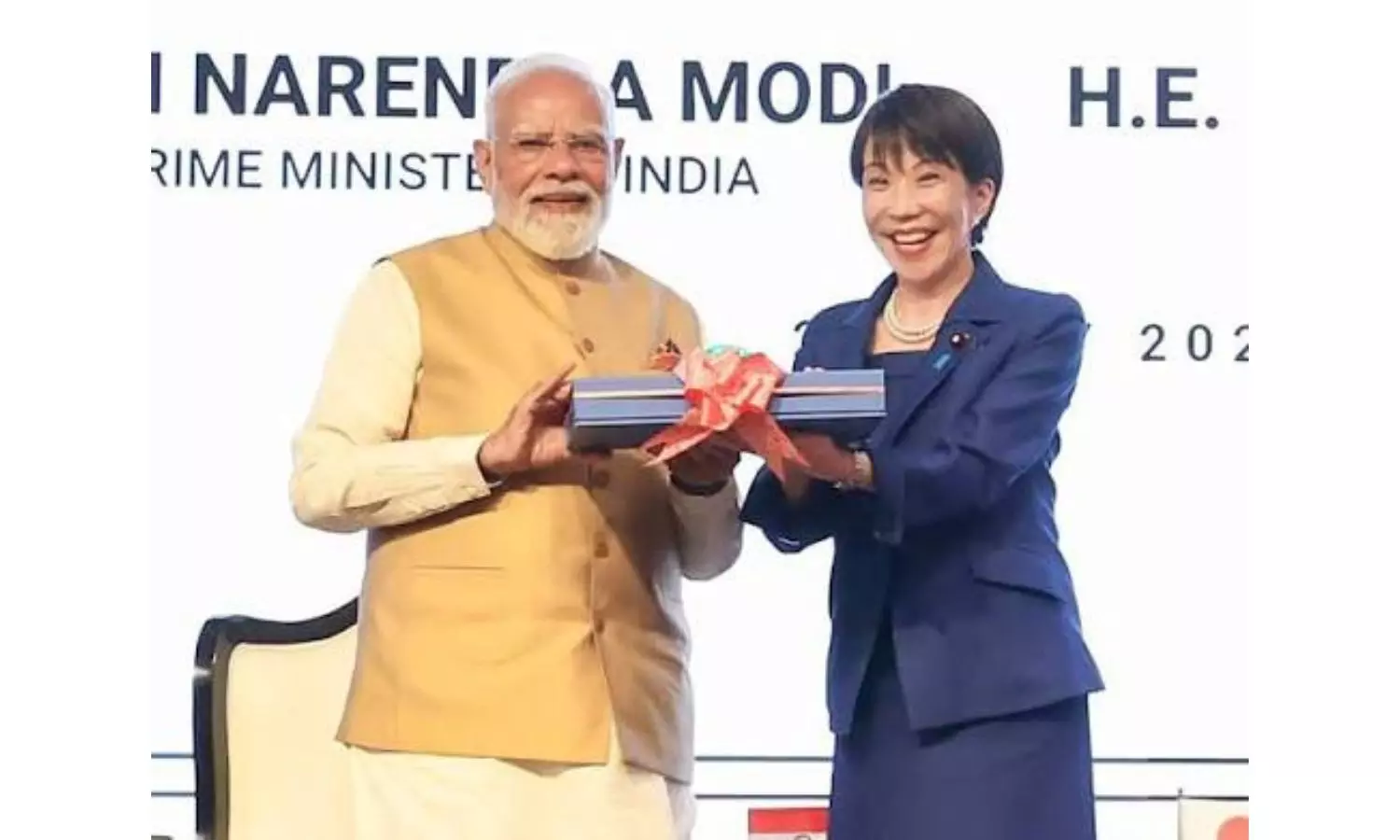
The India-Japan strategic partnership is one of India’s “truly strategic” partnerships, considering that we have defined over thirty bilateral relationships over the past three decades as “strategic”. The relations between India and Japan at the State-to-State level are defined by Kautilya’s simple and straightforward proposition that “a neighbour’s neighbour is a friend”. Shared cross-border concerns bring the two together. These relations were once again in focus last week during the visit to New Delhi of Japan’s Prime Minister Sanae Takaichi.
While these relations have developed vigorously over the past quarter century under three successive Indian Prime Ministers, on the Japanese side two Prime Ministers must be credited for their commitment to relations with India -- Junichiro Koizumi and Shinzo Abe. Prime Minister Takaichi is a disciple of Abe and has restored momentum to the relationship during her brief tenure. Her visit to New Delhi was, therefore, significant.
However, and interestingly, in their present state the India-Japan bilateral relations appear to be the exact reverse of the present state of bilateral relations between India and the United States. Consider this. In the case of the US and India, people-to-people (P2P) and business-to-business (B2B) relations remain robust even as government-to-government (G2G) have become testy, transactional and wanting in trust. India-Japan relations, on the other hand, testify to a robust and growing G2G engagement, with high levels of trust between political leaderships, but remain constrained by inadequate B2B connect and very low level of P2P engagement.
In fact, as a Japanese scholar said to me, in the case of Japan’s relations with China and India there is a similar imbalance. While India-Japan G2G are strong and B2B and P2P remain weak, Japan-China G2G relations have become very strained, especially after Ms Takaichi took charge, while Japan-China P2P and B2B relations remain fairly robust.
Prime Minister Takaichi arrived in New Delhi at a time when the Japanese media was reporting a wave of anti-immigrant, including an anti-tourist, sentiment at home. Japan has hiked its visa fee by more than three times to discourage tourism in a Japan over-run by tourists. Indians have not been spared from this anti-immigrant sentiment. Indian tourists have been reporting back home that several restaurants refuse to admit Indian customers. Apart from traces of racism, the bad behaviour of many Indian tourists overseas has made them unwelcome in many countries, including Japan. This despite the fact that the numbers of Indian tourists travelling to Japan remains low.
Japan’s diplomats in India have been trying to encourage more Indian students to study in Japan, but with limited success. More than the limit imposed on P2P engagements due to low numbers, the quality of such engagement as there is has also been found wanting. While Japanese and Indian elites have high regard for each other’s culture and civilisation, there is very little appreciation of this among ordinary folk in both countries and little is taught about each country in the other’s.
What of the B2B engagements? Japanese businesses, big, medium and small, continue to find China and Southeast Asia more attractive as destination for their overseas investments. It is only post-Covid that Japanese direct investment in China has begun to taper off and Japanese FDI into India has shown any appreciable increase. As a perceptive Indian business person based in Tokyo observed recently, India remains a daunting place for Japanese firms to do business in. “Many Japanese corporations have become accustomed to operating in China which efficiently ‘packages’ everything necessary to ‘plug and play’ in the country.” In India they have to still figure out how to go about doing business.
The Japanese scholar I spoke to also believes that even though the political elites in both Japan and China are wary of each other, the business and social elites in Japan still retain a more positive view of China compared to their view of India. Given that they are themselves so disciplined, organised and efficient, the Japanese elites appreciate a similar commitment to order and civility among other East Asian societies, including China. Indians, on the other hand, come across as noisy, messy, chaotic and boisterous.
These remarks reminded me of Prime Minister Junichiro Koizumi’s question to Prime Minister Manmohan Singh when, in 2005, he asked the latter whether India was part of “Rising Asia” to its East or “Unstable Asia” to its West. It takes more than brotherly and sisterly feelings between political leaders for societies at large to feel more comfortable with each other. East Asians in general, including Japanese, Koreans, Taiwanese and, indeed Chinese, feel more comfortable dealing with the West and with some Southeast Asian nations. India is still viewed by most of them as a difficult place to travel to, to do business in and to live in.
One can only hope that the rapidly growing G2G relations with Japan will forge better B2B and P2P ties. From this hopeful perspective one must derive satisfaction from the visit to India of Prime Minister Takaichi. The 3,700-word joint statement issued by both leaders sets out a wide and important agenda for both governments. It takes forward the vision as first defined by Prime Ministers Shinzo Abe and Manmohan Singh in 2007 and subsequently reiterated by Abe and Narendra Modi.
Prime Minister Abe deserves credit for altering the trajectory of India-Japan relations when he first visited New Delhi in August 2007. The data testifies to this. The graph of Japanese investment in India and the chart on senior ministerial visits to India were both flat till 2007. They rose sharply after that. It took fifteen years of sustained effort for Japanese FDI flows into India to exceed the flows into China, though on an aggregate basis Japan still invests more in China than India. That is changing as a consequence of a change in annual flows.
Ms Takaichi repeated a remark famously made first by her political mentor, Shinzo Abe, when she told Prime Minister Modi that “a strong India is in Japan’s interests and a strong Japan is in India’s”. This is absolutely true. However, the challenge in realising the full potential of this worldview lies in ensuring that the relationship fires on all three engines of G2G, B2B and P2P.
The writer was adviser to Prime Minister Manmohan Singh. His books include The Importance of Shinzo Abe: India, Japan and the Indo-Pacific