Ruchira Gupta | Abdul El Sayed’s Michigan Primary Win And The Rise Of America’s New Left

Unlike India, the United States does not guarantee health care to every citizen. Americans frequently depend upon employers for insurance or purchase expensive private plans. Even insured families can be pushed into debt by illness. Mr El Sayed argues that medical treatment and secure housing should be rights rather than privileges
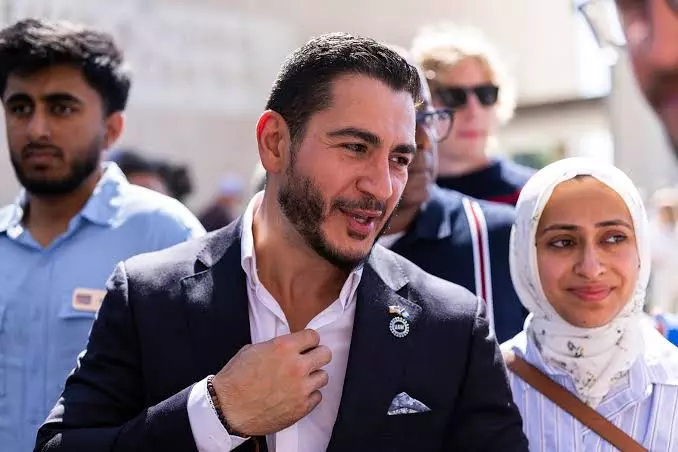
Abdul El Sayed’s victory in Michigan has brought the United States closer to electing its first Muslim senator. It has also placed him at the centre of a struggle over the future of the Democratic Party.
Mr El Sayed has not yet been elected to the Senate. He has won Michigan’s Democratic primary, the preliminary election in which voters choose their party’s candidate. On November 3, he will face Republican Mike Rogers. The winner will become a member of the 100-member United States Senate.
His narrow victory over centrist Congresswoman Haley Stevens was remarkable. Ms Stevens was supported by leading Democrats and benefited from tens of millions of dollars in outside political expenditure, much of it from organisations associated with AIPAC, the powerful pro-Israel lobby.
Mr El Sayed turned the spending against him into a moral argument. He asked whether Michigan’s next senator would represent its people or the corporations, billionaires and special interests seeking political influence. The effort to overwhelm him financially strengthened his claim that concentrated wealth is weakening American democracy.
A physician and former public health administrator, Mr El Sayed believes political and economic systems directly affect people’s health. His programme includes universal medical coverage through Medicare for All, affordable housing, stronger trade unions, better public education, clean air and water, and higher taxes on extreme wealth.
Unlike India, the United States does not guarantee health care to every citizen. Americans frequently depend upon employers for insurance or purchase expensive private plans. Even insured families can be pushed into debt by illness. Mr El Sayed argues that medical treatment and secure housing should be rights rather than privileges.
This has parallels with India’s democratic socialist inheritance. Its different traditions shared the conviction that electoral democracy was incomplete without economic justice. Government had a responsibility to provide essential services, protect workers and prevent a small wealthy class from monopolising national resources.
America’s “Democratic Socialists” make similar arguments within a different political system.
Politics is dominated by the Democratic and Republican parties, leaving smaller parties with little chance of winning. The Socialists, therefore, usually contest Democratic primaries and, if successful, enter the final election as Democratic candidates.
The Democratic Socialists of America, known as the DSA, is not the equivalent of a major Indian party. It is an organised movement seeking to elect socialists and move the Democratic Party towards the left.
More than 250 DSA members reportedly hold elected office across approximately 40 states, mostly in municipal bodies and state legislatures. Only a small number serve in Congress, but their influence is greater than their numbers suggest. When Democrats and Republicans are separated by very few seats, a disciplined group can the make party leaders negotiate.
Democratic Socialists and allied progressives have moved universal health care, affordable housing, stronger unions, higher wages, cheaper education and transport, taxes on billionaires and controls on corporate campaign money further into the Democratic debate. They have also pressed the party on immigration, environmental justice and Palestinian freedom.
Mr El Sayed belongs to this progressive wave. The son of Egyptian immigrants, he presents himself openly as both Muslim and American rather than treating his faith or name as electoral liabilities.
His psychiatrist wife, Sarah Jukaku, has Indian family connections, including to Bengaluru, and they are raising two daughters. If elected, Mr El Sayed would become the first Muslim in the United States Senate. But he offers more than representation. His programme addresses families struggling with rent, medical bills and insecure employment.
Gaza is central to his challenge. Mr El Sayed has described Israel’s actions there as “genocide” and has opposed American military assistance and weapons sales to Israel. Mr El Sayed’s victory shows that support for Palestinian rights is moving from protests into electoral politics.
This has global implications. Israel relies heavily on American weapons, money and diplomatic protection. One senator cannot reverse that relationship. Senators can, however, vote on arms policies, question officials, confirm senior appointments and bring marginalised arguments into the national debate.
The result could also help determine which party controls the US Senate. When the parties are separated by just one or two seats, Michigan can influence legislation, investigations, judicial appointments and the President’s ability to govern. The House of Representatives already contains left-wing voices such as Alexandria Ocasio Cortez and Rashida Tlaib.
South Asians are contributing to this coalition. Chennai-born Pramila Jayapal has led the Congressional Progressive Caucus. Nepal-born Sarahana Shrestha is a DSA member in the New York legislature. Jalandhar-born Democrat Swaranjit Singh Khalsa became the first Sikh mayor of Norwich, Connecticut, in 2025. Their politics differ, but they show how South Asian Americans are helping to shape economic and foreign policy.
The crucial question is whether the New Left can expand beyond progressive cities. Mr El Sayed won by only about one percentage point and performed less strongly in many rural and working class areas. The Republicans will portray his positions on public spending, immigration, policing and Israel as too radical for a divided state.
His November contest is therefore a major test. Victory would show that a Muslim progressive campaigning for universal health care, affordable housing and Palestinian rights can win statewide. It would strengthen similar candidates, move the Democratic agenda towards economic justice and introduce a new moral voice into the Senate.
Defeat would allow centrists to argue that progressives can win party elections but cannot build coalitions broad enough to defeat Republicans.
Mr Abdul El Sayed’s primary victory is, therefore, an opening rather than a conclusion.
Ruchira Gupta is an adviser to the UN and a professor at NYU. Follow her on insta: RuchiraAGupta, on Twitter: RuchiraGupta.