Pradeep C. Nair | Will Myanmar’s Top Leader Gain Legitimacy With His ‘Civilian’ Role?
This elevation of the general has passed surprisingly with little attention in India and much of the wider world, which, is now overshadowed by multiple crisis and geopolitical tensions
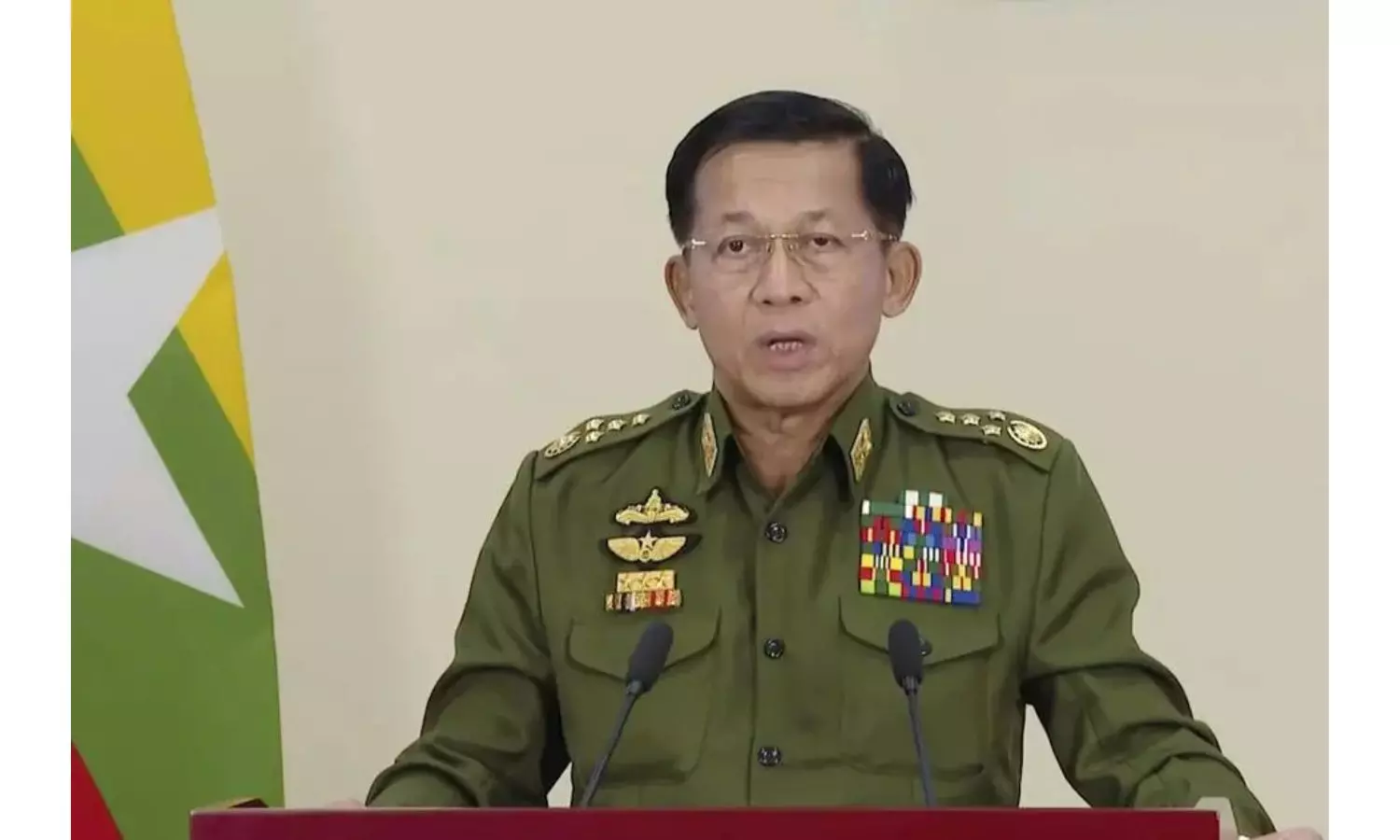
On April 11, 2026, former Senior General Min Aung Hliang, commander-in-chief of Myanmar’s defence forces, was sworn in as the President of Myanmar, thereby transforming him from a uniformed head of state to a civilian head of state. The transformation has not come without its share of criticism, views and espoused interests, both within the country as also internationally. This elevation of the general has passed surprisingly with little attention in India and much of the wider world, which, is now overshadowed by multiple crisis and geopolitical tensions. Yet, it’s long-term effects are profound not just for Myanmar, but for India and the region at large, which is what is reflected in the response by countries in the region.
Hliang has already been the de facto ruler of Myanmar since the February 1, 2021 coup, when the Tatmadav (military) under him seized power. His now becoming the President provides a shred of legitimacy to his government, converting as it does a military rule into a constitutional-looking civilian structure. Within Myanmar, his assuming the presidency has been overwhelmingly shaped by fear, resistance and the political division, although there is a degree of public acceptance by his supporters within and outside the military. Many see this as a further entrenchment of military rule, extinguishing hopes of restoring democratic governance. However, many Myanmar watchers feel that despite the entrenchment of the military, with no coherent popular democratic alternative across the entire country (given the ill-health of Aung San Suu Kyi), in the short term, it provides continuity and may help the country to get out of the socio-economic and socio-cultural morass that it now finds itself in, since it can at least streamline the decision- making process and project order.
In the larger interests of Myanmar and for the short term, this continuity looks better than the dissonance and chaos that exists in the country. The resistance to the Tatmadav by the People’s Defence Force, that is aligned with the National Unity Government (a government-in-exile, which legitimately won the 2020 elections, only to be called a fraud by Hliang) and the Ethnic Armed Organisations (EAOs) is disjointed due to structural, historical and strategic constraints. Their leadership remains fragmented, with no clear-cut objectives. All of them do not share the same vision for Myanmar. The problem further gets compounded by the fact that their capability and organisations are also very dissimilar. The Kachins, the Three Brotherhood Alliance (includes the Ta’ang National Liberation Army, Myanmar National Democratic Alliance Army and the Arakkan Army), the Karen National Union, the Karenni Nationalities Defence Force, Karenni Army and the Chinland Council are all important EAOs, who have long-standing, distinct ethnic and territorial goals, most of which pre-date the coup of 2021 and look at creating their own nations, rather than a unified Myanmar.
Seen regionally, Asean has no consensus on Hliang’s make-over and civilian-looking government. Thailand has responded positively by congratulating him. The Philippines has said that it will continue engagement through diplomatic and Asean channels. Indonesia has not formally congratulated, but instead witnessed strong civil society and legal pushback. Malaysia, which has traditionally been among the more vocal Asean members on Myanmar, has remained constrained and noncommittal. Singapore has neither congratulated nor witnessed any strong public reaction. Vietnam, Laos and Cambodia have been silent and noncommittal. On the whole, realism and prudence seems to have been the order of the day in the Asean grouping.
The People’s Republic of China signaled continued support for Hliang’s leadership by sending a special envoy to attend the inauguration on April 10. Chinese President Xi Jinping also congratulated him on his election, prioritizing stability and maintaining close strategic cooperation despite international isolation. Myanmar’s other friend, Russia, has maintained a supportive stance as well, with a high-level representation attending the swearing-in ceremony. Moscow views the shift to a pseudo-civilian government as an internal matter, continuing to bolster ties through defence and economic cooperation despite international sanctions against the regime. As expected, the United States and the EU, as well as several Western governments have strongly condemned Hliang’s swearing-in, calling it a sham process that legitimises a military dictatorship.
India has also exercised prudence by sending minister of state for external affairs, Kirti Vardhan Singh for the swearing-in ceremony. He carried a congratulatory message and letter of felicitation from Prime Minister Narendra Modi, in which the Prime Minister expressed India's commitment to strengthening bilateral relations and the long-standing friendship between the two nations. In fact, besides China and Thailand, India was one of the very few neighbours that sent a high-level representative to attend the ceremony.
India’s Myanmar policy has always been based on four pillars. These include ensuring border security of the 1,643-km of the India-Myanmar border, preventing camps of Indian insurgents in Myanmar, countering the Chinese influence in Myanmar in whatever way possible and the early completion of connectivity projects such as the Kaladan Multi-Modal Transit Transport Project, the Indo-Myanmar-Thailand Trilateral Highway (which has the potential of getting connected to the other Asean countries as well), besides cashing in on the futuristic Trans-Asian Railway (which will connect Manipur to Asean countries through Myanmar). These four pillars rest broadly on India’s “Act East” and “Neighbourhood First” Policies. A section of the media in India criticised New Delhi sending ministerial-level representation for the inauguration, saying that by doing so India was actively legitimising military rule at the cost of democracy. For India, it makes sense to place its core national interests above everything else, rather than seeking greater democratic credentials for Myanmar. India’s outreach to Hliang and acceptance of his presidency thus signals New Delhi’s continued engagement with Myanmar with pragmatism at the forefront.
The writer is a former Assam Rifles D-G and is currently the vice-chancellor of St. Mary’s Rehabilitation University, Hyderabad