Pradeep C. Nair | Dhaka’s Animosity Likely To Endanger Ganga Water Pact’s Renewal Next Year
The Farakka barrage (which lies 18 km from the Bangladesh border), when it was constructed in 1975, ensured diversion of 40,000 cusecs of water to flush the Kolkata Port
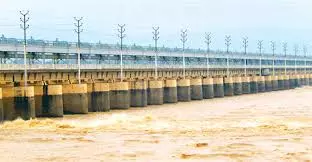
The Ganga Waters Treaty, signed between India and Bangladesh, is up for renewal next year. The treaty, when it was signed in 1996 for a period of 30 years, guaranteed a framework for distributing Ganga waters during the critical dry spell between January and May every year at the Farakka barrage in West Bengal. The Farakka barrage (which lies 18 km from the Bangladesh border), when it was constructed in 1975, ensured diversion of 40,000 cusecs of water to flush the Kolkata Port. When it was commissioned, it led to protests in Bangladesh that led to Bangladesh taking up the matter at the United Nations. It resulted in a five-year agreement in 1977, followed by another in 1982. No treaty for sharing of the Ganga waters existed between 1989 to 1996; a period that witnessed increased disappointment in Bangladesh as a consequence. Subsequently, the 1996 treaty was signed between the two countries, and it assured 35,000 cusecs of water alternately to both countries for 10-day periods during the lean season. The treaty enjoins India and Bangladesh to split the water supply 50:50 if the flow is 70,000 cusecs or less. However, Bangladesh’s share is 35,000 cusecs if the flow is between 70,000 and 75,000 cusecs, while India receives the remaining flow. If the flow is 75,000 cusecs or more, India receives 40,000 cusecs, with the excess flow going to Bangladesh.
The treaty, when it was signed in 1996 between both countries, did not take into consideration climate change and the substantial growth in population that was likely to happen on both sides of the border. According to a report released by Kathmandu-based International Centre for Integrated Mountain Development (ICIMOD) in 2019, the climate crisis will begin altering water levels in the Ganga and the Brahmaputra over the next two-and-a-half decades, and the rivers could record an abrupt decrease in flow after 2050. This will diminish the water available for drinking, irrigation and producing electricity for roughly 250 million people living downstream.
For many years, Bangladesh has raised concerns regarding the treaty, primarily alleging that India withholds water during critical dry spells, leading to water shortages in Bangladesh. Specifically, Bangladesh claims that during the 1997-2016 period, it did not receive its share of water in 39 out of 60 critical periods. Besides, Bangladesh argues that the treaty lacks a minimum guaranteed flow clause, relying instead on diplomatic consultations when flows drop below 50,000 cusecs. Bangladeshi critics also point to a lack of consideration for the river's flow from source to the sea, and an inaccurate projection of future water flow.
The current Muhammad Yunus government in Bangladesh has whipped up an anti-India hysteria like never before since it took power in August 2024. The numerous provocations by Mr Yunus and his cohorts have taken the Indo-Bangladesh relations southwards. The greatest provocation has been by Mr Yunus himself when he made the controversial statement on India’s Northeast during his first state visit to Beijing in March, this year. Despite his numerous provocative statements, his increasing cosying up to Pakistan and China as also fundamentalists at home, India has exercised strategic restraint. Incidentally, the number of people in Bangladesh who are questioning the legitimacy of the interim government of Mr Yunus to take policy decisions on the country’s internal and external matters, has also been increasing.
Seen in the light of the increased strain in the relationship between the two countries, it is fair to assume that a greater degree of disquiet is likely next year when the agreement gets discussed and renewed. After the decision to suspend the Indus Water Treaty with Pakistan, India is now exploring multiple alternatives to reassess domestic needs along with the minimum needs of the Ganga waters for Bangladesh so that both countries can arrive at an agreement that is mutually acceptable. The Centre’s jal shakti ministry set up an internal committee in July 2023 which included the representatives of the Bihar and West Bengal governments. It may be noted that earlier in 2011, the West Bengal government under chief minister Mamata Banerjee had stalled the signing of a treaty for sharing of the Teesta waters at the last moment when India and Bangladesh were on the verge of signing such an agreement. That would still be fresh in the minds of the Bangladeshi people whenever negotiations to finalise a fresh treaty for the Ganga waters commence.
In every likelihood, the fresh treaty would be negotiated by the new government in Bangladesh; given the Yunus government’s announcement that it would conduct elections in March-April 2026. The fresh treaty would have to consider that the new agreement achieves an equipoise in distribution of river waters between both countries. India’s requirements, along with the likely impact of climate change on futuristic water flows, would be considered. Alongside, similar requirements of Bangladesh would also have to be looked into, thereby navigating the political compulsions on both sides. In the meantime, it would be prudent for India to give the necessary reassurances to Bangladesh, besides reminding them of the recent Chinese announcement that work on the 60-GW Yarlung Tsangpo hydro project has commenced, which will seriously affect water flow and ecology in Brahmaputra, both in India and Bangladesh.
India should also remind Bangladesh that China has no water sharing treaty with any of its neighbours and should take Bangladesh on board in jointly calling out the adverse effects that this project of China is likely to trigger. After all, India understands Bangladesh is a very important neighbour which has traditionally been friendly, and work towards ensuring that the current anti-India euphoria in Bangladesh is but a blip in the long-standing India-Bangladesh relationship.
The writer is a retired lieutenant-general who is a former director-general of the Assam Rifles and has extensively served in the Northeast