Pradeep C. Nair | As Manipur Rivals Tussle In State, Let’s Keep India’s Focus On Larger Picture
The polarisation between Meiteis and Kukis has been complete, and has seemingly reached the point of no return
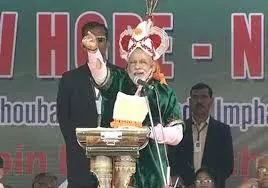
Prime Minister Narendra Modi’s visit to Manipur on Saturday, September 13, had been much awaited by both the Meitei and Kuki communities in the state after 29 months of clashes. At Imphal, he addressed the largely Meitei audience at the historic Kangla Fort and described the 2023 events and the subsequent violence as “unfortunate”, besides emphasising building “a strong bridge between the people of the hills and the valley”. He inaugurated projects worth Rs 1,200 crores and promised 7,000 new houses for the internally displaced people after meeting some of them. He underscored the role played by women, who have been at the forefront of the economy; the Ima Keithel. He also highlighted the role played by the sons and daughters of Manipur in Operation Sindoor.
Before that, the PM had visited Churachandpur, that last saw visits by a sitting PM in 1971 (Indira Gandhi) and 1988 (Rajiv Gandhi). There, he addressed the largely Kuki people at the Peace Ground and laid the foundation stone for multiple development projects worth Rs 7,300 crores, which included highways and roads. Interestingly, he spoke for 20 minutes in Churachandpur and 23 minutes in Imphal, thereby clearly showing a balance and highlighting the importance of both the ethnic groups. At Churachandpur, he also met the displaced people, took into account their perturbation and assured all possible help.
Much has been said about the PM visiting the trouble-torn state too late, by calling it “tokenism” or as “too little being done” for the state that has witnessed cycles of violence for almost two and a half years. However, it must be acknowledged that the past happenings in the state cannot be undone. What is more significant is the way forward for not just the two communities that have been at loggerheads, but also for the entire Northeast region. One also has to take note of the turmoil in Myanmar for over four years now, the turbulence in Bangladesh for the past 14 months and, more recently, the Gen Z uprising that toppled the K.P. Sharma Oli government in Nepal. These potentially impact the Northeast, which is still coming out of the grip of insurgency and faces threats due to trans-border movement of militants, increased inflow of refugees, a spike in the smuggling of drugs and other contraband goods and trans-border ethnic links that challenge the very fibre and soul of Manipur.
The polarisation between Meiteis and Kukis has been complete, and has seemingly reached the point of no return. There are, however, straws in the wind; the home ministry meeting in Delhi in April 2025, when leaders from both communities were spoken to, albeit separately, and given recommendations on the restoration of normalcy. Even early this year, members of both groups had refused to be present for any talks without their grievances being addressed first; for Kukis it was the demand for a separate administration, for Meiteis it was the granting of ST status, besides banning the Suspension of Operations which the Manipur government had unilaterally withdrawn from in February. The SOO has been extended on September 4 in talks between the Centre, the state government and the Kuki SOO groups. The SOO rules are now more stringent and take care of few concerns of the Meiteis. Many Meiteis have condemned the extension of the SOO, but the opening of highways (a major demand of Meiteis) has also been agreed by the SOO groups as contingent to the SOO extension.
The Nagas recently added a new dimension to the unrest across Manipur. Ahead of the Prime Minister’s visit, they called for a “trade embargo” as a sign of protest against the Centre’s move to fence the India-Myanmar border and scrap the Free Movement Regime, which permitted document-free travel for the border residents of both countries up to 10 km from the boundary line dividing the two countries. The Naga bodies executed the embargo on all transit routes passing through the state’s Naga-majority districts. Consequently, hundreds of trucks and tankers were stranded on the highways in the state. The ban remained in place between September 8 and 11, and was later called off by the Naga bodies. The threat of such a future “trade embargo” by the Naga bodies, however, remains.
The highlight of the PM’s visit was not the infrastructure projects that were announced by Mr Narendra Modi, but the healing touch that this visit has provided to the people, despite the opposition by certain groups and the protests during his visit. These, however, were a small minority and did not reflect the true sentiments and aspirations of Manipur’s people at large. The PM’s commitment that he was with them has given the people the necessary assurance that they were seeking. The greatest need today in Manipur is the psychological and mental healing of thousands of traumatised people. This will perhaps be the most significant and challenging task. Without that, the polarisation that exists between the two communities will remain. It’s here that the civil society organisations, the youth, the women’s organisations and well-meaning neutral people have their task cut out.
As a diverse nation, with troubled borders on our north and west, it is our outreach to the Southeast Asian countries and the Indo-Pacific that will determine the future trajectory of our economic prosperity. Manipur’s geographic advantage, given that the Asian Highway and the Trans-Asian Railway will link the state to Southeast Asia, holds out the promise of heralding change like never before. The naysayers must keep this larger picture in mind to help Manipur in both its psychological and physical recovery, and enable the state to achieve its true potential, rather than trying to settle scores from the past.
The writer is a retired lieutenant-general who is a former director-general of the Assam Rifles and has extensively served in the Northeast