Nilanjan Mukhopadhyay | As Toxic Air Chokes Delhi, Will We Learn Any Lessons?

For over three decades, since when awareness about this gained currency, people and the government, courts, doctors, media and environmental scientists played their roles in setting rules, issuing orders and mounting campaigns to educate people on harmful effects, on health, as well as the environment, of the excessive bursting of crackers
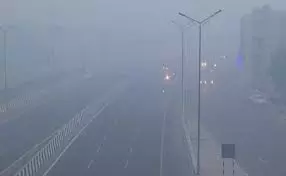
Paradoxically, in large parts of north India, Diwali -- also called the Festival of Lights -- heralds, give or take a week or fortnight, the beginning of the season when practically the entire region gets shrouded in depressing grey smog. For weeks, the pall of gloom filters sunlight and the sound of hesitant to wracking coughs of people, a constant reminder to all-pervading toxicity. It is turning out no different this year.
For over three decades, since when awareness about this gained currency, people and the government, courts, doctors, media and environmental scientists played their roles in setting rules, issuing orders and mounting campaigns to educate people on harmful effects, on health, as well as the environment, of the excessive bursting of crackers. People were told while burning of crop stubble by farmers was a key factor, unfathomable amount of crackers and other fireworks burst and lit in almost every large city, especially Delhi, spiked the level of pollutants. The city’s air pollution this year was reportedly 15 times the WHO limit.
Other approaches were used, including a humanistic one. Children in schools were lectured that numerous factories manufacturing crackers employed child labour because of their nimble fingers. Many of them, the students were told, got grievously injured, requiring amputation of fingers or limbs. The children were told it was “immoral” to enjoy by bursting crackers and playing with fireworks manufactured by kids like them, only that they were born in poorer families and had to contribute to the family’s kitty.
For a variety of geographical, topographical, meteorological, industrial, human practices, and either government inaction or misdirected action, Delhi was from the beginning, not just India’s capital, but also the epicentre of India’s most-polluted urban space. There was no single factor behind the capital’s infamy, but Diwali was undoubtedly one of the biggest, and its effect lasted days, except when the winds blew kindly over Delhi, carrying away smoke and chemicals in the air. For as long as anyone can remember, Delhi’s political leaders cautioned citizens and pleaded for restraints while bursting firecrackers. In time, restrictions were also placed on their sale. Gradually, this had a positive effect: while pollution triggered by Diwali continued being a cause for concern, the number of crackers and people bursting them, declined appreciably.
Against this backdrop, the Delhi government this year was the biggest facilitator for the more raucous and polluting Diwali. Much before the festival, the first BJP chief minister since 1998, Rekha Gupta, urged the Supreme Court to permit firecrackers. It had the desired effect: an apex court bench comprising Chief Justice B.R. Gavai and Justice K. Vinod Chandran relaxed the blanket ban on fireworks in Delhi and the National Capital Region. It permitted the sale of so-called “green” fireworks for a few days and especially within a short time window.
At the risk of offending the higher judiciary, one must say that the judges were naive to believe their order would be followed to the letter. Eventually, as many noted on social media, “green” firecrackers were an oxymoron. Furthermore, the Delhi police did not conscientiously enforce either the time-band or dates when shops could sell the firecrackers. The problem was compounded as the order was applicable to Haryana and Uttar Pradesh too. It is well known that the enforcement of judicial orders by the state police in districts bordering Delhi is even more lax. However, instead of pinning the blame on people and institutions in the middle of the power rung, one should heed what the SC noted: that the Centre too had sought relaxation of the firecracker ban, “at least during the festive periods”.
The judges also recorded that solicitor-general Tushar Mehta, appearing for the Centre and NCR states, made a “fervent plea” to lift the ban during Diwali and other major festivals, including Christmas and New Year’s Eve. This certainly made it seem that the government was not pleading for “full” celebration of the festival of just one community.
The cat was, however, let out of the bag by Ashish Sood, Delhi’s minister for home, power and education departments. He said the SC verdict was a significant step towards enabling the majority community to celebrate “their” festivals ‘freely’. Mr Sood alleged that previous governments (AAP and Congress) blocked firecrackers on Diwali because of “minority and vote bank politics”. If this hadn’t vitiated the communalism pot sufficiently, he further claimed the two previous governments “used to block opportunities where the majority community could celebrate their festivals openly”. Mr Sood’s attempt to classify festivals under column heads of “ours” and “theirs” may have been endorsed by many Hindutva votaries. But it runs against the Indian tradition of such festivals being celebrated across communities.
A cursory Internet search reveals how Diwali was celebrated in the Mughal courts. The idea of cultural nationalism, the basis of Hindutva, talks of a common “culture” of this nation’s people, that is distinct from religion. This kind of Diwali is a people’s culture that is still alive. The conceptualisation of Mr Sood and others like him, that this is the festival of the majority community, is reductionist and downgrades it into a sectarian and crude ritual, where the primary objective is to make the loudest noise and pollute the atmosphere.
These assertions and the episode involving Diwali celebrations in Delhi-NCR was echoed by Uttar Pradesh chief minister Yogi Adityanath during the record-breaking lamp lighting ceremony in Ayodhya on Diwali eve. Although this performance has been staged since he assumed office in 2017, Adityanath still referred to the previous governments (headed by SP’s Akhilesh Yadav and BSP’s Mayawati), alleging that previous governments “fired bullets” in the temple town, while “his government lights lamps”. This is symptomatic of the BJP government’s empty chest of accomplishments; as Adityanath could not speak about a litany of achievements, and had no option but to stir forgotten memories of police firing from the past.
This year’s winter is yet to set in appreciably in most parts of north India. Pollution levels are rising. There might be a short respite, once Diwali fumes get blown away, but there is a long haul ahead till well into 2026. Will the Delhi government approach the challenge from pollution diligently and come up with fresh ideas on ways to combat this hazard, or will it continue to look solely at how the previous governments failed? Past experience since 2014 indicates how the coin will land, but we shall remain hopeful that Ms Gupta and Mr Sood will look beyond jingoism and playing the blame game.