Pakistan, for all its fascination with West Asia, remains fundamentally divorced from the region’s core power dynamics.
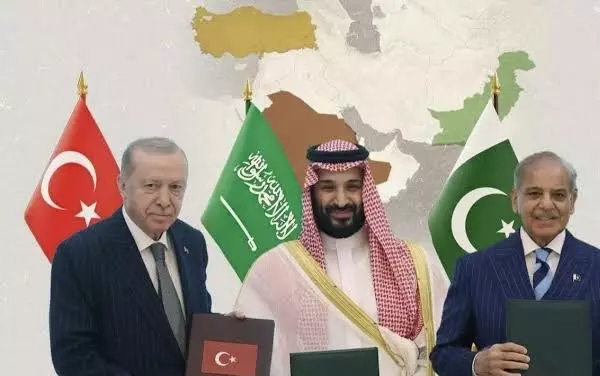
As officials from Ankara, Riyadh and Islamabad extol the virtues of a new tripartite axis — the Mecca Joint Defence Agreement — one could perhaps be forgiven for a profound sense of déjà vu. The pact is a fresh chapter in a long, and largely ironic, chronicle of Pakistan’s strategic forays into West Asia.
It is eerily reminiscent of the Cold War’s most flawed constructs. It is born not of an organic confluence of national interests but of a shared, albeit differently perceived, sense of vulnerability.
Saudis seek deterrence against a revisionist Iran and a restless Houthi insurgency. Türkiye, ever pursuing its neo-Ottoman ambitions, seeks to deepen its foothold in the Gulf. Pakistan, perennially cash-strapped and strategically isolated, seeks the lifeblood of Gulf petrodollars and a renewed sense of relevance on the world stage. Yet, this transactional foundation is precisely what doomed Pakistan’s earlier ventures.
Pakistan, for all its fascination with West Asia, remains fundamentally divorced from the region’s core power dynamics. It has traditionally served not as a net security provider, but as a launchpad for Western strategic projects.
In February 1955, the Turco-Iraqi Baghdad Pact created the Middle East Treaty Organisation (Meto). It was preceded by a Turko-Pakistan defence agreement in 1954, signed between Pakistan’s foreign minister Md Zafrulla Khan and Turkish Ambassador Selahattin Refet Arbel. This arrangement, emanating from the overlapping interests of the UK, the US, and Hashemite Iraq, was designed to complete a “Northern Tier” of containment stretching from Turkey to Pakistan. Subsequently the UK in April, Pakistan in September and Iran in November, joined Meto. Iran’s accession completed the “Northern Belt” along the Turkey-Iraq-Iran-Pakistan line. After the July Revolution in Iraq in 1958, when the government led by Abd al-Karim Qasim withdrew from the pact, Meto was renamed Central Treaty Organisation (Cento).
The same strategic mirage reappeared in Southeast Asia. After the French defeat in Indochina in 1954, Washington was keen to deter and contain communism in the region. In September 1954, representatives of eight governments, including Pakistan, met at Manila and formed South East Asia Treaty Organisation (Seato). Pakistan has no connection with South East Asia except that it was a United States Cold War lackey.
The alliances, for Pakistan, were a means to an end, the end being a stronger hand against New Delhi, thereby negating its very raison d’être for the Western powers who underwrote it. Ayub Khan of Pakistan, himself an early architect of the US-Pakistan relationship, told The Daily Telegraph in London in January 1962 that Pakistan was losing faith in Cento and Seato. These alliances did not serve any collective security arrangement in the wars of 1965 and 1971. The ultimate humiliation was the 1971 dismemberment of Pakistan and the birth of Bangladesh. Pakistan withdrew from Seato in 1973, and Cento was disbanded in 1979, collapsing under the weight of its own irrelevance.
The same pattern appears to repeat with the Organisation of Islamic Cooperation (OIC). Pakistan has been a key part of its militarisation and has used it multiple times to try and internationalise the Kashmir issue, but the OIC has never been inherently suited for a workable strategic alliance, given its multiple internal dissensions amongst Islamic states. The second summit in 1974 was held in Pakistan, at a time when Pakistan still did not recognise Bangladesh. Under pressure from other nations, Pakistan was compelled to invite a delegation from Bangladesh, and it was at this very summit that Pakistan came to recognise the nation. The OIC may offer diplomatic theatre, not strategic substance.
Likewise, the Regional Cooperation for Development (RCD), set up in July 1964 by the regional members of Cento (Iran, Turkey, and Pakistan) was intended to strengthen socio-economic development. But financial, political, and administrative difficulties made progress slow. Its political significance grew steadily even as Cento’s declined. Recognising that RCD could not provide an effective military substitute, Iran and Turkey still attached value to Cento. After 12 unsatisfactory years, the three regional heads of state held a summit in Izmir in April 1976, making amendments to the 1964 declaration. The Treaty of Izmir was signed in 1977 as the legal framework for RCD. Yet RCD was unsuccessful, and had to give way to the Economic Cooperation Organisation in 1985.
Exhumation of the ghosts of Cento and Seato renders the 2025 Saudi-Pakistan mutual defence pact deeply instructive. Touted as extending a Pakistani nuclear umbrella to Riyadh, the agreement did little to deter Houthi missile attacks on Saudi soil. It was conspicuously impotent when Iranian missiles struck the Prince Sultan airbase and Riyadh airport, and when the Aramco refinery at Ras Tanura was hit in early 2026. It was only in late April 2026 that Islamabad dispatched 13,000 troops and fighter jets to the Kingdom. Ultimately, Riyadh was compelled to take matters into its own hands, forming the Multinational Maritime Défense Coalition (MMDC) with thirteen other nations, including Pakistan, to defend the Red Sea.
The Mecca Agreement, too, is not free from internal discords. The Arab Spring initially saw them aligned against Bashar al-Assad in Syria, with both nations financing various anti-Assad factions. However, Turkey also demonstrated support for the Muslim Brotherhood, which Saudi Arabia opposed, creating an uneasy sentiment in Riyadh. In 2013, when the Egyptian coup broke out and Mohamed Morsi, a Muslim Brotherhood member and then-President of Egypt, was forcibly removed by pro-Saudi Abdel Fattah el-Sisi, Turkey condemned the move.
In 2017, the two nations were at odds over the Qatar diplomatic crisis, with Turkey supporting Qatar against Saudi Arabia. The murder of Saudi journalist Jamal Khashoggi inside the Saudi consulate in Istanbul only made matters worse. The conflict in Nagorno-Karabakh saw Ankara and Riyadh trading accusations of destabilizing the region.
Beneath this volatile history lies the unspoken reality of Turkish neo-Ottoman ambitions, which directly threaten the traditional leadership role of the Gulf Cooperation Council. Ankara’s efforts to rebuild military and economic beachheads along the eastern flank of the Arabian Peninsula, from Oman to Southern Iraq, are the building blocks of a revived sphere of influence that encircles and constrains Saudi power.
Pakistan, for its part, has stepped into this volatile dynamic, hoping to act as a bridge. But history suggests it will more likely be a wedge. It is a nation in search of patrons that seeks to extract resources from the relationship — financial assistance, investment, and diplomatic support — while contributing little in the way of genuine, deployable security.
The graveyard of Pakistan’s alliances is thus a place of recurring lessons: alliances forged with external powers for purposes alien to Rawalpindi, weakened by internal discord, and undermined by a fundamental mismatch of objectives.
There is also another informal understanding if not convergence in the South Asian-Middle Eastern thea
