Manash Ghosh | Bangladesh Game Of Votes: How Hindus Aided BNP Victory

For instance, the BNP, concerned over the American and Pakistani Deep State’s unabashed role in promoting the Jamaat-e-Islami’s electoral prospects, was forced to take counter-measures, such as by winning over its bête noire Awami League’s sizeable Hindu vote bank
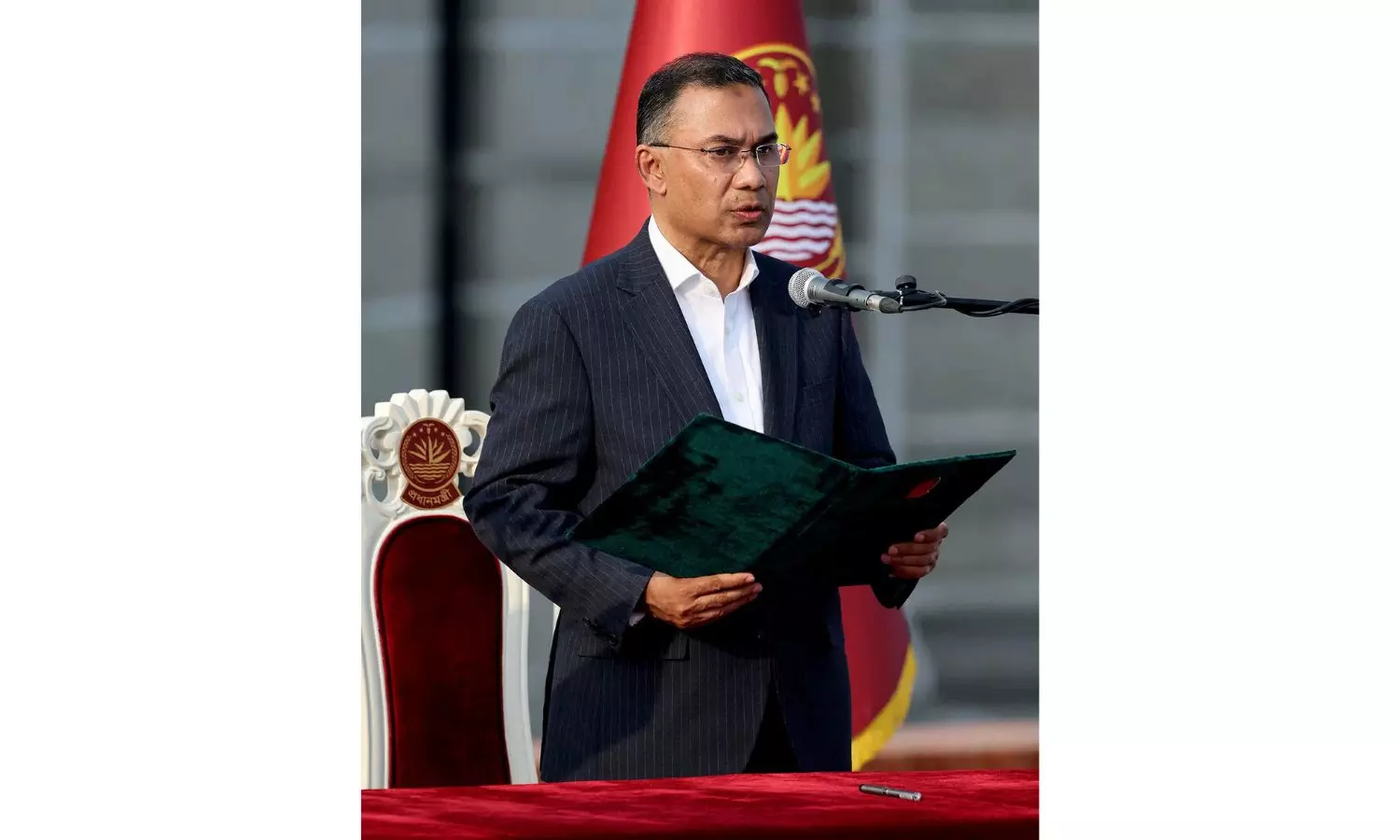
Bangladesh’s recently held 13th parliamentary election was an exercise of paradoxes. Parties which had for over four decades considered themselves natural allies spawned from the same mother, and who had twice jointly run governments for over a decade, contested this time as inveterate foes. Unsurprisingly, both went full throttle in trying to outwit each other through one-upmanship and ingenious moves. For instance, the BNP, concerned over the American and Pakistani Deep State’s unabashed role in promoting the Jamaat-e-Islami’s electoral prospects, was forced to take counter-measures, such as by winning over its bête noire Awami League’s sizeable Hindu vote bank. Just the way Sheikh Hasina’s August 2024 overthrow had been orchestrated, similarly a meticulously designed electoral strategy had been drawn jointly by Jamaat backers as well as Muhammad Yunus, who wanted an outright victory for the 11-party Islamic alliance. They knew that with the votebank’s protective shield gone (provided by the top AL leadership), this minority bloc (comprising 1.5 crore Hindu voters out of a total 12 crore-plus Bangladesh voters) had become extremely vulnerable and could easily be preyed upon by Jamaat through coercive and persuasive tactics. This emboldened their chief Shafiqur Rahman to proclaim that he could “clearly foresee his party’s emphatic victory and that February 12 would be a turning point in Bangladesh’s political history”. His comment was further reinforced by a Western news agency’s prediction of a shock result awaiting Bangladesh, with JeI’s Islamic alliance stealing a march over the BNP at the hustings. The Jamaat was so confident of its success that it even released names of its five Cabinet ministers well in advance.
But the BNP had an ace up its sleeve. Its secretary-general, Mirza Fakhrul Alamgir, along with two other senior party leaders had already held two secret meetings with three Hindu apex bodies to seek the support of Hindu voters. A similar offer had been extended to those bodies by the Jamaat, but it got no response. Hindu leaders, at their meeting with Mr Fakhrul, had been categorically told “to stand by us to resist Jamaat”. But the Hindu community had laid down one condition: the spirit of the liberation war for which Bangladesh fought and won, and which formed the basis of the 1972 Constitution, must be protected and upheld.
Mr Fakhrul pledged that his party would never compromise on the nation’s ideals, but he knew his assurances alone wouldn’t convince Hindu voters. Thus, a meeting was arranged with BNP chairman Tarique Rahman, who reasserted that the BNP was a party of “muktijodhdhas”, and while most Hindus never backed his party, they could give it a chance and see the difference.
Mr Fakhrul, to ensure all Hindu votes were cast for the BNP, saw to it that leaders of the apex bodies campaigned across all 64 districts to convince Hindu voters how crucial their vote was for the BNP to defeat Jamaat. But the Hindu community was unwilling to respond positively. They recalled how BNP cadres had brutalised them for having voted for AL in the 2001 polls. It took a lot of persuasion to bring them around; they were warned that in AL’s absence it would be foolhardy for them to boycott the elections as that would help Jamaat romp to power with ease, which would land all the minorities in an existential crisis. Even Awami Leaguers were for voting the BNP to power to deny victory to Jamaat.
This appeal had a magical effect.
Saikat Paul, a young Bangladesh Supreme Court lawyer, clearly spelt out this exceptional tectonic shift in Hindu votes, a first in Bangladesh elections: “The 1.5 crore Hindu voters, by voting for BNP, kept Bangladesh’s muktijudhdho ethos and identity alive and intact. They realised that if this was not done, the People’s Democratic Republic of Bangladesh would overnight become an Islamic Republic.”
It was the Hindu votes that saved the day for the BNP in at least 80 seats, where the party won by a slender margin of 2,000 votes and more. Besides, the Jamaat chief’s repugnant remark on working women, comparing them to prostitutes, alienated most women voters who, along with Hindu voters, heavily tilted the electoral balance in favour of the BNP. Realising the formidable odds facing them, the Jamaatis began widespread rigging the night before and on the day of the election.
The social media livestreamed Jamaat cadres furiously stamping ballots and stuffing them into ballot boxes, with the presiding officers looking on helplessly. No wonder the Election Commission at 11 am in its accounting of the voting percentage, quoted 14%, which leapfrogged first to 47.91% at 2 pm, and then to 65% at 5 pm. This galloping percentage showed that this “non-inclusive farcical” election was no different from those held under Sheikh Hasina’s rule, which had been labelled both by the BNP and Jamaat as “lacking in credibility”. Despite the dubious nature of the Jamaat’s electoral credentials, its fairly spectacular rise in the polls is the most significant feature of this election. From just two seats it had won in 2008, it raised its tally to 68, which has brought about a significant change in Bangladesh’s political landscape.
What is disconcerting for India about the Jamaat’s dramatic rise is that the bulk of the 68 seats it won (around 40) are all along the West Bengal border. This has already raised security concerns for poll-bound West Bengal, whose border districts have lately seen communal clashes and bomb blasts.
The Awami League’s most significant gain is that despite Muhammad Yunus keeping it out of the poll fray at the behest of the US and Pakistan, the party has proved its indispensability in national politics. lts muktijudhdho-centric policies at times of national crisis have worked as a political beacon that guided Bangladesh to overcome challenges posed by Islamists. The political support that its local leaders and supporters extended to the BNP has begun to minimise the trust deficit between the two traditional rivals. Their equation has changed from open hostility to one of growing understanding and cooperation, which is reflected in local BNP leaders initiating the reopening of AL offices throughout the country, earlier shut down on the orders of Mr Yunus. Given the growing points of friction that are developing between Jamaat and the BNP, the latter knows that containing a regimented, aggressive, foreign-backed JeI and other Islamist forces requires AL’s help, especially when JeI is still scrambling to grab power at any cost. A close Jamaat ally has already given a call to people to “remain prepared for another mass uprising” as it isn’t happy “with the way the country is now being run”.
Manash Ghosh is a veteran journalist who had covered the 1971 Bangladesh liberation war, and is the author of several books including, most recently, Mujib’s Blunders: The Power and the Plot Behind His Killing