Manash Ghosh | After Didi’s Defeat: B’desh Big Challenge For Suvendu

New Delhi’s perception of Mamata and her government saw a sea change after the Khagragarh bomb blast on October 2, 2014 in which two persons, one a Bangladeshi jihadi belonging to the banned Bangladeshi terror group Jamaat-ul-Mujahideen (JMB), were killed
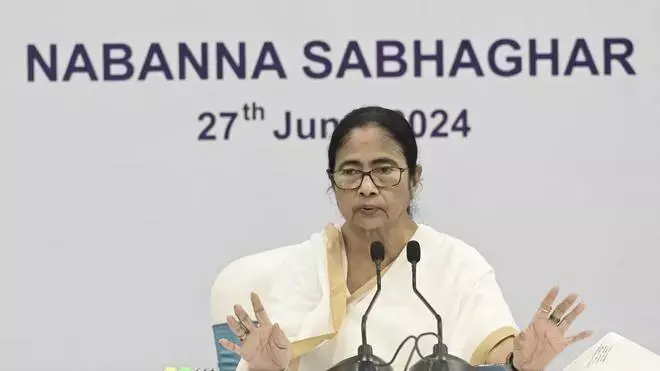
That a much-vaunted secular party like Mamata Banerjee’s Trinamul Congress, which during its 15 years of rule in West Bengal had proved itself to be electorally invincible, could suffer such a humiliating defeat at the hands of the BJP, a much-derided party in the state where it was seen by some as a “rank communal and Hindi-speaking cow belt outfit run by banias”, bears eloquent testimony to how a host of chauvinistic policies, inimical to national interests, pursued by Mamata had alienated a large section of Bengali and non-Bengali Hindu voters, leading to her party’s debacle.
Also contributing significantly to the saffron surge was the rather desperate attempt by Mamata to move Bengalis away from the national mainstream by raising many psychological barriers between West Bengal and the rest of India, so that a sense of mistrust and alienation could sink deep into the Bengali psyche, which she could exploit politically to stay in power.
One of the key themes in her campaign was that Bengalis were being forced out of BJP-ruled states for speaking in Bengali and eating fish and meat; that anyone doing so was called a Bangladeshi and deported. Letters written by Bengalis from outside West Bengal to newspaper editors called her charge “absolute lies”. During the campaign, she ended her speeches with Bangladesh’s liberation war cry “Joi Bangla” as she felt that West Bengal, like the former East Pakistan, was being denied its share of the national pie and was being exploited by the Centre. She also started replacing the Ashok Stambha national emblem on iconic government structures with the “Biswa Bangla” logo. The screening of films like Kashmir Files and Bengal Files were disallowed, and national heroes like Maj. Gen. G.D. Bakshi (Retd), who were to deliver lectures on national security issues at Kolkata’s premier clubs, were dissuaded from entering the city.
This made the RSS-BJP leadership and the national security establishment sit up and look at West Bengal as a national security problem, which must be urgently addressed through the ballot, as any other means might backfire and plunge the state into anarchy.
Ever since 2011, when Mamata came to power with offered many “wild” promises, such as job reservations, special housing, healthcare facilities and OBC certificates for Muslims in the state, which together with all-out support from Muslim clerics helped to solidify her Muslim vote bank. However, she could not deliver on many of her promises as the courts struck down official implementation orders as these were “patently unconstitutional”.
New Delhi’s perception of Mamata and her government saw a sea change after the Khagragarh bomb blast on October 2, 2014 in which two persons, one a Bangladeshi jihadi belonging to the banned Bangladeshi terror group Jamaat-ul-Mujahideen (JMB), were killed. She and her administration desperately tried at first to cover it up as a gas cylinder blast. Later, she put the blame on Central intelligence agencies, alleging they had orchestrated it to tarnish her government’s image. Later, a CBI probe revealed the house where the blast occurred was rented by JMB supporters for making indigenous explosive devices (IEDs) to carry out terror attacks in India by JMB jihadists who had clandestinely entered India and were sheltering in a local madrasa where they were engaged as religious teachers.
What upset Delhi the most was Mamata blaming the security agencies for the blast, as that had come in handy for Pakistani politicians, media and ISI to capitalise on to sharpen their anti-India campaign and justify their claim that Indian spy agencies themselves were responsible for those blasts.
What raised Delhi’s hackles further was the “warning” by one of Mamata’s ministers, Siddiqulla Chowdhury, that “all hell would break loose” if it dared to harass Bengal’s Muslims on the Khagragarh issue. He called for a siege of Kolkata’s city centre Esplanade -- where lakhs of his armed supporters converged and squatted for hours, paralysing the city.
Being the state’s home (police) minister, Mamata deliberately turned a blind eye to Bangladeshi infiltrators, especially jihadists, building terror hubs in Muslim-majority districts like Dinajpur, Malda and Murshidabad, where in large areas local Hindus could hold pujas only with orders obtained from the Calcutta high court. Such was the social pull of the Bangladeshi “bhaijans” on their Indian brethren that any trivial issue could be used to incite them to vandalise Hindu households and desecrate their temples. They even burned down the entire Kaliachak thana in Malda and all its vehicles, and forced its personnel to flee. To hide the extent of devastation, Mamata got the thana repainted overnight and ordered the removal of burnt police vehicles to far-off places. The Hindus of Beldanga in Murshidabad could not celebrate any of their religious festivals, fearing a Muslim backlash. Bangladesh-made ordnance like hand grenades and bullets were found by the NIA there.
Mamata Banerjee’s ignominious defeat and the BJP’s emphatic victory in West Bengal have come as a huge shock to Dhaka’s current rulers. No wonder Mamata’s defeat made an Islamic leader, Nurul Huda, appeal to her to declare West Bengal as independent and to start a “war of independence”.
West Bengal chief minister Suvendu Adhikari’s first Cabinet decision to hand over land to the BSF to complete barbed wire fencing along the most vulnerable, unfenced stretch of the international border has caused considerable consternation to the Dhaka establishment. Prime Minister Tarique Rahman’s foreign affairs adviser has warned Suvendu Adhikari that he cannot intimidate Bangladesh by fencing the unfenced portion of the border.
Mamata had procrastinated far too long in handing over land to the BSF for plugging this unfenced section so that the implementation of Bangladesh’s geo-political concept of “lebensraum” could continue unchecked. This concept had become the undeclared policy of successive Dhaka rulers from Gen. Zia-ur Rahman onwards, all of whom were sending their economically marginalized population into those parts of eastern India and the Northeast that were sparsely populated. Dhaka’s policy planners always believed that India’s states adjoining Bangladesh and beyond had considerable “living space”, where their settlers could go and live. Bangladesh felt it needed that space to support its vast population and secure resources for its natural development. Its present land area couldn’t support its growing population of 180 million.
That Bangladeshi “colonisation” of Indian land could change the political geography of South Asia was recently proved by Muhammad Yunus, Dhaka’s interim leader, who redrew the borders of Bangladesh by including the whole of the Northeast and parts of eastern India as a part of “Greater Bangladesh”. How Suvendu Adhikari and Assam’s Himanta Biswa Sarma deal with Dhaka’s “lebensraum” threat is what every Indian will be eagerly waiting to see.
Manash Ghosh is a veteran journalist based in Kolkata and the author of several books including, most recently, Mujib’s Blunders: The Power and the Plot Behind His Killing