Krishnan Srinivasan | Why Ukraine’s Zelenskyy Is A Great Salesman And Illusionist

There were claims in February that Ukraine made more territorial gains than Russia. Not all pro-Ukrainian monitoring platforms supported these, amid a “grey zone” where control is unclear and advances are measured in 150-200 square km per month
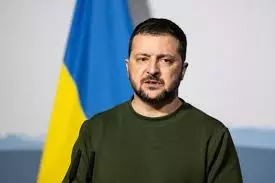
Ukrainian President Volodymyr Zelenskyy’s public relations skills have earned him a reputation acknowledged by all; US President Donald Trump, who had attacked Mr Zelenskyy publicly, called him “the greatest salesman on earth” and a sympathetic New York Times columnist, David French, ludicrously portrayed him as “the leader of the free world”. But Mr Zelenskyy’s daily broadcasts can do little to change the battle dynamics in Eastern Ukraine. Of late, Kyiv has tried to create the impression that the Ukraine war is near a successful turning point.
There were claims in February that Ukraine made more territorial gains than Russia. Not all pro-Ukrainian monitoring platforms supported these, amid a “grey zone” where control is unclear and advances are measured in 150-200 square km per month. The situation lends itself to producing the preferred conclusion that Ukraine or Russia is gaining ground.
Reality paints a different picture. There is nothing to suggest any significant change in the battlefield dynamics over the past two years. Russian troops are besieging a number of cities in the north of the Donetsk region and their advances along the northern border are extending the active front line by hundreds of kilometres, which renders Ukraine’s personnel shortages feel more acute than usual. Four years into the war, the Ukrainian authorities had now to resort to brutal campaigns to enforce mandatory conscription, including pulling men off the streets of towns and villages. Meanwhile, Russia can still lure volunteers by offering lavish compensation.
Ukrainian officials claim that Russia is losing more troops than it can recruit, but this is based on dubious data. Mr Zelenskyy has claimed that the Russians suffered their highest number of monthly casualties, at 35,000 last March, but his own defence ministry contradicted this, saying the highest Russian monthly losses was 48,000 in January last year, and an average monthly loss of about 35,000 throughout 2025. Mr Zelenskyy’s chief of staff Kyrylo Budanov also corrected the narrative that Russia is having difficulty in recruiting personnel, noting any collapse of the Russian mobilisation campaign was not taking place.
It’s definitely true Ukraine is conducting a successful campaign with drones to damage Russian oil facilities, but this is unlikely to change the dynamics of the war, apart from providing dramatic footage of oil tanks on fire. In April, Russian oil revenues surged to $9 billion, due to US-Israel strikes against Iran and the closure of the Hormuz Strait to shipping including oil exports. The windfall Russia received in that one month was equivalent to 10 per cent of the total loan Ukraine will get from the European Union over the next two years to help fund its war effort.
Certainly, Russia has sustained considerable economic losses due to the war, and President Vladimir Putin has acknowledged as much. But the Russian economy mirrors much the same downturn as other European economies that are also affected by the wars in Ukraine and the Middle East. Russia’s gross domestic product per capita adjusted for purchasing power parity (an indicator reflecting living standards) currently exceeds that of the less affluent eastern European countries, according to the IMF. But the same indicator for Ukraine is on par with Mongolia and Egypt, while the country’s battered infrastructure is in ruins and millions of Ukrainians have fled the country, most of them probably for good.
With Ukraine’s prospects evidently not improving, pro-Ukrainian lobbies led by Mr Zelenskyy concentrate on every bad tidings from Russia, which they hope signify cracks in the regime. There is definitely deep cause for frustration in Russia, but it is far from approaching decline and fall. This narrative, however, serves to distract Ukraine and the EU in Brussels from the unwelcome truth that the war is heading towards a deadlock at best, and Ukraine’s collapse at worst.
Mr Zelenskyy has received a lifeline with the $90 billion Euro loan, but his and his allies’ lack of vision for any winning strategy are discouraging.
Perhaps some reality has already begun to dawn. German Chancellor Friedrich Merz recently suggested that Ukraine would have to concede some of its territory to Russia to end the war and obtain a faster track to EU membership. The EU’s Lithuanian commissioner for defence, Andrius Kubilius, has claimed that Nato membership for Ukraine was out of the question and EU membership was going to be a complicated process. Instead, he proposed a military union of Ukraine and other European countries, an idea that Moscow will certainly reject as implying Nato’s eastward expansion through the back door.
What these assorted statements seem to show is that dialogue over the terms of peace is currently not so much between Mr Zelenskyy and Mr Putin, but between Mr Zelenskyy and his Western allies. As Mr Budanov recently stated, the positions of Kyiv and Moscow can be moved closer through bilateral talks to what is realistically attainable. But Mr Zelenskyy needs politically to show some kind of benefit for Ukraine when a rather unpalatable peace treaty is finally signed. That gain should be EU membership and credible security guarantees, but as the statements of Chancellor Merz and Mr Kubilius suggest, the chances of attaining them now may be slim.
The frustration among Ukrainians is already evident. The head of Ukraine Parliament finance committee, Danylo Hetmantsev, blamed European officials for treating Ukrainians as “a tool for solving someone’s geopolitical tasks” or as a human shield, who had no right to define Ukraine’s destiny. Mr Zelenskyy himself, now facing investigation into corruption scandals involving his immediate entourage, seems unable to exert any influence on Russia or his Western allies. The current situation, as he poses as an articulate and defiant war leader under massive pressure, serves his image well, but can’t be sustained indefinitely. The odds are stacked against him.
Krishnan Srinivasan is a former Indian foreign secretary