I would squirm every time I watched a song filmed abroad and wonder at the shamelessness of it all. How could anyone be that thick-skinned, that immune to what people thought of them? That, too, when at other times — like failing an exam or being at the receiving end of a cuss word — the very same shame mattered so disproportionately to us that we were even willing to kill someone or take our own lives?
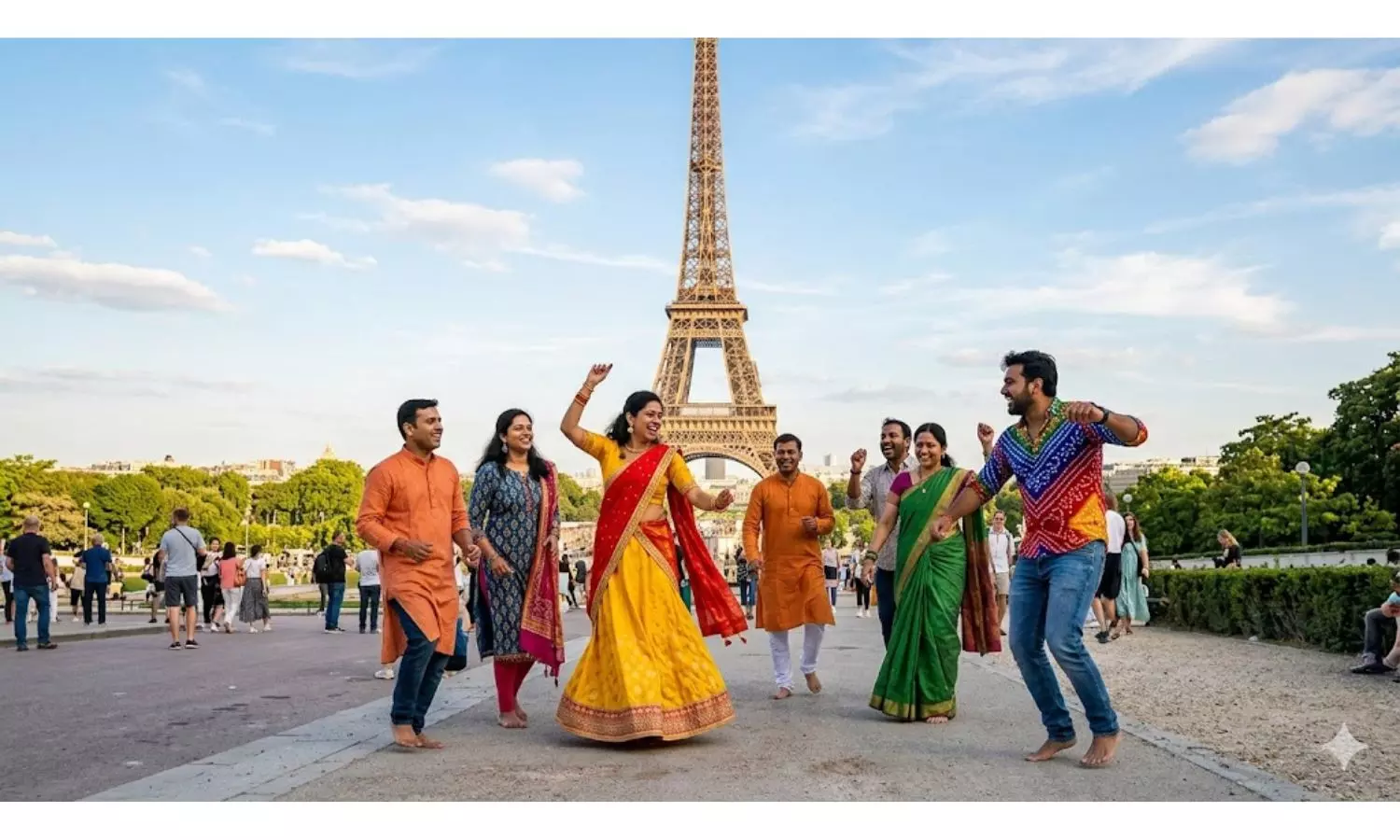
Press freedom, women’s safety, corruption, hunger, pollution, you name it, India is at the wrong end of every list. Despite these achievements, of late though, we have come to be known (and despised) for something entirely surreal: our unstoppable impulse to dance, in large, cacophonous groups, and turning everything from war memorials and railway tracks to airport runways and protected sites around the world into impromptu stages to showcase our skills.
It’s not too hard to figure out the origins of this perversion. In the late ’80s-early ’90s, Indian filmmakers came to the conclusion that having the lead pair dance in Switzerland, New Zealand, or Swaziland was pretty nearly mandatory for any movie with a ‘big’ star.
So we grew up watching these big heroes, and their disposable female counterparts, clad in inexplicable gear, dancing in the most bafflingly mundane locations in some random country chosen by the movie unit’s travel agent.
Bewildered foreigners hurriedly exiting the frame on discovering they had become unwitting background props in some tribal ritual being filmed for historical purposes was one of the ‘highlights’ of these songs. Alternatively, we had white folk staring saucer-eyed, wondering what tropical neural ailment had afflicted the strange foreign couple in their midst that caused them to have involuntary pelvic judders.
I would squirm every time I watched a song filmed abroad and wonder at the shamelessness of it all. How could anyone be that thick-skinned, that immune to what people thought of them? That, too, when at other times — like failing an exam or being at the receiving end of a cuss word — the very same shame mattered so disproportionately to us that we were even willing to kill someone or take our own lives?
Apparently, one could do both. And one did. An entire generation that grew up watching this came to believe it was ‘normal’.
The only reason the rest of the world remained safe for a while — with the exception of these minor invasions by film crews — was because not every Indian could travel, and there wasn’t any social media.
With those two factors changing, the average Indian now thinks they are the leads in an execrable ’90s movie, and views whichever country they are in as the backdrop and its hapless citizens as extras. The WhatsApp narrative that the whole world alternately fears us and lusts after us hasn’t exactly helped either.
So, rather than a lack of civic sense (a congenital Indian deficiency, no doubt), this has to do with the average Indian’s complete inability to read a room, and his poor understanding of consequence, both of which seem to suggest underdeveloped prefrontal cortices.
A few years ago, a research team from IIIT Hyderabad developed the first Indian Human Brain Atlas which concluded our brains are smaller in height, width and volume than, say, the average Caucasian or Chinese brain, and are among the smallest in the world. (I wonder if some of the brains tested were from Film Nagar.)
Last week, I was in the unenviable position of being an Indian tourist. In our short stay, as we negotiated the beautiful country we were visiting — quietly, tentatively — my prayer was that my grey hair and my being seen in the dignity-ensuring company of my wife would mean I wouldn’t be asked to **** off back to India on Day One.
Thankfully, I wasn’t. It turned out to be a refreshing, laidback trip, featuring warm encounters with strangers.
One day, we found ourselves on a boat that was taking us island hopping. It was a four-five-hour affair. And other than us and an Indian family of four, the boat had a European group of fifteen or so, all compatriots.
Alcohol flowed from the minute we set sail and the boat became a floating discotheque with music chosen entirely by the European group (obviously popular in their country, considering everyone was singing along). And the lot of them, without exception — ranging from ages twenty to sixty — sang and danced nonstop.
A rare occasion when something hadn’t been totally co-opted by an Indian mob. We were at the receiving end for a change, it appeared. Initially we were left alone. But after a while, the Europeans insisted we join them. When we politely declined, no one pushed us. Instead, they took on the role of hosts, every now and then checking if we needed a refill. They didn’t understand a word of English and we didn’t understand a word of what they were saying. But we ‘conversed’, using gestures and laughter.
On our return journey, it was decided ‘Indian’ music would be played. It was just the group’s way of showing us that, despite their outnumbering us on the boat, it wasn’t all about them. Now we had no option but to dance. Which we did for a bit. And the Europeans danced along with us, and took pics, too, for posterity.
The whole journey was a perfect example of how one can enjoy oneself, express oneself according to one’s ‘culture’, even while being part of a group, even while having a drink or two, even while bordering on over-enthusiasm, and still be inclusive, courteous, warm. Just human.
