Kamal Davar | Reset With China Amid Friction With Trump’s US: Need To Tread Carefully

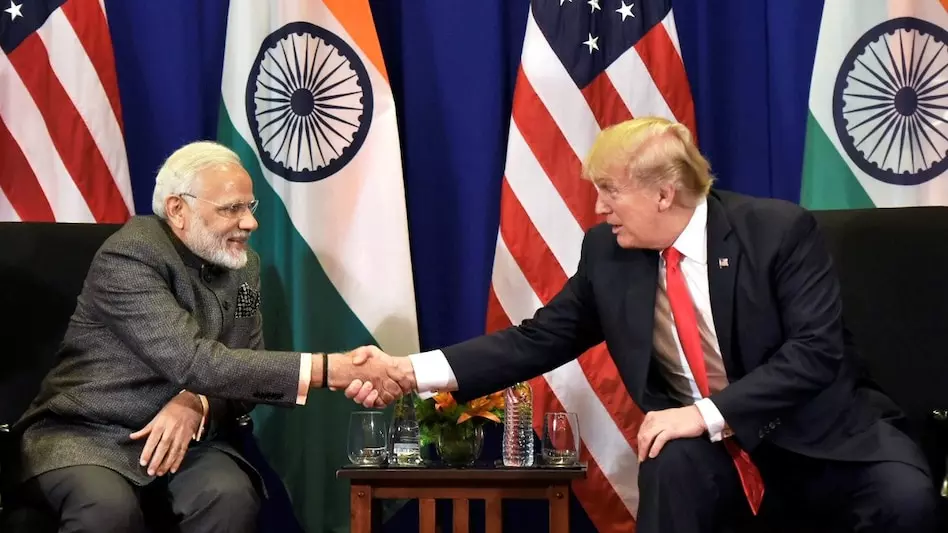
Amazingly, President Trump and India’s Prime Minister Narendra Modi, who earlier had a warm personal relationship with each other and were expected to carry India-US relations to new heights, have witnessed a major chasm in their personal relations, which have transcended adversely in very recent ties between the two large democracies
India is indeed the flavour of the season for multiple reasons, with unexpected geopolitical churnings emerging in the global and regional landscape. Startling changes have come to the fore, especially after US President Donald Trump, a Republican, assumed office in January this year for the second time, with his two terms in the White House interspersed with that of Joe Biden, a Democrat. Few people across the world, including in his own country, could have imagined that the President of the world’s most powerful democracy would cause so much upheaval across the world’s economies with his imposing inexplicable tariff tantrums on most nations. Mr Trump appears vastly different in his second avatar as US President, and for all the wrong reasons.
Amazingly, President Trump and India’s Prime Minister Narendra Modi, who earlier had a warm personal relationship with each other and were expected to carry India-US relations to new heights, have witnessed a major chasm in their personal relations, which have transcended adversely in very recent ties between the two large democracies. For 25 years, successive US administrations and Indian governments had arduously worked to come closer in matters of nuclear energy, transfer of technologies, defence relationships, sharing “Quad” ties and cooperation in other fields. Both former Indian PMs, Atal Behari Vajpayee and Manmohan Singh, had established sound relations with different US administrations without compromising on India’s national interests. Prime Minister Narendra Modi tried to do the same, but in the past three months or so faced unexpected and insulting behaviour from the US. President Trump has strongly criticised India’s purchase of crude oil from Russia, while the seeming thaw in India-China relations also irked the US as America sees China as its long-term adversary, both militarily and economically.
China’s speedy acquisition of military capabilities across all spectrums of warfare and its alliance with Russia does make the US vulnerable, to some extent, militarily to this grouping. The just-concluded SCO summit in Tianjin, China, witnessed a lot of bonhomie between President Xi Jinping of China, President Vladmir Putin of Russia and Prime Minister Modi, which seems to have further annoyed President Trump. Most geopolitics observers ascribe the likely new strategic grouping of Russia, China and possibly including India too as a bulwark against the US bid for unipolarity. Many eminent Americans, including two former NSAs, strategic analysts and think tanks have openly criticised President Trump for his insensitive and unjustified handling of India in the past two months, especially by punitive tariffs up to 50 per cent, the highest in the world along with Brazil. It has, at least for now, sounded the death knell for India-US relations, carefully crafted over the past three decades. The deeply significant geopolitical churnings of late have left India surprised, but also made it stand tall in the face of American bullying.
It is a good opportunity for India to analyse its futuristic foreign policies, both with short-term and long-term perspectives. There couldn’t be a better time to holistically chart out its geopolitical positioning now, in the background of the current kinetic turmoil in the world, newer alignments in the making, the security situation in our restive neighbourhood and own recent experience with Operation Sindoor.
At the same time, in my considered view, it would be a mistake to bracket our problems with Donald Trump’s tariffs and a reset of our relations with China, as is being done by many analysts and sections of the media. Mr Trump’s tariff shenanigans are just three months old, while our problems with China go back over 60 years, such as when the Chinese had invaded India in 1962, and occupied over 38,000 sq km of Indian territory. Just over five years ago, in April-May 2020, and many earlier occasions, China had unabashedly made border incursions in Eastern Ladakh, Sikkim and Arunachal Pradesh. The June 2020 Galwan Valley clash, in which 20 Indian soldiers were killed, cannot be easily forgotten. China’s actions were despite a formal border management pact with India since 1993. All Indian PMs made sincere efforts to improve ties with China, but to no avail. However, if the Chinese show a genuine desire to improve relations, we should welcome it too. But China will have to be cautioned against assisting Pakistan in its terrorism activities against India or overly arming it. During the recent Operation Sindoor, China had openly supported Pakistan with intelligence, equipment and reportedly even manning some weapons systems of Chinese origin against India.
We should go by China’s actions on the ground, rather than the clichés it sprouts. But it’s also a fact that both Asian giants, with their roots in two ancient civilisations, must strive to cooperate among themselves, for confrontation with each other will be self-destructive. Recently, at the Tianjin summit, all the right noises were made, with Narendra Modi and Xi Jinping talking of a bright future for the two nations’ 2.8 billion people. As we look forward to improving our relations with China, we must give top priority to our military preparedness, for only in military strength lies the requisite deterrence.
Amidst the growing friction in our ties with the United States, the world’s most powerful nation with whom ties were on the ascendant till recently, India needs to exercise maturity and patience. Donald Trump will remain President for almost three and a half years more, but he is not President for life. Also, his powers may get cut drastically if the Democrats make gains in the US mid-term elections in November 2026. India, in the face of Mr Trump’s provocations, has remained steadfast, without buckling. New Delhi should simply ignore his immature tantrums, which have even embarrassed his fellow Americans. Both India and China, meanwhile, need to sincerely step up their cooperation in order to make this an Asian century!