Indranil Banerjie | Will Nepal’s Balen Set an Example for South Asia?

Balendra Shah's win signals a shift from traditional power structures
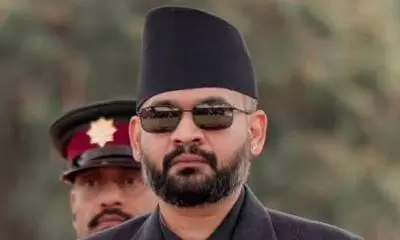
Some new Instagram reels of rapper Balendra Shah, 35, show him dancing on the streets of Kathmandu, Nepal’s capital, soon after assuming office as the country’s youngest ever Prime Minister on March 27, is a message that is resonating across South Asia. That a young man with no political background or affiliations could successfully face a big electorate and come out on top has created ripples -- and tremors -- in the region’s power structure dominated by ageing leaders and political parties.
Mr Shah’s victory has broken the stranglehold of traditional political parties in Nepal. Since 2008, following the demise of the country’s age-old monarchy, the Federal Democratic Republic of Nepal has been ruled either by the Nepali Congress or by one or the other Communist party factions.
Mr Shah’s party, the Rastriya Swatantra Party (RSP), came out of nowhere to sweep the general election held on March 5 this year, winning 182 of 275 seats. Mr Shah’s victory is a monumental political landmark for several reasons. Not only is he the youngest Prime Minister Nepal has ever had but he also brings with him the youngest Cabinet ever, with mostly fresh faces and a promise to end corruption, unemployment and fractious politics that have kept the country backward and divided. His is also the first government since 1999 which does not depend on coalition partners for its survival. He has a field clear of rivals but pitted with massive challenges ahead.
Should Balendra Shah prevail, his impact on South Asian politics would be profound. For one thing, young people in a number of South Asian countries have shown every sign of becoming increasingly restive in recent years. Millions of youngsters who are coming of age in South Asia’s desperate neighbourhoods and dead-end rural backwaters have begun to express their distaste for traditional political parties, most of whom are seen as incompetent, corrupt as well as unresponsive.
Protests fuelled by surging youthful crowds pulled down President Gotabaya Rajapaksa of Sri Lanka in 2022, forcing him to flee the country; similarly, in August 2024, rampaging youth forced Bangladesh Prime Minister Sheikh Hasina to abandon the country; and then last September large-scale Gen Z protests in Nepal led to a crackdown and eventually to the resignation of then Prime Minister K.P. Sharma Oli.
Many analysts believe there is a pattern in South Asian political unrest fuelled by youth discontent, which is unsurprising given the massive population bulge most countries in the region have witnessed in recent times. This coupled with low productivity, lack of industrialisation, blatant inequalities and massive unemployment have created combustible conditions that successive governments in South Asia have failed to reverse.
The underlying socio-economic problems in most South Asian countries being essentially similar, though to different degrees, suggests that Nepal could be the beginning of large-scale future political disruptions. The signs are already flashing. In two of the region’s most depressed countries with a ballooning “youth bulge” and low productivity -- Afghanistan and Pakistan – political disenchantment is reflected in the rise of militancy and extremist activity fuelled largely by young recruits.
Bhutan, with its small population and high immigration rates, is an exception in South Asia and so too in some ways is India, where the “youth bulge” as well as demographic expansion has not contributed to significant youth participation in political unrest. This is surprising given massive youth unemployment, which is highest among the educated segment -- an estimated 67 per cent of total unemployed. Overall productivity levels in India too remain at just about 45 per cent of global levels and high productivity (accompanied by high wages) is restricted to a few sectors such as information technology.
Indian politics remains a gerontocracy with mostly 60-plus individuals dominating key party offices and institutional positions. India’s current Prime Minister, Narendra Modi, took office at the age of 63 and is now 75 years old, making him one of the oldest world leaders. The country’s previous Prime Minister, Dr Manmohan Singh, took office at the age of 71, a position he held for a whole decade.
India’s leaders have traditionally been senior citizens (60-plus or close to that) with the only two exceptions -- Indira Gandhi, who took office at the age of 48, and Rajiv Gandhi at 40. The oldest Indian Prime Minister to take oath was Morarji Desai, at 81. The median entry age of Prime Ministers in India is 63 years and their median exit age 74 years. Despite being one of the “youngest” countries in the world, old men continue to rule the roost.
Some evidence suggests that most transformative leaders tend not to be old men. Singapore’s first Prime Minister, Lee Kuan Yew, who is credited with the remarkable transformation of his island state, was only thirty-six when he assumed office. Mao Zedong became China’s Communist Party boss when he was less than fifty. The charismatic US President, John F. Kennedy, was just 43 when he took office. Indonesia’s revolutionary anti-colonial leader Sukarno was only 44 when he took office.
There is however no convincing evidence linking leadership age with good or effective governance or diminished corruption. In general, however, it has been observed that older leaders tend to rely on bureaucratic and institutional structures to govern, while younger ones are prepared to bypass these and break traditions. Younger leaders also tend to be less tolerant of corruption and vested interests. These are necessary conditions for any radical transformation of a nation. The growing awareness of these fundamentals could be a harbinger of revolutionary changes in South Asia’s power structures.
South Asia’s young are perhaps only beginning to grasp the age-old truth that power corrupts and absolute power corrupts absolutely. The longer politicians are associated with a political organisation, the more they become beholden to the powers that be and end up owing favours at multiple levels and to various entities which they must redeem on assuming office. Therefore, the real benefit of the advent of leaders like Nepal’s Balen Shah is the fact that they lack affiliation to entrenched parties and political oligopolies. This frees them of fundamental obligations that often bind senescent leaders.
Youth leaders usually, but not always, come without strings attached and can start on a clean slate. That is their greatest strength -- and one that is sadly most easily and most often squandered.