Devi Kar | How To Deal With Punishment In School, As Well As In Society At Large

I was extremely disturbed by the public reaction. Have we gone back to the days when punishment of criminals also served as entertainment? Acts like throwing criminals to wild animals for the entertainment of the rulers or public hangings were meant to serve as strong deterrents and warnings. In some American states, family members of victims are allowed to witness executions (by lethal injection or the electric chair) from an adjacent viewing room
Soon after the recent change of government in West Bengal, some images came up in the media that will haunt me for long. These were of “criminals” and “gangsters” linked to the TMC who had been arrested. They were stripped to their underwear and had a rope tied around their bellies. The comments, including by a strident anchor, were full of glee, expressing the sentiment of “it serves them right”.
I was extremely disturbed by the public reaction. Have we gone back to the days when punishment of criminals also served as entertainment? Acts like throwing criminals to wild animals for the entertainment of the rulers or public hangings were meant to serve as strong deterrents and warnings. In some American states, family members of victims are allowed to witness executions (by lethal injection or the electric chair) from an adjacent viewing room. This business of “closure” can be taken to absurd lengths. It’s natural for families of victims to expect justice, but to claim the right to actually watch the delivering of punishment smacks of a perverse and primitive pleasure. As sensitive and civilised humans we should be above these base and raw emotional needs.
We need to revisit the concept and purpose of punishment. Surely it’s to seek the correction of the culprit, and not just to inflict pain? Many thinkers and educators have written at length on the relative effectiveness of reward and punishment and on positive and negative reinforcement. Generally, it has been accepted that rewards and incentives succeed better in producing a desired behaviour than punishment does.
Punishment is more effective as a deterrent, that is, in stopping undesirable behaviour. However, it also has complex and unhealthy consequences.
A state has a structured set of laws governing crime. So, every person would be aware of the consequences of his misdeeds if they are discovered. In school, this doesn’t always happen and punishment becomes arbitrary. Besides, with children, instead of uniform punishment, an attempt is made to tailor the punishment to suit the misdeed as well as the temperament of the child. The aim is to make them reflect, and dissuade them from repeating such behaviour, while ensuring that relations between the punished and the punisher are untarnished. This sounds difficult to achieve, but children seem to understand when parents and teachers “correct” without anger and malice and perceive these disciplinary measures from the right perspective. Adults too must be careful about feelings when they are doling out punishment; they must be in touch with their own emotions as well as of those they punish.
While I was working on this piece, I got a call from a journalist who was reporting on various types of punishment and on “how strict teachers should be”. This assignment was triggered by a strange but tragic incident of a high school student meeting with sudden death after having gulped down a cup of very hot tea. The blame game started soon, and school students began to protest against the overly strict handling of students by their teachers and the authorities. I am still puzzled about the link between the boy’s unexpected death and the teachers’ strictness towards the boys. Anyway, it is impossible to prescribe an ideal level of strictness.
I do realise punishment is more effective if you are looking for immediate deterrents. But it stops there. Not doing something bad because of fear doesn’t teach children to understand the difference between right and wrong or voluntarily choose to do the former. In a recent chilling murder case, a young dentist had been suspended from practising dentistry for a period of five years because she had posted insensitive comments about the murdered person -- mocking his looks and making other cruel remarks. The insensitive and callous behaviour by young people is a matter of deep concern and the strict and quick action by a national association of medical professionals indicates that we still care about our finer human traits.
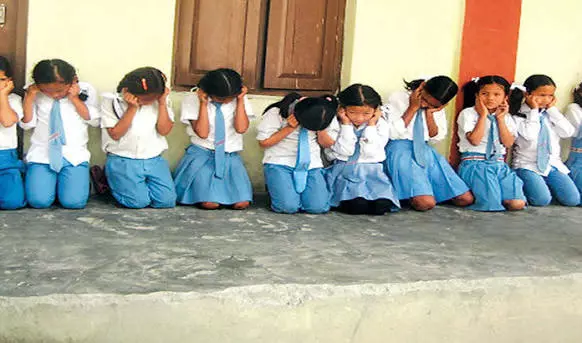
The journalist and I also talked about how fragile children were becoming. As I have been in the field of school education for several decades, she wanted me to tell her how the nature of punishment had changed over the years. I told her about boys being caned and girls made to stand on their chairs. Kneeling down and writing down the same sentence a hundred times over were common punishments and I don’t remember boys or girls being “scarred” for life as a consequence. Thankfully, corporal punishment in school was eventually banned. Today, it seems that the wheel has turned a full circle. Leave alone punish, teachers are reluctant to reprimand their students as parents complain that their children’s sensitivities were being trod upon. The school authorities like to be on the right side of parents.
As the well-known saying goes, discipline helps a child solve a problem while punishment is making a child suffer for having a problem. The real question is: can one discipline without punishing? Connecting, empathising, guiding and modelling rather than instilling the fear of punishment, have been recommended by educators over the years. On the subject of “modelling”, there may be some truth in the observation that today there is a dangerous dearth of role models in schools and in society. Our self-serving political leaders seem to be obsessed with chasing power, wealth, aggrandisement and revenge. Parents are no longer role models for their offspring for various reasons, the chief being that they don’t practise what they preach.
Alas, society and public life appear to be totally devoid of the marks of culture, civilisation or indeed, of a conscience. In these circumstances, we must wake up and do something about our lost values: now.
The writer is a veteran school educator based in Kolkata