Dev 360 | How Uzbekistan Balances Faith, Freedom And Future | Patralekha Chatterjee

Uzbekistan is indeed a land of history, charm and blue-tiled mosques and minarets. The cuisine is a huge draw and familiar to the Indian palate. The fusion of Indian and Uzbek cuisine probably began with Babur, the Uzbek-born Mughal emperor
A late evening train from Samarkand drops us around midnight at a station just outside Bukhara. It takes some time to find a taxi through the local Yandex app. We finally locate the driver with help from a young Uzbek couple. The taxi driver turns out to be a dour, taciturn man who speaks no English. Some may view a post-midnight taxi ride from the railway station to a hotel in old Bukhara down a dark empty road, partly through a semi-arid landscape, as a high adventure. But honestly, with very few vehicles on the road, even an experience-junkie like me was a wee bit apprehensive.
Then I tried the SRK hack. Mentioning Shah Rukh Khan in Uzbekistan is genuinely like a passport/visa/travel insurance/ safety charm all rolled into one. In the stillness of that Uzbek night, I tried it. Magically, our sullen cabbie broke into a smile, started humming Janam Janam from that iconic Shah Rukh Khan-Kajol starrer Dilwale. In faltering Hindi, he asked which part of India we were from. I felt safe and snug for the rest of the journey.
Raj Kapoor still holds sway among the older generation, but Shah Rukh Khan is the face of modern Bollywood for many young Uzbeks. Indian movies (including many of SRK’s) are dubbed into Uzbek and aired regularly on TV. Posters of Bollywood stars are common in shops and homes. Khan is not just an Indian movie star there — he is a cultural icon, a symbol of India.
As an Indian travelling for the first time through Uzbekistan, I found a landlocked country in Central Asia — widely celebrated as the geographic and cultural heart of the ancient Silk Road — balancing faith, freedom and future. It is hard to decode the country beyond the Silk Road stereotypes in a few days and on the basis of first impressions garnered from cities like Samarkand and Bukhara. Yet some impressions linger. It is Muslim-majority, constitutionally secular (Soviet-era legacy) and palpably tourism-pragmatic.
Uzbekistan is indeed a land of history, charm and blue-tiled mosques and minarets. The cuisine is a huge draw and familiar to the Indian palate. The fusion of Indian and Uzbek cuisine probably began with Babur, the Uzbek-born Mughal emperor. “Babur introduced the region’s fruits — grapes, melons, pomegranates and apricots — to India, nuts to enrich dishes and thicken sauces, mutton fat as a cooking medium and a delectable meat, and dry fruit in rice. Pulao undoubtedly came from the Turkish pilaf and the Uzbek Plov,” food connoisseur Karen Anand notes. Our samosa reportedly originated from the Central Asian somsa, sold everywhere in Uzbekistan. One drinks tea from small ceramic bowls called piala, pronounced almost the same as in Hindi.
Yet Uzbekistan is not frozen in history. Its pragmatic present is visible in how it treats both its heritage and its visitors.
In Bukhara, we stayed in a restored 15th-16th century madrasa converted into a boutique hotel, with a beautiful courtyard. Bukhara has many boutique hotels converted from historic madrasas and caravanserais. These buildings, once centres of Islamic learning and prayer, have been tastefully restored with modern amenities (AC, wi-fi, private bathrooms, bars/gardens in some cases) while keeping original architecture like courtyards, carved wood and tilework.
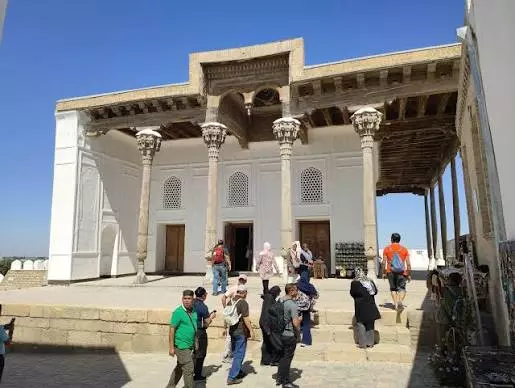
Bukhara’s old town is the Unesco-listed historic core with narrow streets, ancient mosques, madrasas and trading domes. Dining at an open-air restaurant in the historic Labi Hovuz complex, overlooking a pond which over four centuries has served as the place of recreation for visitors and city residents of Bukhara, surrounded by ancient-old mulberry trees, madrasas and a khanaka (Sufi lodge), I watched tourists and locals clinking glasses of draft beer, enjoying plates of grilled shashlik as ambient music drifted through the evening air. Our hostess, a 19-year-old economics student, who spoke fluent English, taught it for extra money, said the madrasas are still functional, though in a different form. They are no longer residential; they hold classes in Arabic and theology.
A stone’s throw away stood the Jomi Mosque, where men went in for prayers as we walked back. No one seemed to mind.
In a country where over 90 per cent of the population identifies as Muslim, faith and fun share the same space without visible friction. The separation of private faith from public space is treated as a foundational rule of civic life.
As I walked around, I could not help thinking about the culture wars back home and what the reaction would be if a restaurant served alcohol and meat close to a major house of worship.
There are other emerging connections between India and Uzbekistan. Over 10,000 Indian students, mostly studying medicine, are now enrolled in the country’s universities. The Indo-Uzbek Education and Business Summit 2025 in New Delhi brought together over 100 participants from both countries. Bilateral trade is expanding through cooperation in business (pharmaceuticals, IT, textiles, and agriculture), education, and cultural exchanges.
At Samarkand’s famous Siyob Bazaar, where you can find breathtaking ceramics and giant watermelons, locally called tarvuz, a pottery seller spoke about the growing number of Indian medical students in Samarkand, noting with warmth that many among them could converse in Uzbek. Like many young Uzbeks of his generation, he spoke English. Uzbekistan is also a new destination for many Indian blue-collar workers.
As a woman, what touched me deeply was safety in public spaces. I saw many women walking around late in the night, unbothered, free of the staring and stalking, an everyday reality in Delhi. This sense of security is the direct result of a highly assertive, efficient state machinery that views public order and tourist safety as non-negotiable priorities.
This focus on institutional execution shows up most clearly in sports development. While Indian sports fans constantly wonder why a country of 1.4 billion people struggles to make an impact on the global stage, Uzbekistan — with a population of just 36 million — qualified for the 2026 Fifa World Cup after a historic 0-0 draw against the UAE. As football legend Bhaichung Bhutia recently said: “During my career as well, you played a number of matches with Uzbekistan, at least 6-10 matches, and India would win 50 per cent of the matches. But the way Uzbekistan has taken over, I think that they have changed the entire footballing structure.”
Travelling through Uzbekistan, one saw more than monuments and bazaars. One saw a country where food carries history, faith and freedom share space, and sport reflects discipline. I long to return.
The writer focuses on development issues in India and the emerging economies. She can be reached at patralekha.chatterjee@gmail.com.