Dev 360 | How Tiruppur Is Coping Under Shadow Of Tariffs | Patralekha Chatterjee

“The last one year has been a roller-coaster ride — tariff threats, geopolitical turmoil, orders being put on hold and cancelled. But I am optimistic,” says Dinesh Babu Ravikrishnan, executive secretary of the Tiruppur Exporters’ Association (TEA)
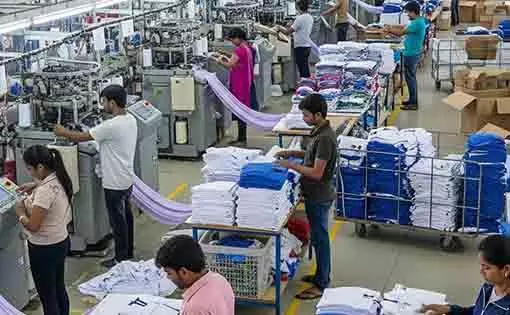
Tiruppur, India’s knitwear capital, is famous as the “Dollar City” for its thousands of export-oriented garment and hosiery units, the migrant workers who power them, and the dollars they bring in.
Last year, the threat of a 50 per cent US tariff on Indian goods set off alarms in Tiruppur, which accounts for nearly 60 per cent of India’s knitwear exports. Orders were cancelled. Exporters feared losing their biggest market.
During the peak tariff shocks, migrant contract labourers were among the first to feel the pain. Many were laid off, forced to pack their bedding and board north-bound trains because factories could no longer afford to pay wages to idle workers. Many units in this textile hub on the banks of the Noyyal River in western Tamil Nadu shut or scaled back.
The crisis stretched from August to December 2025 following the sudden US tariff hikes. While the situation saw a temporary recovery in early 2026, export units are still restructuring their workforces.
A year later, the shadow of sanctions and tariffs is back.
On September 18, when President Donald Trump signed the Lindsey O. Graham Sanctioning Russia and Iran Act of 2026 into law, he opened the way to tariffs of up to 100 per cent on countries importing Russian oil and gas. The penalties will not kick in immediately. But China and India, as major buyers of Russia’s oil, have been put on notice: This does not automatically impose a 100 per cent tariff on all Indian exports to the US. And the rate, targets and implementation are yet to be decided. But the threat is now backed by law rather than relying solely on executive action.
If a 100 per cent tariff is imposed, the impact will hit Tiruppur and export hubs across India whose businesses depend heavily on the US market. Arguably, with Mr Trump, anything can happen. For Tiruppur, where around 35 per cent of exports went to the US last year, uncertainty looms again.
But, as I spoke to several people in Tiruppur this week, the mood seemed calmer.
“The last one year has been a roller-coaster ride — tariff threats, geopolitical turmoil, orders being put on hold and cancelled. But I am optimistic,” says Dinesh Babu Ravikrishnan, executive secretary of the Tiruppur Exporters’ Association (TEA).
Why?
“Because we have now accepted geopolitical turmoil and uncertainties and tariffs as part of the new normal, new business reality,” he told me.
Tiruppur exporters have learnt to look beyond a single export destination. Their new markets include the UK and Europe.
They are concerned about the new US law targeting major buyers of Russian oil, but they have learnt how to absorb shocks. Last year’s shocks offered a masterclass in adapting to a geopolitically turbulent world where tariffs can strike any time. Exporters are diversifying markets and products, bringing orders forward and preparing for a world in which disruption is no longer an exception. Some export units are automating to improve productivity and reduce costs.
News reports flag a “pull-forward” scramble among India’s apparel exporters, with manufacturers racing to accelerate production and ship out Spring 2027 orders early. Businesses are trying to get ahead of geopolitical decisions they cannot control.
The changes are visible in what they make as well as where they sell. Tiruppur’s knitwear industry has traditionally depended heavily on cotton. Ravikrishnan says exporters are now trying to diversify towards a mix of cotton and man-made fibre (MMF) products to tap emerging global export opportunities.
D. Elango, a hosiery and knitwear manufacturer and exporter, told me business has been slower over the past six months. His company caters heavily to the US. “We were happy when the Supreme Court (of the US) struck down the tariff. Now the threat is back, and it is in the form of a law, not an executive order. No one knows what will happen,” he says.
The essence of his survival strategy, like that of so many others in the age of sanctions, is anchored in diversification. Most exporters I spoke to are hopeful that the Modi and Trump governments would eventually work out something to avoid the worst-case scenario.
Meanwhile, Tiruppur’s experience shows how a geopolitical decision travels through an economy.
Its garment industry employs about one million workers, around half of them migrants. Many experienced workers — both local Tamils and north Indian migrants — leave, tired of the repetitive work. Some export units face labour shortages.
But migrant workers from northern India are still arriving, despite the new tariff threat, says A. Aloysius, a Tiruppur-based labour rights activist. A large number are from Bihar. Increasingly, they are bringing their families, including children, he points out.
Aloysius says his organisation is now trying to arrange schooling for these migrant children, even if in informal classes. Young single women from the Northeast and Odisha also continue to arrive for work and live in factory hostels.
It is a small but telling picture of life in an unstable global economy. An American decision about Russian oil can alter an Indian exporter’s order book. An exporter responds by looking for a European or British buyer or switching from cotton to synthetics. A migrant family from Bihar moves to Tiruppur anyway. And somewhere in the middle of all this, an NGO worker has to figure out how the migrant children are going to school.
The factories can diversify. The markets can shift. Orders can be brought forward or put on hold. Children still have to study.
The language of “tariffs” and “sanctions” can sometimes obscure what is actually happening on the ground. These are not merely instruments used by governments against governments. Geopolitical risk is becoming part of everyday commercial planning.
The UK and Europe do offer new opportunities, but it is not going to be easy to break into these markets in a big way. Diversification requires investment; moving into synthetic fibres requires new capabilities. Finding new markets takes time. And the smallest enterprises and workers with the least security have less room to absorb another disruption.
The calm in Tiruppur should not be mistaken for complacency.
It is the calm of a place that has learnt that old assumptions can no longer be relied upon. As Ravikrishnan of the Tiruppur Exporters’ Association puts it, “There are no stable markets.”
The world outside Tiruppur may discuss the new tariff threat in terms of India-US negotiations, Russian oil and geopolitical leverage. Inside the export hub, it is a more practical story — ship what you can, find other markets, make something different, automate where possible and keep going.