Bhopinder Singh | The Begin Doctrine and How Pakistan Is Seen as a Growing Threat to Israel

Pakistan’s rhetoric could draw Israel’s pre-emptive security doctrine.
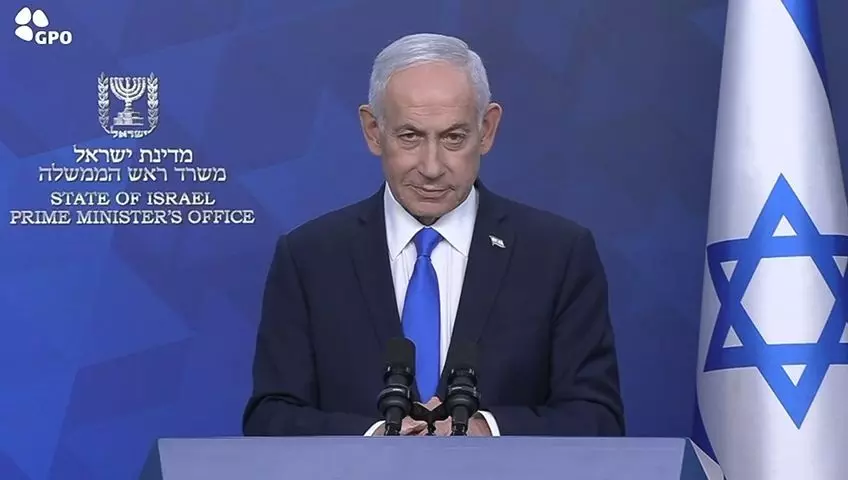
Israel’s lived history and perennially tense geopolitics have ensured that it remains paranoid about its security preparedness at all times. Planning for worst-case scenarios is institutionalised. The Six-Day War (1967) is cited as its defining moment, as Israel had launched pre-emptive strikes on its Arab neighbours based on the intelligence that they would soon be attacking the Jewish state.
Israel’s sixth Prime Minister and the first from the hard-right, Menachim Begin, founded the Herut and later the Likud party, to which Israel’s current Prime Minister, Benjamin Netanyahu, belongs. Begin was driven by the “never again” principle predicated on the memory of the Holocaust, that Israel would never allow any future existential threat to fully materialise.
Amongst Begin’s radical moves was to launch the first invasion of Lebanon, and he infamously oversaw the Sabra and Shatila camp massacres. Later, he was to propound the Begin Doctrine that insisted that Israel will not allow any hostile state to develop nuclear weapons and would act pre-emptively to neutralise the threat. Implicit in the Begin Doctrine were the principles that pre-emption was better than deterrence, that there would be “zero tolerance” for existential threats, and there would be willingness to act unilaterally, without any international or multilateral action.
Iraq’s late dictator Saddam Hussein, who always framed Israel as the biggest regional threat by suggesting that “the Zionist entity must be confronted and ultimately eliminated”, was the first to pursued by the Begin Doctrine. On June 7, 1981, Israeli fighter jets daringly flew over 1,600 km and suddenly swooped, struck, and destroyed an unfinished Iraqi nuclear reactor, the Osirak facility, under Operation Babylon. A stunned world woke up to Israel’s intolerance of any rhetoric aimed at threatening Israel and to Tel Aviv’s determination to walk the talk. Begin had clearly said that “this attack will be a precedent for every future government in Israel… every future Israeli Prime Minister will act, in similar circumstances, in the same way”.
Twenty-six years later, on September 6, 2007, Israeli jets struck again under Operation Outside the Box, targeting a suspected nuclear reactor under construction in Syria. For the longest time, the Israelis neither confirmed or denied the attack, with a telling smirk, and a wry deflection to “according to foreign reports”. Years later, the IDF chief coldly confirmed: “The message of the attack on the reactor in 2007 is that Israel will not accept the construction of a capability that threatens the existence of the State of Israel. That was the message in 1981. That was the message in 2007. And that is the message to our enemies for the future.”
Last year, working in tandem and fronted by the US armed forces in the Twelve-Day War, three Iranian nuclear facilities were attacked under Operation Midnight Hammer.
But the curious case of Pakistan and its so-called “Islamic bomb” has eluded the Begin Doctrine so far. As the Pakistani nuclear programme was ostensibly India-centric and did not overtly target Israel (unlike the Iraqi, Syrian and Iranian programmes), besides geographical, operational and “alliance” concerns (Islamabad was a US ally), it hadn’t got under the skin of the Israelis with the same intensity. However, there are unconfirmed murmurs of a similar plan to denuclearise Pakistan in the early 1980s by a joint Israeli-Indian action at the Kahuta nuclear facility. Besides the fact that India had no official relations with Israel then, other factors like American pressure (the Pentagon had apparently tipped off Pakistan to safeguard Islamabad as it was then mostly doing its bidding in Afghanistan), fears about domestic unrest and the prevailing insurgency in Punjab had complicated the decision for Indira Gandhi disproportionately.
Now, as Pakistan waded into the peace talks with the US and Israel’s nemesis Iran (which had be aborted the failure to reach agreement on Sunday), Tel Aviv watches Pakistani actions suspiciously and disconcertingly. Israel does not view Pakistan as a neutral or trustworthy mediator. Pakistan’s defence minister Khwaja Muhammad Asif’s recent statement calling Israel a “curse for humanity” and “cancerous” elicited an expectedly sharp rebuke from Israel. Israel’s foreign minister considered the Pakistani minister’s tweet as a “call for the extermination of Israel”, and added tellingly: “Israel will defend itself against the terrorists who pledge to destroy it.” The red-faced Pakistani minister was forced to delete the tweet, prodded by no less than his country’s military boss, Field Marshal Asim Munir himself!
Amid the shaky peace talks under the aegis of Pakistan between Tehran and Washington DC, the Israelis remain unmoved and unconcerned about the peace prospects. Any further bravado, rhetoric or sabre-rattling by Pakistan aimed at Israel will put them in the immediate spotlight and radar of the Israelis, who have a history of taking action under the Begin Doctrine. Today, the Pakistani nuclear programme remains the only nuclear threat from the Ummah (the Islamic world) that has a declared hostile status vis-à-vis Israel (Pakistan has refused to recognise or have any official ties with Israel till now). A few years back, Prime Minister Benjamin Netanyahu had clearly spelt out the long-term security threats for Israel: “The first is called Iran, the second is called Pakistan, or more specifically, a Taliban takeover of Pakistan”. What perhaps Mr Netanyahu had implied was a bigoted and larger-than-life role imagined for the Ummah by an extremist Pakistan (the sort represented by the language of Khwaja Muhammad Asif). As Pakistan now wades cavalierly into the tense sensibilities of Israel, the haunting spectre of the Begin Doctrine clearly looms.
The writer is a retired lieutenant-general and a former lieutenant-governor of the Andaman and Nicobar Islands and Puducherry