Why then did the RSS and its political front, the BJP, feel the need to close ranks and end all speculation about a succession to Narendra Modi?
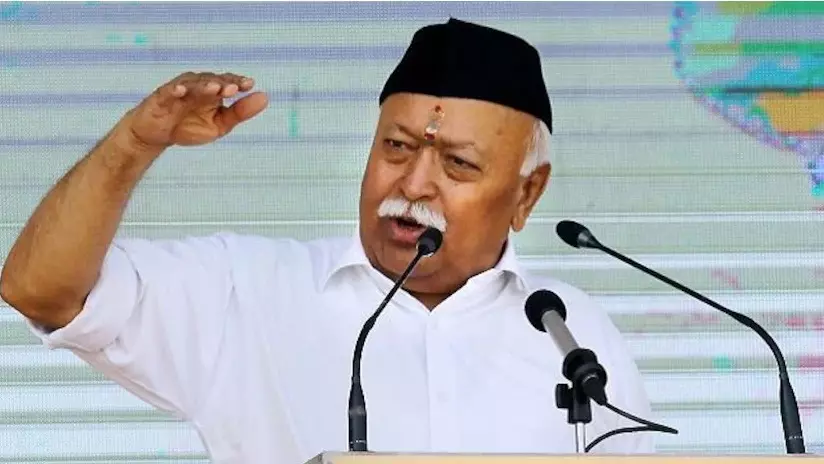
One and a half months after he made the statement about making way for others at 75, Rashtriya Swayamsevak Sangh supremo Mohan Bhagwat has inexplicably backtracked. “I never said that I will or someone else should retire.”
Both Prime Minister Narendra Modi and Mohan Bhagwat turn 75 in September.
However, the RSS chief neither makes off-the-cuff remarks nor does he retract from them without any reason.
Why then did the RSS and its political front, the BJP, feel the need to close ranks and end all speculation about a succession to Narendra Modi? What is the shadow that fell between Mr Bhagwat’s first statement and his subsequent retraction?
In the interregnum, Mr Modi had made an enigmatic statement. Reacting to the first round of punitive tariffs by the United States on Indian goods, he had said: “India will never compromise with the interests of its farmers, livestock holders, and fishermen. I know that I will have to pay a huge price for this personally, but I am ready.”
The statement is curious because it is not Mr Modi personally, but Indian businesses, who are paying a “huge price”. Mr Modi was clearly referring to a political price -- apprehension that he may be cast as a global outlier, or worse, there may be a conspiracy to remove him from power.
Mr Modi is not new to such conspiracy theories. In December 2024, in a series of social media posts the BJP had openly accused the US state department of targeted attacks on the Narendra Modi government.
In posts on X, the BJP had also claimed that the French investigative media group Mediapart had revealed that a media NGO, Organised Crime and Corruption Reporting Project (OCCRP), was funded by USAID, along with “Deep State” figures like George Soros and the Rockefeller Foundation.
The BJP claimed that OCCRP was instructed “to provide material aimed at damaging Mr Modi’s and India’s image. The Congress then exploited this material to launch attacks on Mr Modi, propagate false narratives, and disrupt the functioning of Parliament. The US Deep State was always working behind the scenes”.
The party suggested that the Financial Times article on November 13, 2020, titled “Modi’s Rockefeller: Gautam Adani and the concentration of power in India” was also part of a conspiracy. It claimed that the newspaper was known for its “close connections with George Soros” and had expressly suggested that to weaken Mr Modi, one must target Mr Adani.
The BJP further alleged that in 2021-22, OCCRP had released a number of reports on the government’s use of the Pegasus spyware against its adversaries that were “timed perfectly just before the Indian Parliament sessions” and that “from 2023 until now, OCCRP has published around 5-7 articles targeting Adani. While there are thousands of major corporations globally, OCCRP seems singularly focussed on just Adani.”
Some pro-government media commentators also argued that the Sterlite protests of 2018, the 2020 Delhi riots and the 2020-21 farmers’ protests were the handiwork of NGOs -- especially those funded by Mr Soros’ Open Society Foundation, Open Society Institute and the Omidyar Foundation, allegedly connected with the US Deep State.
The conspiracy theorists suggested that after the home ministry crackdown and withdrawal of licences under the Foreign Contribution Regulation Act for these foundations, they started to operate through other networks in India -- the Commonwealth Human Rights Initiative and Centre for Policy Research, among others --- against whom the government agencies acted promptly.
Was it the same spectre of foreign interference that Mr Modi was raising when he said that he will pay a heavy personal price for defying the United States?
The singling out of India for demonstrative punitive action by President Donald Trump cannot be explained by his fragile ego alone. Is his policy emanating from deep within the current US administration and does it point to a carryover from the previous Joe Biden administration? Having seen “regime changes” across West Asia, Ukraine and most recently in Bangladesh, is it possible that Mr Modi fears destabilisation in India too?
It may be pertinent to note here that the national capital is rife with unconfirmed rumours that former vice-president Jagdeep Dhankhar may have been removed because he audaciously attempted to destabilise the government and tried to send emissaries to the NDA allies to withdraw support. While these developments are difficult to confirm, that has not prevented social media commentators from flagging them.
Such rumours are bound to have fed apprehensions that larger forces were in play to destabilise the government.
The RSS could not afford to stick to the retirement age issue once it was made aware of the larger forces possibly working against the government. One can reasonably hypothesise that Mr Bhagwat’s earlier statement about retirement at 75 years would have stirred the hopes of ambitious individuals in the BJP. This could no longer be allowed and, therefore, Mr Bhagwat had to walk back to preserve Prime Minister Modi’s authority, at least domestically.
If indeed there is apprehension about the Modi government being destabilised, it is unclear what instrument can be used to achieve that. One may claim that India is not Bangladesh, where the government could be overthrown by facilitating youth protests, but that was at least attempted in India during Jayaprakash Narayan’s “Total Revolution” movement of 1974. It is also clear that if other political parties replace the BJP, they will also be under the same electoral compulsions to protect farmers and dairymen in any trade deal with the US.
The so-called external forces in fact may not be interested in regime change. They only need India to be a stable and predictable partner. A weak government -- say, a larger coalition of parties and, therefore, more vulnerable -- will not be advantageous to them. Lesser strategic clarity, greater domestic instability and slower decision-making cannot suit them as chaos does not equal compliance. Narendra Modi may have become a difficult partner but not yet expendable. He may yet forge a compromise with the United States.
What the perception of external destabilisation seems to have done, however, is to consolidate his support where it matters most -- in the ideological family whose underpinning he needs the most to survive.