Bharat Bhushan | Nepal Political Earthquake Reshapes Neighbourhood

Balendra Shah’s rise may reshape Nepal’s politics and foreign policy
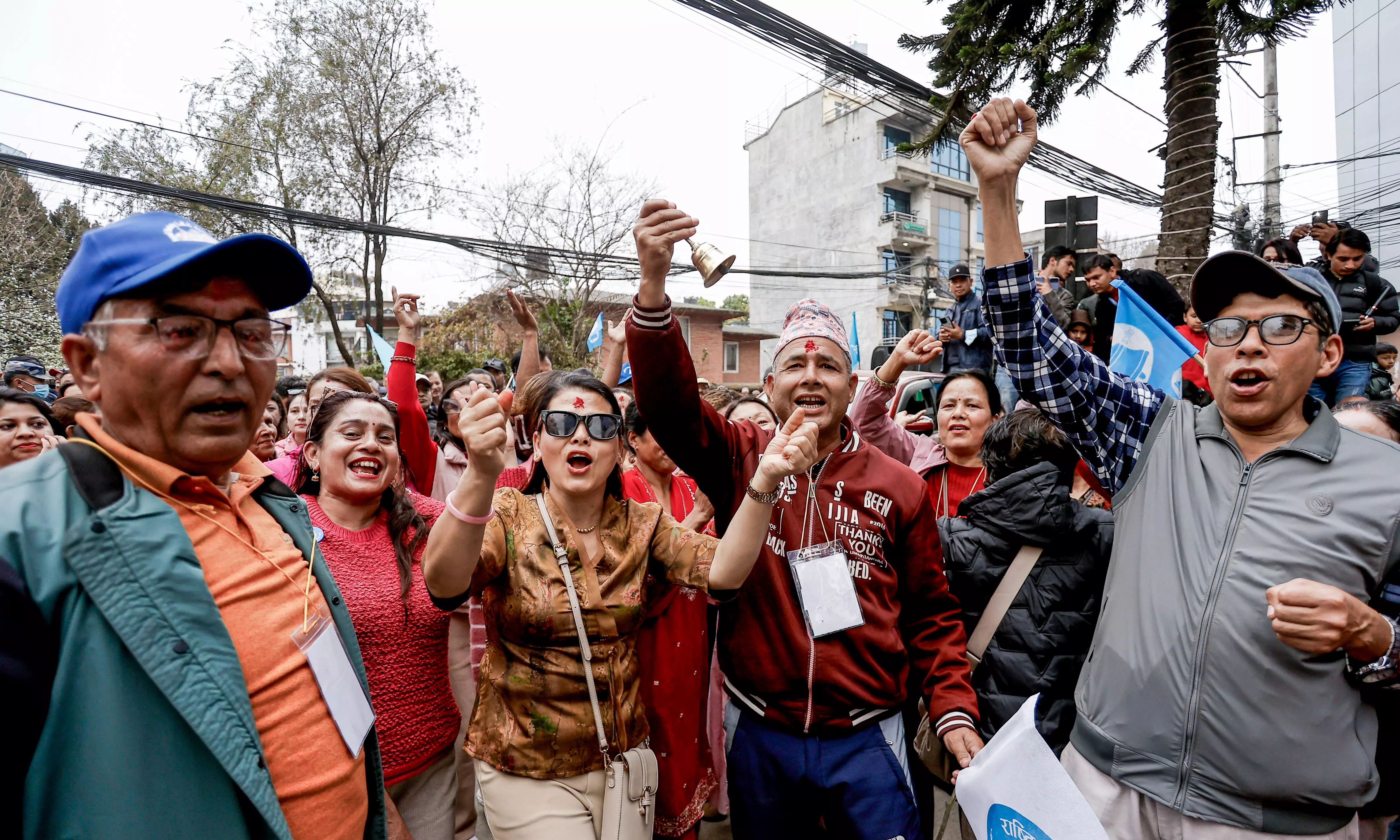
The electoral sweep by the youth-led Rashtriya Swatantra Party (RSP) represents a tectonic shift in Nepali politics. The RSP has gained a thumping two-thirds majority with an unprecedented overall vote share of more than 55 per cent.
The legacy parties like the Nepali Congress, Communist Party of Nepal (United Marxist-Leninist) and Prachanda’s Maoist Centre managed to grab a few seats -- mostly in the remote, hilly constituencies. The RSP swept the urban centres, the mid-hill region and made major inroads into the Madhesi or Terai region, where the legacy parties traditionally dominated.
Once the government, expected to be led by former Kathmandu mayor and rapper, Balendra Shah, takes charge, neither the country’s domestic politics nor its foreign policy are likely to remain the same.
The anger of the youth -- the Gen Z-led protests of September 2025 which toppled the K.P. Sharma Oli government -- has been transformed into institutionalised power. The dominance of Nepali politics by legacy parties has ended.
The traditional patronage structure of the legacy parties posed no hurdle for the RSP as it mobilised youth facing a bleak future and women weary of sending their children to work abroad as immigrants for lack of employment within Nepal. The rural networks, party cadres and bureaucratic loyalty of the legacy parties failed in the face of the RSP’s narrative -- presenting an aspirational economic vision, legally binding promises (Bacha Patra) and projecting itself as a “Nepal first” force. This agenda was a scathing indictment of the legacy parties.
With RSP in power, there will also be a paradigmatic shift in Nepal’s foreign policy – which tilted either towards India or China with limited US influence. With “Nepal First”, while both India and China will have to recalibrate their approach. The influence of the United States, however, especially its soft power, is likely to see a quantum leap.
India and China have lost their traditional channels of communication with the electoral rout of the legacy parties. The US, on the other hand, can start an immediate dialogue with the RSP leaders who are familiar to it as Gen Z activists. The prevailing belief in Kathmandu’s political circles is, with no direct evidence in the public domain, that the US encouraged the youth protests last year. The US has supported “youth-led” democratic movements the world over, including in neighbouring Bangladesh.
Washington also sees Nepal as part of its Indo-Pacific strategy, of which an important element is encircling China. A youth-led government, not tied to India’s apron strings, may be more amenable to cooperation with the US in governance, technology and security. There are already apprehensions in Kathmandu that the State Partnership Programme (SSP) proposed by the Americans in 2022 and rejected by every government since then, may possibly be implemented by the new government. Despite the US clarifying that the SSP is not a security or a military alliance, apprehensions persist in Nepal that the programme provides a backdoor entry for US security presence.
There could be more US programmes in education, IT and governance reforms, and Nepal could be invited to Indo-Pacific dialogues. The RSP government may also look to the US for investment, particularly as it pursues the $30 billion IT export vision promised in its election manifesto.
China’s influence is unlikely to become insignificant even under the RSP. Nepal already has heavy Chinese investment in roads, hydropower and economic connectivity projects. The new government is unlikely to shut the door on Chinese investments. However, the transparency demands on Chinese investment are likely to increase in the light of accusations that Nepal may be falling into a Chinese debt trap. China will have to forge a new relationship with the RSP leaders, who are likely to resist being drawn into any overt strategic alliances or appear dependent on China.
India may be the biggest loser as youth rhetoric has taken a definite turn against India -- recall Balen Shah’s 2025 Facebook post (later deleted) abusing all foreign influence which triggered outrage in India. However, one cannot conclude that India has now lost Nepal for good as mutual dependencies will continue. However, New Delhi will not have the comfort of its old patronage networks in political parties. An added difficulty is that the Gen Z protesters and urban youth have little respect or recollection of India’s historical role in Nepal’s transition from a monarchy to a democracy as they are more inward-looking and focused on sovereignty.
The RSP’s manifesto calls for renegotiating the 1950 Treaty of Peace and Friendship with India, which like a significant number of Nepalis, the party sees as skewed against Nepal. The new government may expect India to concede ground on trade, transit and security arrangements.
India will probably need to pivot away from a relationship of dependency to one based on economic diplomacy -- offering greater cooperation in hydropower development, connectivity projects and becoming an enthusiastic partner in Nepal’s IT development and export push. In short, Nepal’s new government will have to be engaged on economic modernisation with full support for its sovereignty narrative.
With the change in government in Nepal, there is hardly a government left in South Asia that is not under US influence. Nepal is the latest to come under the sway of the Americans in the name of a youth uprising, even though the RSP government may be careful not to be seen as a US proxy. In India, the US influence on the Narendra Modi government is already quite high and rising, despite legacy ties with Russia.
In Bangladesh, the youth revolution has thrown up a government of the Bangladesh Nationalist Party which was always pro-US and now has a US (dual) citizen as its foreign minister. In Sri Lanka, the US influence works through the IMF and World Bank, even though Chinese investment in ports is considerable. In the Maldives, despite its earlier “India out” and pro-China tilt, its government still engages with the United States on security. The military and political leadership of Pakistan have become the new favourites of US President Donald Trump, even though Chinese links remain economically strong. Even in a small country like Bhutan, while the US role is now limited, it is growing through increased scholarships for higher education and the support of US-linked NGOs and foundations involved in climate change, adaptation and resilience education -- initiatives that will have a generational impact on Bhutanese youth.
US influence in South Asia is at its highest in the last two decades and growing. Nepal is the latest in the series.
The writer is a senior journalist based in New Delhi