Naravane memoir row and midnight trade deal raise doubts about government intent
Why did Lok Sabha Speaker Om Birla advise Prime Minister Narendra Modi to skip the House because of a supposed “security threat” from the Opposition? Was it to do with the “unpublished” memoir of Gen. M.M. Naravane (Retd), a former Chief of the Army Staff, which had surfaced in the House debate?
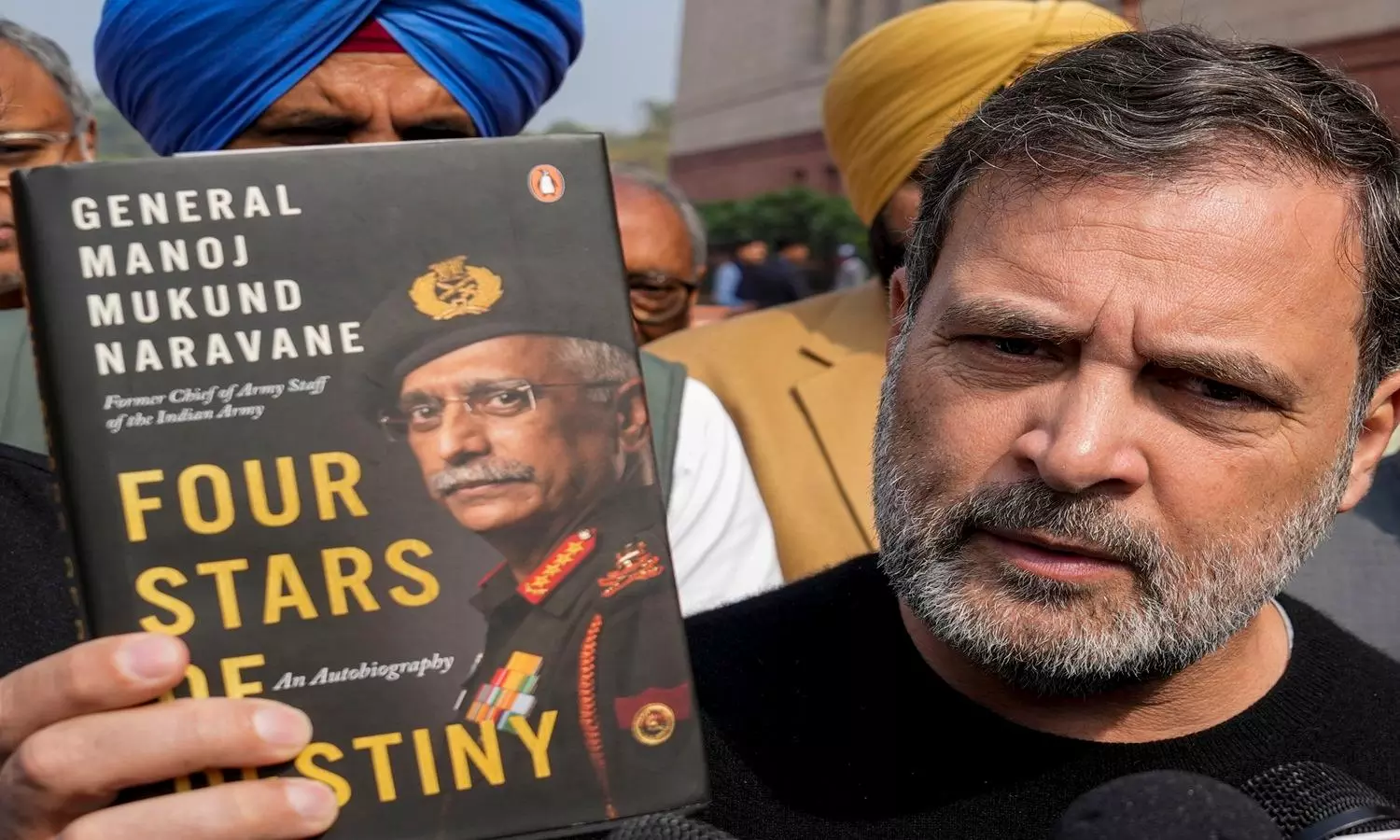
The Speaker’s claim that there was a threat to the Prime Minister inside the Lok Sabha immediately shifted the narrative to the Opposition’s allegedly threatening behaviour. It seemed to be an attempt to blunt Rahul Gandhi’s interrogation of Prime Minister Narendra Modi about the indecisiveness which Gen. Naravane describes in his memoir Four Stars of Destiny and to portray Mr Modi as a victim.
The timing of the government’s sudden midnight announcement of a “successful” US-India trade deal on the very day Gen. Naravane's account of Mr Modi’s indecisiveness was aired in Parliament also smells suspicious. It turns out that the deal is unlikely to be signed until mid-March. Why then did the Prime Minister let US President Donald Trump trumpet half-truths about a done deal on social media? And why did he himself enthusiastically endorse it within hours of Mr Trump’s post?
Perhaps the answer lies in the Modi government’s obsession with controlling the narrative.
Rahul Gandhi quoted from journalist Sushant Singh’s exposé in Caravan magazine on Gen. Naravane’s unpublished memoir. The carefully inflated image of Mr Modi as the ultimate guardian of India’s national security was punctured. In Gen. Naravane’s words, Mr Modi appeared as a man with sunken shoulders, passing responsibility to the Army brass during the crisis caused by Chinese incursions in Eastern Ladakh.
Apparently, the government took too long to respond to the Army’s request for clear instructions. After repeated attempts by the Army Chief to seek guidance, the response was ambiguous: “Jo uchit samajho, woh karo” (Do what you think is appropriate).
If French Prime Minister Georges Clemenceau once said “war is too important a matter to be left to the generals”, Mr Modi doesn’t seem to have heard it. Gen. Naravane’s memoirs suggest that he abdicated political leadership, and the instructions given reflected less delegation than indecision.
Mr Modi never spoke to Gen. Naravane directly. The message was conveyed by defence minister Rajnath Singh, ostensibly from Mr Modi, but neither of them has denied the content. Instead, the government is hiding behind a technicality that because the book is unpublished it cannot be quoted in Parliament. The book remains “unpublished” because the government itself has not allowed its official release for over one year (although PDFs of the book are widely available on social media).
The day after Rahul Gandhi attempted to read from the Caravan article, he was able to procure a copy of the book. He told the media: “I don't think the PM will have the guts to come to the Lok Sabha today, because if he comes, I’m going to give him this book.” Clearly the prospect that a copy might be thrust into Mr Modi’s hands when he came to reply to the motion of thanks to the President’s address had to be avoided at all costs.
This was where the Speaker’s warning of a “security threat” saved the day. He advised Mr Modi not to attend the Lok Sabha, claiming physical danger to him from Opposition MPs. Mr Birla did not reveal the source of his intelligence: was it the Delhi police, CRPF, Parliamentary Security Service, Intelligence Bureau or the Special Protection Group? And why did none of these agencies think it fit to inform their overseeing authorities -- the home minister, intelligence chiefs or the PMO?
Surely the Lok Sabha Speaker should have called the Leader of the Opposition and other leaders to share the alarming intelligence, and sought their help to prevent an incident? Alternatively, he could have informed the Prime Minister’s security detail and left it to Mr Modi to decide whether to attend Parliament or not. His decision would have shown Mr Modi’s character as a leader. Instead, the PM meekly agreed to the Speaker’s advice, which was politically convenient.
If the threat was real, it implies two disturbing things: First, that the Parliamentary Security Service is spying on Opposition MPs; and second, the Speaker is not acting against those allegedly conspiring MPs. The Opposition ought to demand answers on both counts.
Gen. Naravane’s revelations were a double whammy for Mr Modi, who had earlier declared that “no one has entered our territory”. American officials may have seen Mr Modi’s rhetoric as domestic spin but let it pass, believing that structurally India was willing to stand up to China. But they could not have known how poorly it would perform under stress and leave the Army to struggle without clear political instructions.
The details of the Army Chief running from pillar to post for guidance are shocking. The US would be right to ask: If India under Mr Modi could not protect its own territorial claims against China, how could it be expected to serve as America’s bulwark against China in the region? During the Ladakh crisis, India received US diplomatic backing and perhaps military intelligence and logistics support. While Washington may not have expected transparency in Mr Modi’s public statements, it did expect India to hold its ground. Gen. Naravane’s memoirs suggest that Mr Modi did not rise to the occasion. This was a bad strategic signal for all concerned.
President Donald Trump is notorious for weaponising the weaknesses of his negotiating partners. Is it plausible that Mr Modi, apprehensive of Mr Trump’s tendency to embarrass counterparts publicly, may have sought a face-saving trade deal? By giving Mr Trump a visible win on trade, and allowing him to crow about it, he may have hoped to prevent him from exploiting Mr Modi’s indecisiveness and vulnerability revealed by Gen. Naravane’s memoirs.
Both the Opposition “security threat” and the midnight trade deal appear as desperate attempts at narrative control. The fallout from Gen. Naravane’s exposé shows how this government runs on narrative. Its instinct is not to confront uncomfortable truths but to change the subject. Yet changing the narrative does not resolve the issue. Statesmanship requires decisiveness, not diversion.
The Speaker’s intervention and the midnight trade deal reveal a government obsessed with optics. The government’s frantic attempts to bury it all underscore the fragility of the image that Mr Modi has so carefully constructed. The government's response shows us a political system in which managing the narrative is a substitute for leadership. Surely a crisis demands better governance and leadership.
The writer is a senior journalist based in New Delhi