Much before Narendra Modi, another Prime Minister, Vishwanath Pratap Singh, had risked a gambit with the issue of reservation when under political pressure
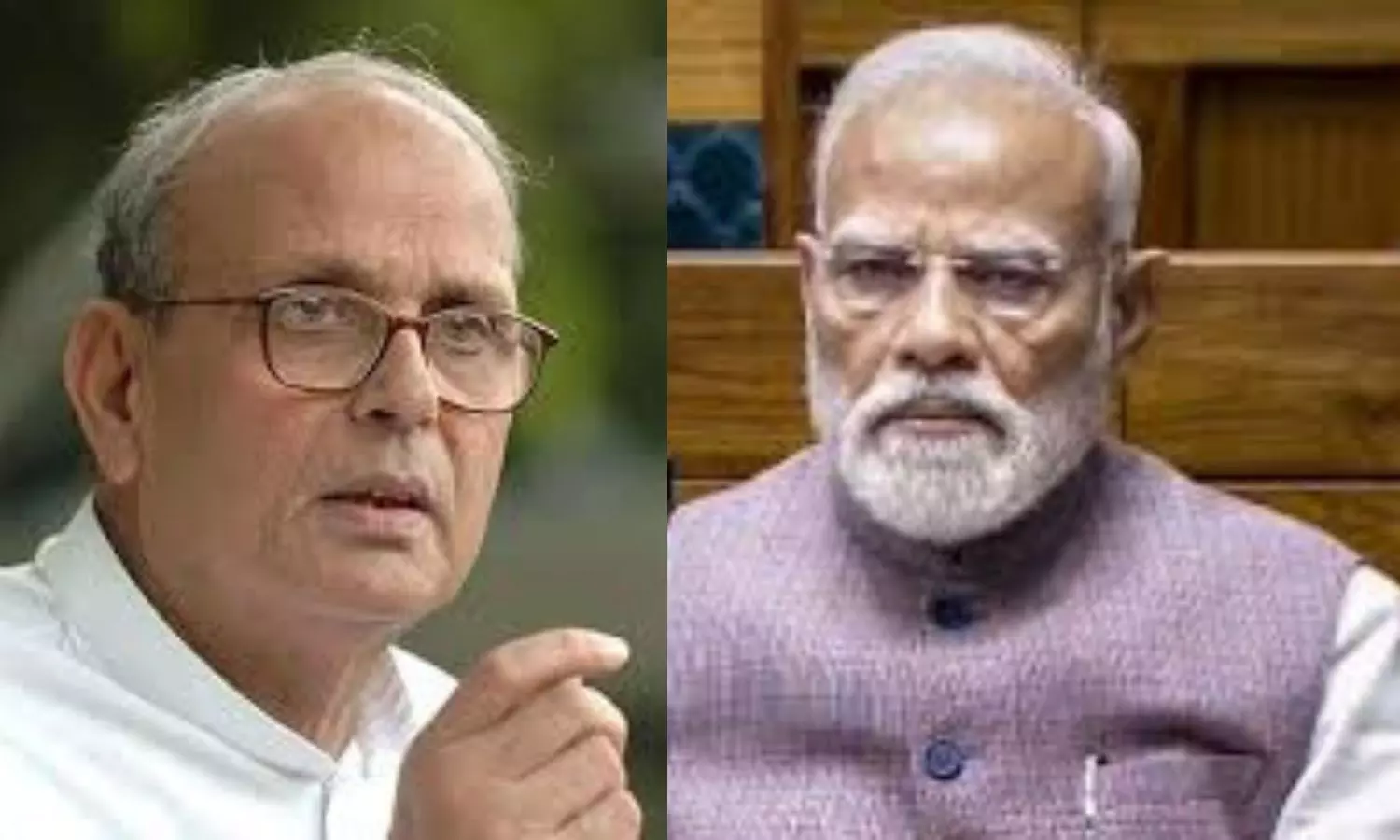
The Narendra Modi government’s resounding defeat in Parliament on Friday night over implementation of women’s reservation shows that a clever move is not always a winning move. The gambit was essentially for the delimitation of constituencies to change the political terrain of the country, taking the cover of women’s empowerment.
Much before Narendra Modi, another Prime Minister, Vishwanath Pratap Singh, had risked a gambit with the issue of reservation when under political pressure. His minority government was under pressure both from his own deputy Devi Lal and the BJP, which supported it from outside. To ensure that Mulayam Singh Yadav did not cross over to the Devi Lal camp, V.P. Singh sprung OBC reservations to ensure that he stayed by his side.
Mr Modi’s own parliamentary majority is weakened after the 2024 general election. He had hoped that women’s reservation would help him reshape the political landscape of the country before the next general election in 2029. Like V.P. Singh, Mr Modi believed that he would gain far more from reshaping the political narrative irrespective of the legislative outcome of his move.
The structural differences between the two situations, however, are crucial.
By implementing 27 per cent reservation for the OBCs in government jobs, V.P. Singh tangibly helped the intended beneficiaries. Mr Modi’s move was defeated before it could create even a single beneficiary. V.P. Singh lost power despite Mandal but changed the political terrain of India for good. Mr Modi’s gambit has changed nothing structurally.
V.P. Singh lost power because he triggered a Hindutva upper-caste counter-mobilisation of tremendous ferocity. Its momentum led to the rise of the BJP. It is unclear for now whether Mr Modi’s failed move will provoke a similar counter-mobilisation and counter-narrative.
The Opposition has pointed out that the Modi government’s real intent was to carve out extra legislative constituencies before data from the caste census became available. That could have led to the demand for reservation for OBC women. If the Opposition can create a convincing narrative that the BJP’s women’s reservation was essentially an anti-OBC move, it can puncture the BJP’s self-projection as the only party promoting women’s empowerment.
The BJP was fully aware that its move could well fail in Parliament. Its swift counter-offensive blaming the Opposition and announcing a nationwide campaign and door-to-door contact with voters shows it was ready for it.
This is likely to be first attempted to woo women voters in the West Bengal elections, where voting will begin later this week. Perhaps that is why the government held the special session of Parliament in the midst of the ongoing Assembly polls. On the eve of the vote in the Lok Sabha, a BJP MP told the media: “We will use it as a stick to beat them with, starting with the West Bengal elections until the 2029 general election.”
Hindsight might even suggest the defeat was by design. The bill had a better chance of being cleared if the Modi government had implemented these bills in its previous term. But live coverage of the Modi government’s support for women’s reservation on national television allowed the possibility of converting even a defeat into a live election issue at no extra cost.
Mr Modi said as much in Parliament with the observation: “Crores of women are watching us... our intent and our decisions”. Home minister Amit Shah’s intentions to convert defeat into victory was clear when he warned the Opposition it would face the “wrath of women” not only in the general election of 2029 but also “at every level, in every election, and every place”.
In three general elections 0f 2014, 2019 and 2024, Mr Modi has consistently underperformed among women voters relative to male voters. Contrary to the party’s propaganda, women are not a committed constituency of the BJP.
In fact, the 2024 general election data suggests that the party which benefited from women’s votes was the Congress. This is the fragility in its support base that the BJP wants to address in 2029. Its bid for early implementation of women’s reservation was meant for women voters who never fully bought into Mr Modi’s narrative.
This is also the faultline the Opposition must address. It has already begun by pointing out that Mr Modi and his party are comfortable with women as instruments of delivering welfare but intolerant of independent and autonomous women leaders. This is clear from the shabby treatment meted out to strong leaders like Sushma Swaraj, Vasundhara Raje, Uma Bharti and Sumitra Mahajan -- all of them self-made women with their own support base. They were often more popular than the male leaders who replaced them. Independence is a major disqualification and only women personally beholden to Mr Modi become representational political figureheads.
The BJP’s less than adequate response to crimes against women is hardly an affirmation of a party that champions women. The BJP expelled rape convict minister Kuldip Singh Sengar only under public pressure; after he was imprisoned and reportedly tried to get the victim killed in a road accident. Its reaction to the Hathras rape case was bizarre -- blaming the incident on an “international plot” and a “deep-rooted conspiracy” to incite caste-based riots. The party was reluctant to act against Brij Bhushan Sharan Singh, who allegedly molested women wrestlers as head of the Wrestling Federation of India.
Given these facts, a campaign that the Opposition parties are against women’s empowerment may not be as rewarding for the BJP in 2029 as it might expect. In fact, it might even bring negative returns.
In addition, the delimitation of constituencies that was sought to be built into the implementation of women’s reservation will likely turn the southern states even more firmly against the BJP. They have seen how the BJP sought to marginalise minority populations through delimitation of constituencies in Assam and Jammu and Kashmir. South Indian states like Tamil Nadu, Kerala, Karnataka and Telangana, which have a better record of population control than the North Indian states with high-fertility, deeply resent any delimitation that might reduce their relative weight in Parliament. The perception that this is the real aim of the BJP would make its expansion in the southern states even more difficult.
The failure of the women’s reservation legislation may be Mr Modi’s failed Mandal moment. Yet, as with V.P. Singh, it may well signal the beginning of his political slide.
The writer is a senior journalist based in New Delhi